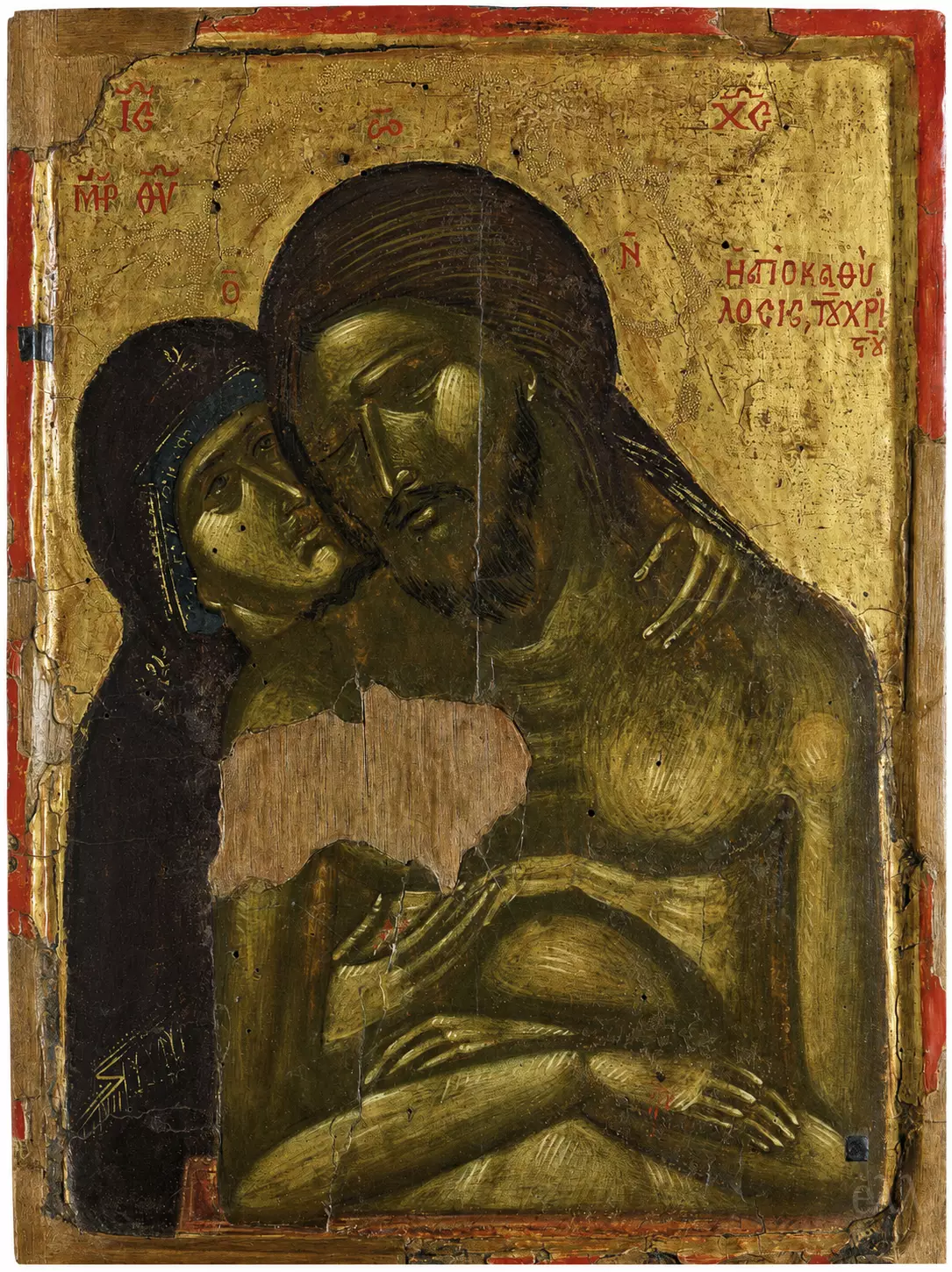
The Extreme Humility icon preserved in the Museum of Byzantine Culture in Thessaloniki presents the dead Christ half-length above a sarcophagus, his arms crossed over his body as the Theotokos bends toward him and encloses him in an intimate embrace. Dated by the Museum to around 1400, the portable icon measures 50.5 × 37.5 cm and is 2 cm thick. Painted in egg tempera on wood, it retains an integral wooden frame; the Museum records its provenance as a donation by Rena Andreadi and lists it under inventory number BEI 971. Around the figures extends a golden field, extensively marked by age and dense ornamental working, while substantial passages of red paint survive along the narrow frame.
The subject belongs to the Byzantine iconographic type known as Akra Tapeinosis, or Extreme Humility, closely related in English-language art-historical terminology to the Man of Sorrows. Christ is represented after death, yet vertically displayed above the tomb, a formulation that compresses elements of the Passion into a single image. In this example the grieving Theotokos gives the composition an especially close physical structure: her face approaches Christ’s, her arm passes around him, and the dark mass of her maphorion merges with the shadowed contours of his body. The Museum dates the formation of the type to the late eleventh century and associates its development with hymns of the Virgin’s lament introduced into the typika of private monasteries in Constantinople.
Compressed into the narrow panel, the two figures occupy almost the entire pictorial field. Christ’s torso expands across the centre and lower part of the composition, while his head inclines sharply toward the Theotokos. Beneath him the sarcophagus appears as a low horizontal structure, sufficient to establish the funerary setting without constructing an extended spatial environment. Above, the broad nimbus and curved outline of Christ’s head press upward into the golden background. Beside him, slightly lower, the Virgin’s smaller face is framed by a dark maphorion edged with a narrow blue band; their haloes overlap visually, gathering the two heads into the most concentrated area of the panel.
Extreme Humility Icon: Composition, Lament, and Late Byzantine Form
Christ’s body is rendered through controlled, strongly directional lines. Long strokes define the chest, arms and abdomen; finer parallel marks move over the flesh, producing restrained modelling while preserving the clarity of the contours. Below the heads, the crossed forearms establish a second point of visual concentration: one descends diagonally and the other passes across it, the fingers extended in narrow, carefully separated forms. These lines echo the downward movement of Christ’s head and the forward motion of the Virgin’s embrace — head, shoulder, forearms, hands — and from this limited sequence of intersecting forms the painter builds much of the composition’s internal rhythm.
The Virgin’s presence gives the established Akra Tapeinosis formula a markedly intimate character. Her head rises from the dark mantle beside Christ’s shoulder, turned upward toward him, while her arm surrounds his upper body and draws him toward her. Spreading across the left side of the panel, the maphorion also covers part of his torso. The gesture connects the image closely with the visual language of Byzantine lamentation, here reduced to the interaction of only two figures.
That concentration matters. Where more extensive Passion compositions could accommodate numerous participants and a developed narrative setting, this painter fixes attention on two faces, an embrace, and the crossed arms of the dead Christ. Spatial recession consequently carries little weight. The Virgin’s compact face appears beside Christ’s larger head, her dark garment deepening the surrounding tonal field, while the golden background isolates both silhouettes with considerable clarity.
The inscriptions remain clearly integrated into the surrounding field. The conventional abbreviations IC XC identify Jesus Christ, and MP ΘY the Mother of God. Within Christ’s cruciform halo appear the letters of Ὁ ὬΝ, the customary Greek designation meaning “He Who Is.” More unusual in relation to the museum title is the longer red inscription on the upper right: Η ΑΠΟΚΑΘΗΛΩΣΙΣ ΤΟΥ ΧΡΙΣΤΟΥ, “The Deposition of Christ.” This inscription places the representation verbally within the sequence of the Passion, while the Museum classifies its iconographic type as Akra Tapeinosis; narrative designation and established devotional formula thus coexist on the same surface.
The Theotokos and the Language of Mourning
Across the upper part of the icon, the golden field has a distinctly worked character. Dense arrangements of minute impressed points and fine linear patterns remain visible around the haloes and inscriptions, producing areas of ornament whose effect varies with the surviving surface. Against this texture, the red lettering remains conspicuous, and along the perimeter the integral wooden frame establishes a second strong chromatic boundary through its surviving red-painted bands.
The condition of the panel is visually prominent. A broad irregular loss near the centre has removed the painted surface from part of the Virgin’s garment and the adjacent area of Christ’s body, exposing the wood underneath. A vertical fissure crosses the central field through Christ’s head and torso; smaller cracks, abrasions, dark marks and losses occur elsewhere. At the upper edge and along the sides, considerable areas of the frame are also reduced to bare wood. Without obscuring the principal figures, these interruptions reveal several material levels of the object — painted surface, underlying preparation and wooden support.
Christ’s physiognomy nevertheless remains substantially legible. Repeated curved strands articulate the long dark hair. A narrow face, long nose, lowered eyes and small mouth are enclosed by the beard, with fine highlights defining the brow, nose and cheek. Similar precision survives on the extended fingers. The Virgin’s features are more compact: large eyes beneath sharply described brows, a slender nose, small mouth. Around her face the deep brown-red maphorion forms a broad dark enclosure, bordered with blue and punctuated by small golden ornaments. Their silhouettes approach and overlap, though differences of scale and tone preserve the individual forms.
A particularly effective relationship develops between the heads and hands. Above, the faces almost meet; below, Christ’s hands lie crossed and passive over his body. Between these two areas stretches the long diagonal of the Virgin’s embracing arm, and the eye moves down this sequence with little interruption. Only at the bottom does the painter allow the sarcophagus to enter, as a heavy horizontal stop beneath the more fluid lines of the bodies.
Around 1400: The Development of the Akra Tapeinosis
The Museum dates the icon to around 1400, placing it chronologically within the Palaiologan period of Late Byzantine art. Its authorship is unspecified in the museum record. The composition, however, participates in a pictorial tradition already several centuries old. According to the Museum of Byzantine Culture, the subject of Extreme Humility emerged in Byzantium toward the end of the eleventh century, while the earliest known surviving example of the type is in Kastoria and dates to the twelfth century. The development of the imagery was shaped by hymns centred on the lament of the Theotokos that had entered the liturgical rules of private Constantinopolitan monasteries.
By the date of the Thessaloniki panel, this established formula could support considerable variation. The essential elements remain readily recognizable: the dead Christ, the crossed arms, the tomb. Around this core, the painter has introduced the Virgin’s embrace and compressed the scene until its emotional structure rests almost entirely upon physical proximity — the bowed head, the surrounding arm, the crossed hands standing in for what a broader narrative sequence might otherwise have unfolded at length.
The Man of Sorrows imagery developed an extensive life outside Byzantium as well. Byzantine examples contributed to the transmission of the subject into late medieval Western art, and the type subsequently appeared in the work of major European painters during the fifteenth century. Such circulation belongs to the wider history of artistic exchange through which Byzantine devotional images and iconographic models acquired new settings while retaining recognizable features of their earlier visual ancestry.
In the Thessaloniki Extreme Humility icon, particular intensity gathers in the meeting of Christ and the Theotokos. His bowed head approaches hers; her mantle gathers around his shoulder; the long arm completes the embrace, and his crossed hands descend toward the tomb. Across a surface fractured by losses and abrasion, the principal geometry still survives with considerable force — the joined heads above, crossed forearms below, sarcophagus running horizontally along the lower edge.
(The translation was edited by A. Orfanos)