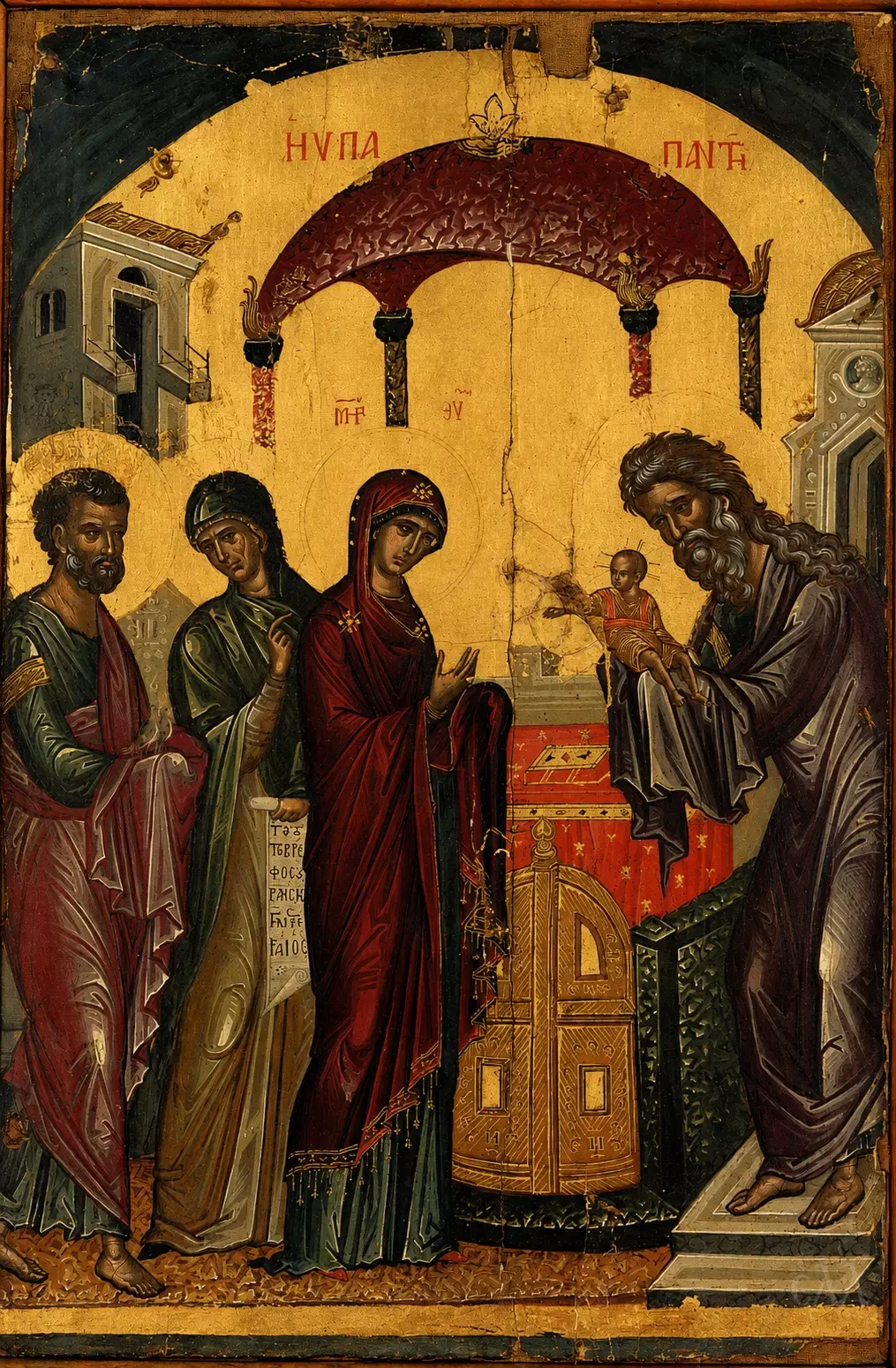
A small panel measuring barely fifty-seven by thirty-nine centimetres, painted around 1546 by the Cretan master Theophanes Strelitzas, preserves one of the more accomplished renderings of the Presentation of Christ in the Temple to survive from the artist’s mature period. Strelitzas — recorded elsewhere as Theophanes the Cretan, or Theophanes Bathas — executed the panel for the katholikon of Stavronikita Monastery on Mount Athos, as part of the cycle of the Dodekaorton, the twelve principal feasts of the liturgical year rendered as a set of despotic icons for the templon screen.
The subject, known in Orthodox liturgical usage as the Hypapante, or the Meeting, commemorates the fortieth day after the Nativity, when, in accordance with Mosaic Law, every firstborn son of Israel was to be brought to the Temple in Jerusalem and formally presented before God. Luke’s Gospel supplies the narrative core: Symeon, told by revelation that he would not die before beholding the Messiah, receives the infant Christ into his arms, while the elderly prophetess Anna, present at that hour, bears witness to the child’s identity. Strelitzas follows an iconographic formula already fixed by the early post-Iconoclastic centuries, placing the infant not in his mother’s arms but in those of the elder Symeon — a detail that governs the dramatic logic of the entire composition.
Theophanes Strelitzas’ Presentation of Christ: Composition and Iconography
Beneath a green, round arch springing from slender columns, and against the flattened gold ground conventional to the school, the four principal witnesses of the Gospel narrative assemble on a shallow, stepped platform before an ornate golden ciborium fitted with cross-patterned doors — a compressed image of the Temple sanctuary rather than an attempt at architectural description. An inscription identifying the feast runs across the upper field, and low, schematic buildings project from either side of the arch, marking the enclosure of the Temple precinct without dissolving the frontality of the scene. As is customary for panel icons of the Cretan school, the wood support would have been prepared with a gesso ground and gilded before the tempera layers were laid, a sequence that accounts for the luminous consistency of the gold field beneath the pigment.
To the right, on a raised step, stands Symeon, his long hair falling to the shoulders and his mantle gathered into dense, angular folds. His hands, wrapped in the cloth of his own garment rather than touching the child directly — a customary sign of reverence before the sacred body — hold the infant Christ, who has just been given into his arms by the Virgin. The child, dressed in a gold-red tunic with broad woven bands descending to a pleated girdle, turns his head back toward his mother and extends his right hand toward her, while the left, holding a closed scroll, rests against his knee; the small bare feet, slightly drawn up, introduce a note of physical immediacy against the otherwise hieratic stillness of the group. Mary stands opposite in a dark red maphorion bordered in gold, her hands raised before her chest in a gesture combining supplication and the completion of an offering already made. Immediately behind her stands the aged prophetess Anna, identified by the open scroll she carries; Joseph closes the procession at the far left, holding the pair of doves prescribed by the Law for the purification offering, a detail that grounds the scene in the specific ritual requirements of the Torah rather than in generalized piety.
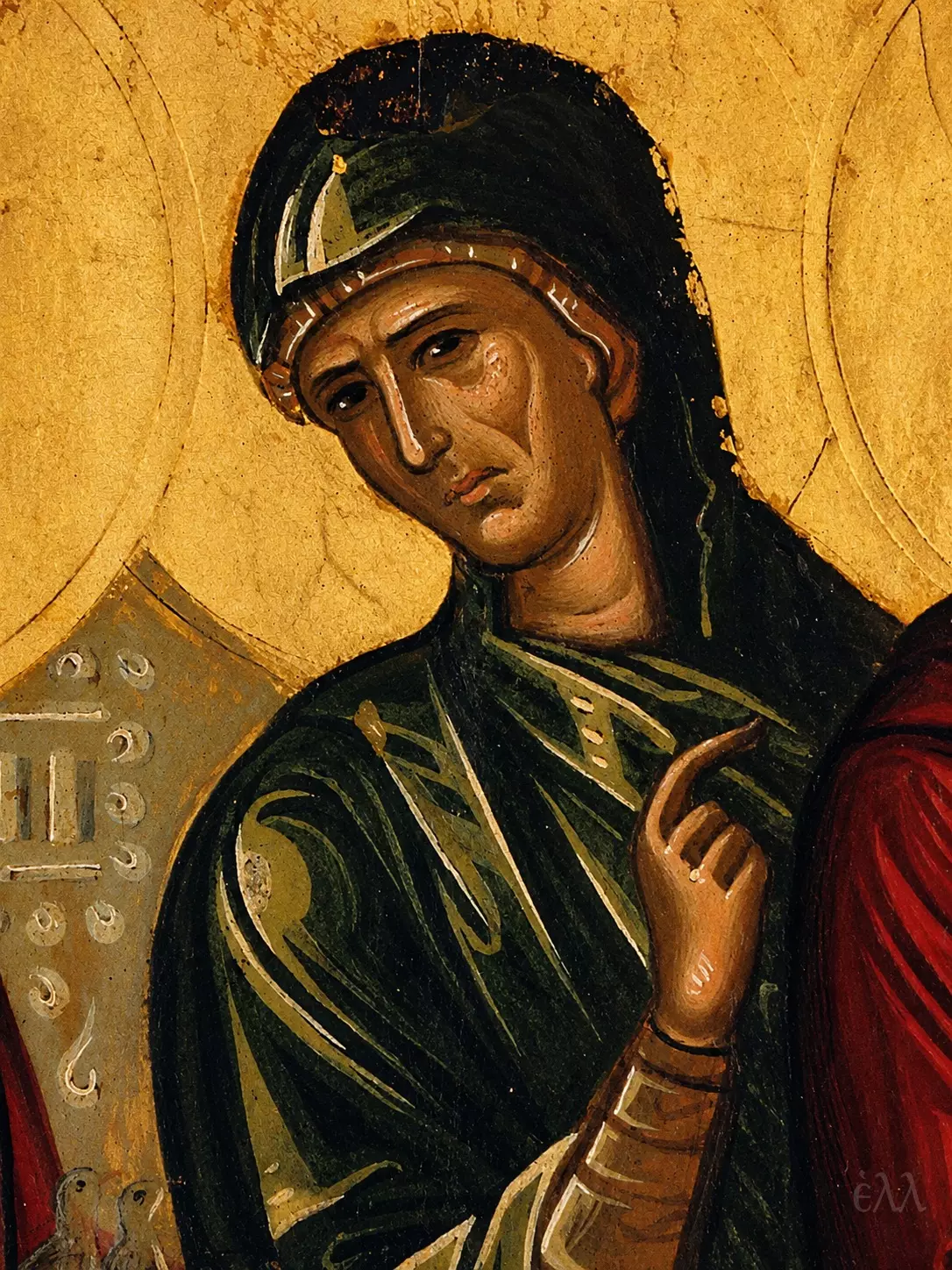
Detail: The Prophetess Anna in the Presentation of Christ Icon
Observed at closer range, the woman standing behind the Virgin reveals a face built up through smoothly graduated ochre modelling around a firmly linear structure — the long, straight nose, the small mouth, the heavy-lidded, faintly melancholic eyes characteristic of the mature Cretan manner. Her head is wrapped in a mantle of near-black green, its edge catching a slender band of lighter underpainting at the hairline, and her gaze turns slightly aside, directed toward the event unfolding beside her rather than outward toward the viewer. Her right hand rises to shoulder height, fingers extended rather than closed, in the gesture by which, in the wider composition, she indicates the infant Christ; a decorative cuff, banded in ochre and white, closes the sleeve at the wrist. To one side, the silvery-grey mass of an architectural element establishes the Temple setting; to the other, a fragment of deep red announces the adjacent figure of the Virgin, while at the lower edge the pale form of a bird belongs to the pair of doves carried by Joseph, confirming her position within the procession immediately beside him.
This figure is Anna, described in Luke’s Gospel as a prophetess of great age attached to the Temple, and she ought to be kept distinct from Saint Anne, the mother of the Theotokos — a different woman with whom she is sometimes loosely, and incorrectly, conflated.