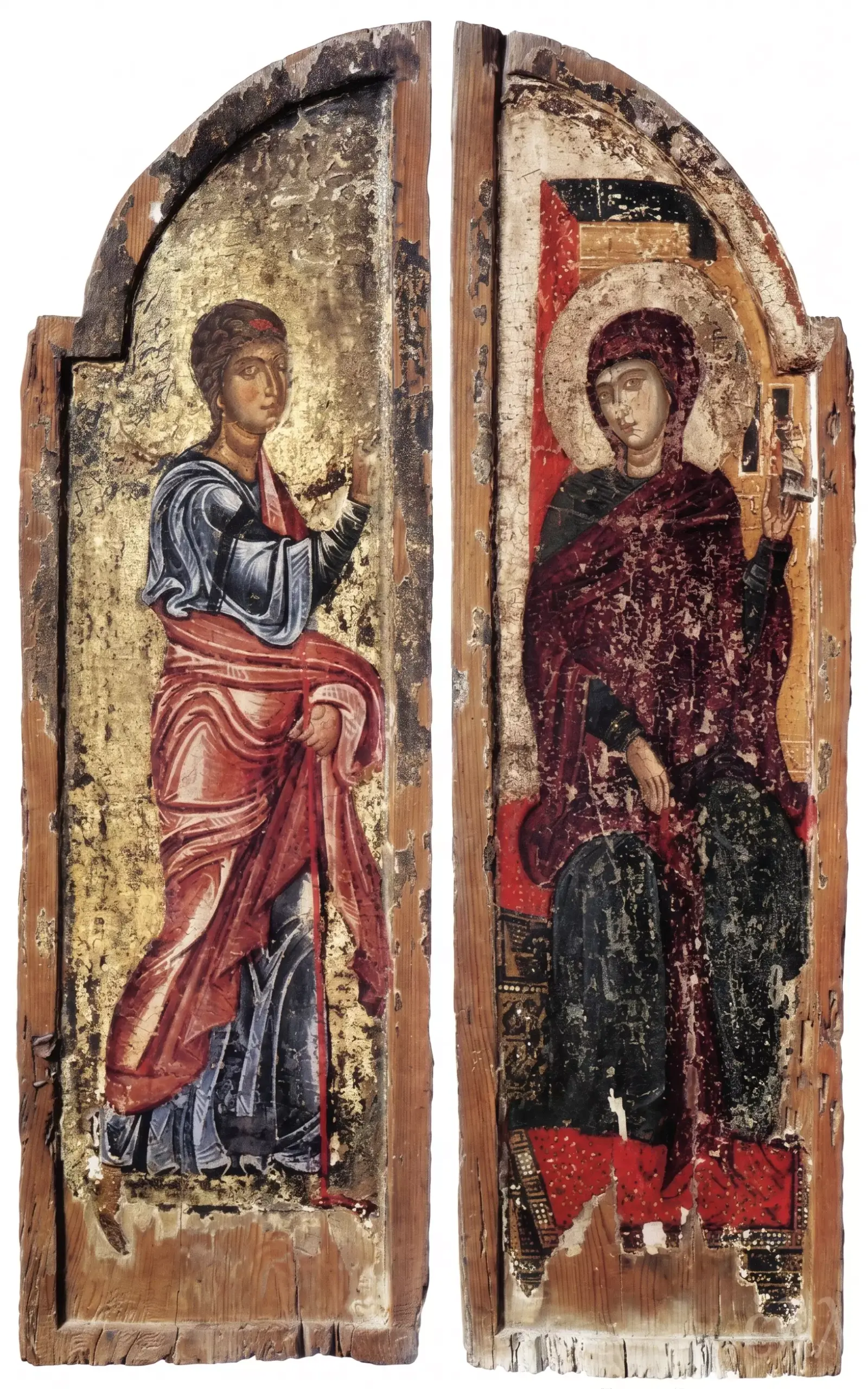
The Annunciation bema doors of Lefkara, preserved in the Church of the Holy Cross at Pano Lefkara in Cyprus and generally dated to the late twelfth century, belong among the earliest surviving painted doors associated with the central entrance of a Byzantine sanctuary screen. Measuring approximately 102 × 62 cm, the two wooden leaves form a tall, arched ensemble whose physical division becomes part of the composition itself. Gabriel occupies the left leaf; the Theotokos, the right. Between them runs the narrow vertical opening of the doors, a real architectural interval placed inside a sacred narrative.
Their subject is the Annunciation (Luke 1:26–38), already deeply established in Byzantine visual culture and particularly appropriate to the principal opening of the templon. Yet the importance of the Lefkara doors lies equally in their date. Scholarship places them at the very end of the twelfth century, sometimes more broadly around 1200; Anthi Andronikou’s doctoral thesis records the Annunciation wing from the Church of the Holy Cross as a work of about 1200 and cites the principal bibliography surrounding it. The full text is also available through the Research Repository. They therefore stand close to a decisive moment in the development of the painted sanctuary screen, while preserving the restless linear energy associated with late Komnenian painting. The work is provincial in execution, though hardly isolated from the larger artistic language of its age. Cyprus, during these final decades of the twelfth century, participated intensely in that language.
Annunciation Bema Doors of Lefkara and the Sanctuary Threshold
The two leaves were conceived together. Their arched upper termination establishes a unified silhouette, while the painter gives each figure a different relation to space and movement: Gabriel advances towards the seated Theotokos, with motion on one side balanced by stability on the other and extended gesture by controlled withdrawal. The dialogue of the Annunciation is thus articulated before any inscription is required to explain it.
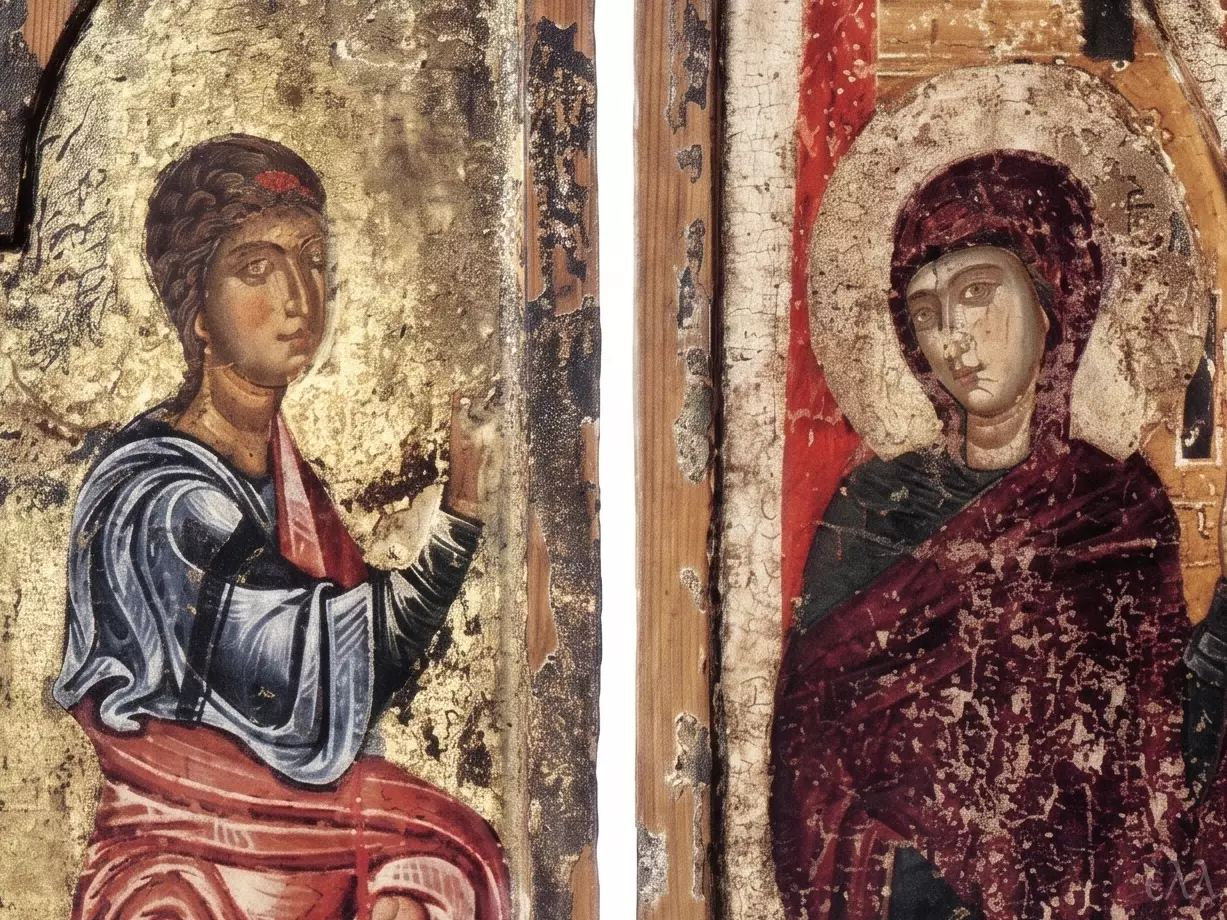
On the left leaf, Gabriel appears as a full-length standing figure moving towards the Theotokos. His body is elongated, the narrow proportions accentuated by the long fall of his garments and by the upright messenger’s staff. His right hand rises in a gesture of speech. Small in relation to the whole figure, the gesture nevertheless becomes one of the principal centres of attention because the forward inclination of the body directs the eye towards it. The head turns towards Mary; beneath the drapery, the legs continue the movement.
That drapery is among the most revealing features of the painting. Broad pale passages sweep across the upper garment, while parallel white highlights strike through the folds and break the surface into sharp, mobile units. Lower down, the reddish mantle crosses the body in long curves, then gathers into more angular folds around the advancing legs. Two rhythms consequently inhabit the figure at once: the underlying stride, the more agitated movement of the painted cloth. Such restless drapery belongs to the dynamic visual vocabulary that became especially pronounced towards the close of the twelfth century. In major monuments of the period this language could attain extreme elongation, calligraphic elegance or emotional intensity; in Cyprus it was adapted in several different local manners.
Gabriel’s figure demonstrates that adaptation with unusual clarity. The painter knows the effects of the current style—the repeated highlights, the elongated contours, the sudden changes in direction—yet translates them through broad areas of colour and a comparatively hard linear structure. Little effort is made to dissolve the figure into atmospheric space. Gold surrounds him. The body remains isolated, readable, almost emblematic, even while the garments imply rapid movement.
Across the central joint, the Theotokos introduces another order. She sits frontally upon a throne ornamented with pearls, her feet placed above a vivid red footstool, while her head turns towards the approaching archangel. The body remains largely aligned with the vertical structure of the throne. Only the head decisively answers Gabriel, a slight displacement that prevents the seated figure’s frontality from becoming inert and brings the two leaves into communication.
Mary is shown spinning, an established component of Byzantine Annunciation iconography connected with the long pictorial tradition of representing her occupied with thread at the moment of Gabriel’s arrival. In the Lefkara image, the motif also serves a formal purpose. The small action performed close to the body concentrates the right-hand leaf inward, whereas Gabriel’s raised arm and long staff extend his figure outward. The contrast remains quiet and exact.
The throne contributes weight and verticality. Its reddish and dark elements, together with the intense red of the footstool, interrupt the otherwise extensive golden field and make the Theotokos appear more spatially anchored than Gabriel. Her dark maphorion encloses the head and shoulders in a broad continuous mass. Folds descend over the seated body without developing the same centrifugal agitation found in Gabriel’s garments. The balance between the two leaves therefore arises through differentiated poses and rhythms: an angel entering, a woman receiving; mobile drapery, compact drapery; standing figure, enthroned figure.
When the doors were closed, those differences met directly along their central seam; when they were opened, the Annunciation itself was physically separated as access to the sanctuary was created. The pictorial field was therefore inseparable from the function of the object. A later journal study discussing the evolution of the iconostasis specifically cites the late twelfth-century painted doors at Holy Cross, Lefkara, while observing that the adoption of the Annunciation on holy doors formed part of the developing iconographic structure of the sanctuary screen by the end of the Komnenian period.
This liturgical position sharpened the meaning already inherent in the scene. The Annunciation concerns entrance in several senses: the beginning of the Incarnation within the Gospel narrative, the reception of the angelic message, the movement from promise towards fulfilment. On bema doors those associations were encountered at an actual architectural threshold, where two figures alone could sustain the relation between narrative and passage.
Their faces are correspondingly restrained. Both are oval in type, with large eyes, long noses and relatively small mouths. Small red accents on the cheeks enliven the flesh, although the general expressions remain controlled and somewhat impassive. Gabriel’s gaze carries greater directional force because his head accompanies the motion of the body. The Theotokos looks towards him without abandoning the stillness created by her frontal seated pose. Neither face depends upon extensive volumetric modelling; line, tonal contrast, a few concentrated accents establish the physiognomy.
Certain anatomical details also belong to the regional character of the work. Especially characteristic is the swelling at the base of the thumb, a feature recorded in Cypriot icons throughout the thirteenth century. Such details matter because they connect stylistic history with workshop practice. A large artistic tendency—the dynamic painting of the late twelfth century—may travel widely; the treatment of a hand, a cheek or a fold can reveal the local habits through which that tendency was absorbed.
In chronological terms, the doors occupy a delicate position. They retain the dramatic linear impulse of late Komnenian art while anticipating features that would become increasingly recognisable in Cypriot panel painting after 1200. Their provincial quality does not imply an art cut off from metropolitan developments, nor does their familiarity with broader Byzantine conventions establish direct Constantinopolitan authorship. What survives is a regional interpretation of a shared Byzantine visual language, delivered with enough individuality for the local character to remain visible.
The gold ground, once a stronger and more continuous component of the pictorial field, is now interrupted by extensive losses, abrasions and disruptions that expose areas of the wooden support and disturb the continuity of both leaves. Gabriel’s surrounding field is particularly worn, and the edges of the panels preserve the scars of prolonged use. The painted surface of the Theotokos is likewise heavily abraded. Yet the principal compositional relations remain legible. The long red passages of Gabriel’s mantle, the pale upper garment, Mary’s dark maphorion, her red footstool and the remaining gold still establish a forceful chromatic structure.
More tantalising are the surviving traces of relief ornament in the background. Only vestiges remain, but they indicate that the field originally possessed a richer material articulation than the present surface suggests. Raised or relief decoration of backgrounds would become conspicuous in Cypriot icons during the following century. On the Lefkara doors, its incomplete survival is therefore historically significant, since what now appears fragmented belonged to an ornamental tendency close to expansion.
Condition changes perception. The present interruptions make the figures appear almost detached from their setting, especially on Gabriel’s leaf, and the exposed wood introduces earthy vertical passages that were never intended as components of the painted composition. The damaged surface has to be distinguished mentally from the original pictorial structure, in which the gold formed a more continuous field around the figures.
The arched wooden framing remains equally important. Heavy, irregular and worn, it encloses the painted figures without the polished regularity of a later, more elaborate iconostasis. The object retains something architectonic in its simplest sense: these are images and also doors. Their painted programme had to accommodate repeated opening, closing, handling and movement around one of the most active points of the ecclesiastical interior.
By about 1200 the relationship between image and sanctuary barrier was undergoing a long process of enrichment. Painted icons appeared with increasing prominence upon and around the templon; feast imagery, the Deesis and other sacred representations gradually established stronger visual relationships with the rites performed beyond the screen. At an early and unusually tangible stage of this history stand the Lefkara doors. Scholarly discussion of the developing iconostasis places them precisely among the late twelfth-century evidence for the Annunciation at this central threshold.
Their artistic interest survives independently of typological importance. Gabriel’s clothing is restless almost to excess; the Theotokos, by comparison, remains contained and vertical. The gold field offers no landscape in which the figures might retreat. Little unused space remains within the narrow panels. Every long contour consequently matters—the staff, the curving mantle, the straight edge of the throne, the central division of the doors.
At that division lies the visual tension of the entire work. Gabriel approaches it; Mary answers across it. The painter needed no elaborate architecture, crowded narrative accessories or enlarged rhetorical gesture, relying instead on the very construction of the object. The doors divide the scene; gaze and movement carry the figures across that division, while the Annunciation unfolds over a boundary that could itself open.
Energetic in line, severe in expression, regionally distinctive while connected with broader artistic transformations of the Komnenian world, the image remains unmistakably a work of the late twelfth century. Its damaged surface has removed much, though the fundamental conception remains clear. Among the surviving painted works of medieval Cyprus, the Annunciation bema doors of Lefkara preserve an early conjunction of icon, architecture and liturgical space—two wooden leaves, two figures, one narrative suspended across the sanctuary threshold.
(The translation was edited by A. Orfanos.)