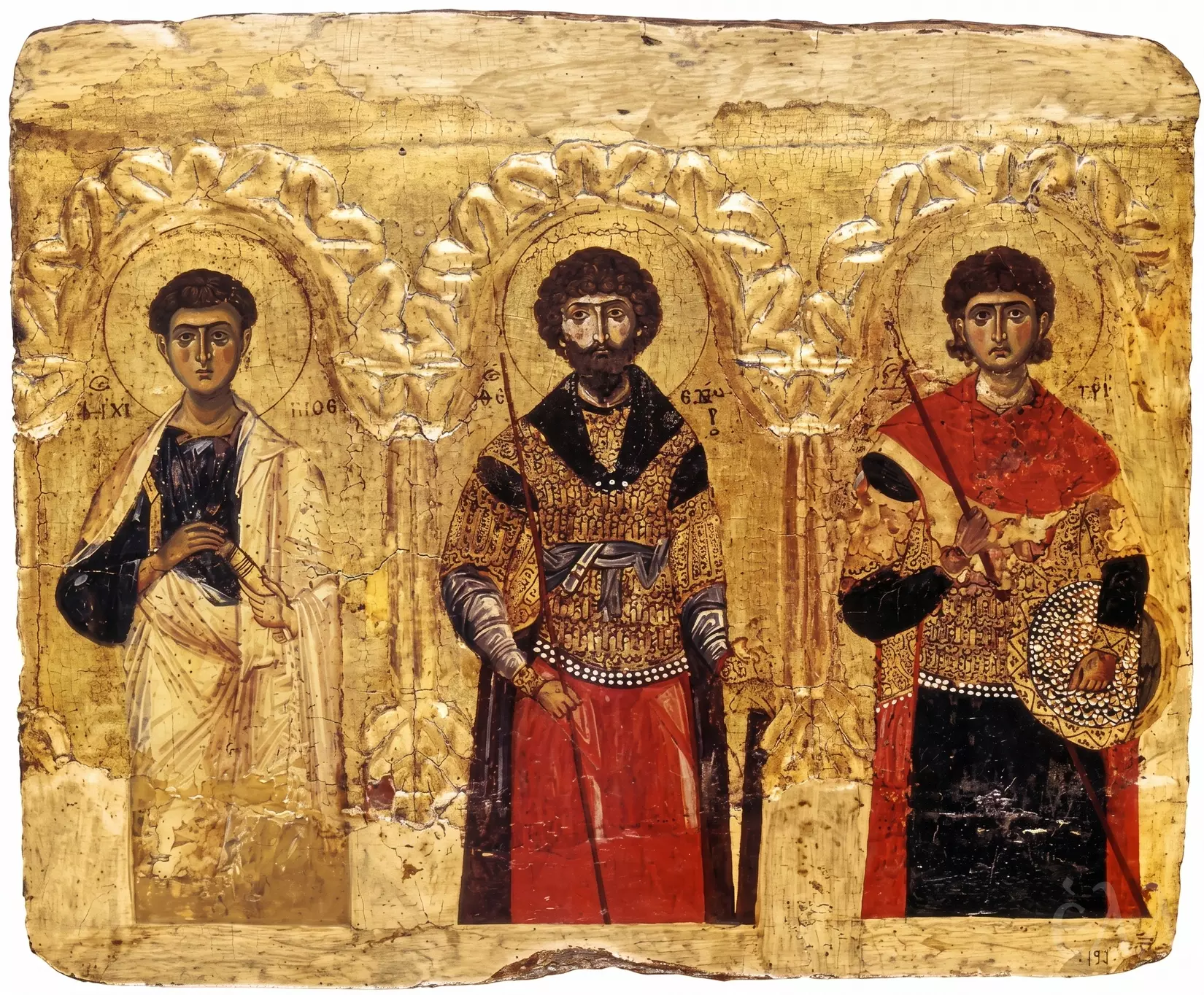
Three frontal saints stand beneath a sequence of raised arches, each figure contained within an architectural bay yet joined to the others by the continuous gold field. The work, an Apostle Philip Byzantine icon with Saints Theodore and Demetrios, survives as a fragment of a templon epistyle and is generally dated to the first half of the twelfth century. Measuring about 41 × 50 cm and now preserved in the State Hermitage Museum in Saint Petersburg (inv. I-186), it came from Mount Athos. Its present dimensions are deceptive. At the sides and, more severely, along the lower edge, the panel has been cut down, so that figures originally conceived as full-length presences now terminate abruptly.
The architectural framing is unusually insistent. Relief arches rest on paired colonnettes whose shafts form knot-like intersections, turning the upper field into a repeated ornamental rhythm. Against this framework the three saints remain almost immobile. The gold ground is worn in places, the lower zones especially abraded, yet the principal contrasts survive: dark hair and garments, pale flesh, red military dress, white and bluish dotted ornament. What has been lost at the edges alters the proportions of the object, though its fundamental pictorial structure remains legible.
Apostle Philip Byzantine icon and the rhythm of the templon
At the left stands the Apostle Philip, youthful, clean-shaven and markedly different in costume from the two military saints beside him. Beneath a pale mantle, crossing the body and descending in broad, light folds, appears a dark tunic. His figure is narrower, less heavily patterned, visually quieter. The hands gather close to the torso, while the large halo and direct gaze establish the same frontal authority given to the soldiers. Nothing in his posture introduces narrative action. Philip belongs to the sequence as a standing sacred figure, identified through the adjacent inscription and through his place within the wider programme.
Saint Theodore occupies the central bay. Bearded and broad-shouldered, he wears elaborate military dress whose surface is articulated by repeated small motifs and a strongly defined cuirass. A deep red garment descends below the armour, creating the most concentrated field of colour in the centre of the fragment. His right hand drops towards the belt, while a slender shaft rises along his right side towards the shoulder; another dark vertical element is visible at his left. The surviving details establish the military character of the image without requiring a more specific reconstruction of every object. Pattern is important: armour, edging, belt, sleeves, each participating in a dense decorative system.
Younger in appearance is Demetrios, who occupies the right-hand bay. He holds a long spear in his right hand and supports a round shield at his left side. The shield is covered with a close field of pale dots, a motif repeated in sections of his armour so that weapon and costume share the same ornamental language. His red upper garment spreads broadly across the shoulders, then gives way to the densely patterned surface below. More unusual is the moustache. Demetrios is commonly represented without facial hair, and this small departure from the familiar physiognomic type gives the figure a distinct identity without disturbing the symmetry of the group.
Faces carry much of the expressive weight. Heavy, nearly joined brows, large dark eyes, narrow noses, small mouths: these establish a family resemblance among the three saints, while red accents on the cheeks animate otherwise restrained flesh modelling. The effect is neither portrait-like nor emotionally demonstrative. Frontality dominates; contour, repeated ornament, measured intervals. Within early twelfth-century painting, the hieratic stability inherited from the preceding century remained strong even as Komnenian art developed increasingly mobile and psychologically charged forms.
The fragment also preserves evidence of its original liturgical setting. It belonged to an epistyle associated with an expanded Great Deesis, a programme in which Christ formed the governing centre of an intercessory hierarchy extending across the sanctuary screen. Only one section of that larger order survives here. The repeated arches make the relationship particularly clear: they establish a continuous architectural and pictorial sequence rather than a group of three independent icons placed together. Scholarship concerning painted epistyles and the changing relationship between icons and the templon has long regarded such fragments as important evidence for the development of the sanctuary barrier; Anna Gonosová’s templon study provides comparative material and references to the Hermitage corpus.
Beside an apostle, the presence of Theodore and Demetrios adds another register to the programme. Military saints in Byzantine art could appear as fully armed frontal figures, their martial equipment serving as identifying attributes within a sacred hierarchy. These two neither fight nor advance, nor does the composition narrate their martyrdom. They stand. Spear, shield, armour, patterned surfaces, disciplined posture: all are absorbed into the stillness demanded by the epistyle.
Provenance requires some care. Mount Athos identifies the place from which the fragment came, not necessarily the workshop in which it was painted. An older survey by Talbot Rice regarded the panel as probably imported from Constantinople, a judgement characteristic of scholarship that often associated highly accomplished Middle Byzantine panels with the capital. It remains an attributional assessment and does not follow from the Athonite provenance itself. More tangible is what the surviving fragment preserves: three saints ordered beneath an ornamental arcade, the paired colonnettes and knot-like shafts retaining the cadence of the longer beam from which this section was separated.
(The translation was edited by A. Orfanos.)