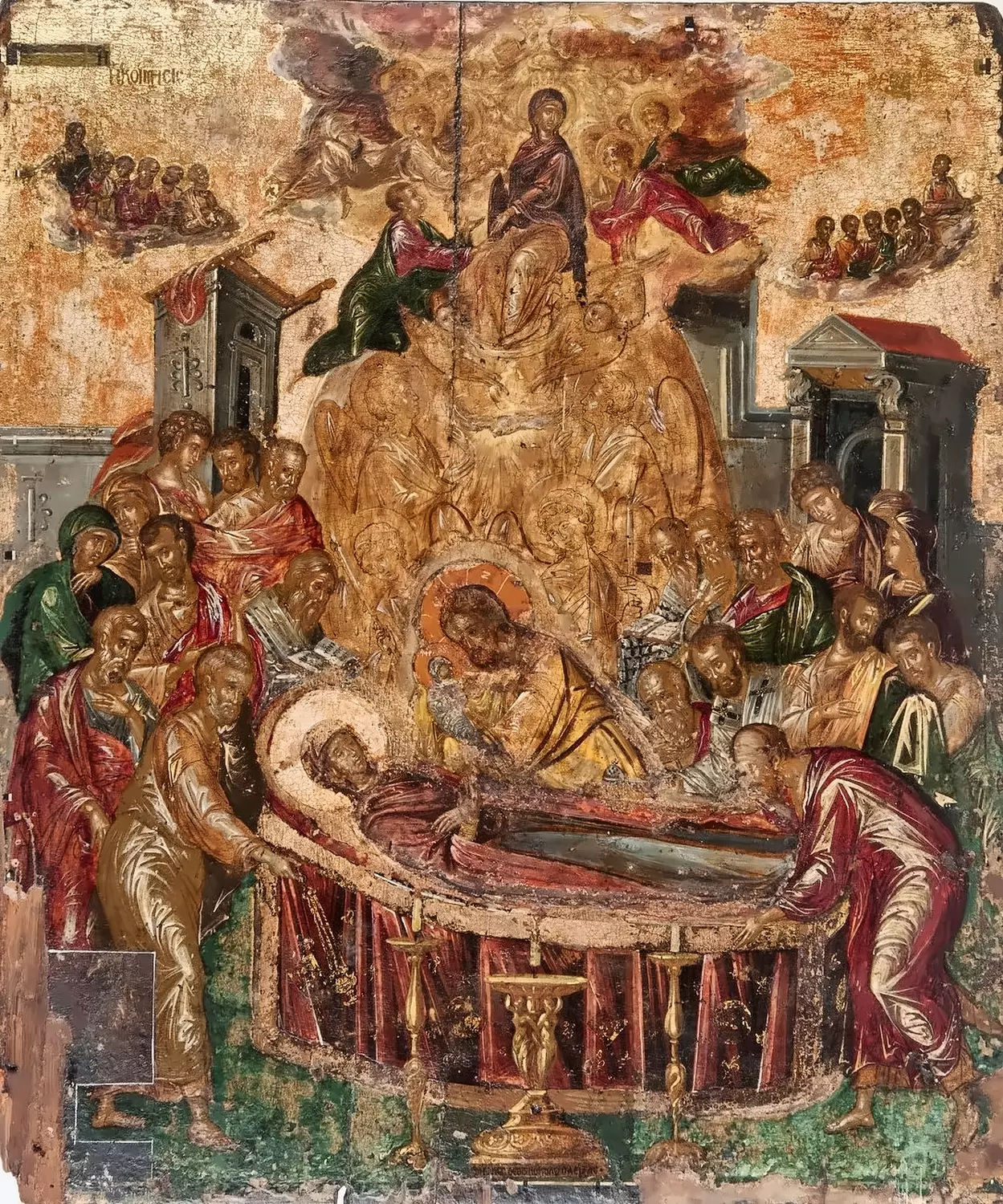
El Greco’s Dormition of the Virgin, generally dated shortly before 1567 and often placed around 1565–1566, belongs to the small group of works that provides direct access to his formation as a Cretan icon painter. Executed in egg tempera and gold leaf on a wooden panel measuring 61.4 × 45 cm, it is preserved in the Metropolitan Church of the Dormition of the Theotokos in Ermoupolis on Syros. The painting predates the artist’s departure for Venice in 1567, before the visual language associated with his Italian years and, later, Toledo had fully emerged. The Metropolitan Museum of Art identifies the Syros Dormition among the rare early works documenting El Greco’s training in the tradition of religious icon painting on Crete.
Within this small panel, an unusually crowded sacred narrative unfolds. The Theotokos lies across a narrow bier, apostles and ecclesiastical figures gathering closely around her, while Christ rises immediately behind the body and holds the small swaddled figure representing her soul. Above them, further groups of apostles approach on clouds; higher still, the Virgin appears again amid angels within an ascending celestial episode. Earthly death, reception of the soul, heavenly elevation—three moments compressed into a single pictorial field.
The Dormition and its vertical structure
At the lower centre, the Virgin’s body establishes the dominant horizontal axis. Her dark red maphorion and the long edge of the bier form a broad band across the panel, against which the movements of the surrounding figures become more pronounced. Apostles bend forward, turn toward one another, raise hands, lean over the body. Behind them, additional heads and shoulders emerge in compact succession, leaving remarkably little unoccupied space.
This density gives the scene its particular visual pressure. Figures overlap, garments meet, gestures intersect. On one side an elderly apostle reaches toward the bier; nearby, another bends deeply, his grey beard falling against a dark garment. Across the opposite group, several faces appear at different heights, some seen frontally, others in three-quarter view. Individual physiognomies survive even within the condensed arrangement: sharply described brows, narrow noses, dark eyes, grey or brown beards.
Directly above the Virgin stands Christ. His head is enclosed by a large halo and his figure occupies the lower part of a luminous mandorla, now heavily interrupted by surface loss. In his arms rests the Virgin’s soul, represented according to established Dormition iconography as a small wrapped figure. The compositional geometry is simple and forceful: Christ and the soul create a central vertical, the bier a long horizontal, the surrounding apostles a curved human enclosure.
The post-Byzantine character of the icon appears clearly in this organization of sacred space, in which theological hierarchy determines placement more strongly than naturalistic recession. The term post-Byzantine is especially appropriate for the continuation and transformation of Byzantine artistic traditions in works produced after the end of the Byzantine Empire.
Higher in the panel, the rhythm changes. Two reduced groups of apostles appear on clouds at either side, approaching the central event according to the traditional narrative of their miraculous gathering for the Dormition. Between them and above the principal scene, the Virgin appears for a second time, surrounded by angels in a luminous heavenly field. A green-clad figure reaches upward toward her. This upper episode extends the iconography beyond the deathbed itself and introduces the visual language of the Assumption into the vertical sequence, a combination recognized in scholarship on the Syros panel.
Architecture stabilizes the crowded arrangement. Tall structures stand at either side of the central action: arched openings, projecting roofs, a suspended textile, and a classicalizing pediment. Their scale remains subordinate to the figures, yet their forms bring sharper geometric accents into an image otherwise dominated by bodies and curving drapery.
Gold, colour and the surviving painted surface
Gold originally played a stronger unifying role than the present condition of the panel allows. Across the upper field, broad passages are abraded and irregular, exposing lighter areas beneath the original surface. The celestial zone around Christ and the Virgin has suffered particularly extensive wear. A pronounced vertical fissure descends from the upper edge through the central region, while surviving gold remains more concentrated around halos and peripheral passages.
The losses reveal something important about the material life of the icon. Its present appearance combines original painting, exposed preparation, worn gilding, cracks and areas of abrasion accumulated over centuries. Especially in the upper half, figures seem to emerge through this altered surface, parts of their garments and halos retaining colour beside extensive passages of exposed ground.
Within the surviving paint, El Greco’s handling is already varied. Fine linear highlights articulate folds, at times approaching chrysographic patterning. Red, ochre, dark green, muted blue-grey and black establish a compact but active chromatic range. In several garments, narrow light strokes run rapidly along folds; elsewhere, broader zones of colour provide weight beneath the linear surface pattern.
Faces receive careful modelling on a very small scale. Shadows gather around eyes, noses and cheekbones; lighter passages pick out foreheads and the bridge of the nose. The treatment remains closely connected with Cretan icon-painting practice, though the repeated turns of the heads and differing gestures create a greater degree of animation within the group.
The Virgin is the principal point of stillness. Her eyes are closed and her head inclines gently within a broad halo. Long folds descend over the bier, their restrained direction contrasting with the broken rhythms of the apostles’ garments. Around this quiet horizontal figure, nearly everything else bends, rises, gestures or turns.
Detail: Christ, the Theotokos and the Apostles around the Bier
Seen at closer range, the lower scene reveals how carefully El Greco manages a composition that could easily have become visually confused. Christ occupies the centre, his ochre-gold garment separating him from the darker robes around him. The small soul of the Virgin is held close to his body, almost directly above the face of the sleeping Theotokos. This close alignment connects the two representations of Mary—the body below, the soul above—without requiring a large empty interval between them.
Around this axis, the apostles form overlapping arcs. Grey-haired figures alternate with darker-haired men; episcopal vestments introduce patterned white and black passages amid the reds, greens and ochres. Hands become particularly expressive at this scale: one touches the bier, another rises toward the face, others disappear partially beneath folds and neighbouring bodies. The scene gains intensity through these small variations rather than through exaggerated facial expression.
The bier itself is equally important. Its curved edge leads the eye across the lower composition, while red fabric falls in deep vertical folds beneath it. In front stand tall candlesticks and the central candelabrum whose base would eventually provide one of the most consequential pieces of evidence in the modern history of the panel.
Cretan tradition and Italian visual culture
The iconographic framework remains rooted in the long Byzantine tradition of the Dormition, with close affinities to earlier Palaiologan compositions and to the established repertoire of the Cretan School. Studies of El Greco’s early work have also emphasized his contact with Italian visual material, particularly compositions and motifs transmitted through prints.
Those different visual languages coexist across the panel. The gold ground, hierarchical arrangement, central Christ holding the Virgin’s soul and close-packed sacred space belong to the established icon tradition. Greater bodily movement, the elaborated celestial sequence and elements of classicalizing architecture indicate another field of visual experience. In sixteenth-century Crete such exchanges formed part of the environment in which painters could preserve Byzantine iconographic models while responding selectively to Italian art.
El Greco was formed within that environment before moving to Venice and subsequently Rome and Spain. The wider trajectory from Cretan icon painter to an artist immersed in Italian Renaissance painting is fundamental to the understanding of his later development, though the Syros icon still belongs securely to the first phase of that career.
Certain features already invite comparison with the painter he would become. Elongated bodies, compressed groups, upward-directed movement and a preference for strong vertical organization occur here within the discipline of the Cretan icon. Their later transformation would be substantial. In Toledo these possibilities would operate through oil painting, monumental scale, Venetian colour and Mannerist spatial construction, far beyond the material and formal circumstances of this small wooden panel.
The division between an earthly gathering and an opened heavenly domain has also prompted comparisons with El Greco’s later Burial of the Count of Orgaz. The proposed relationship has a long scholarly history: some authors have seen the Byzantine Dormition type as a significant compositional precedent, while others have placed greater weight on Italian Renaissance sources for the Toledo painting.
The signature and the rediscovery of an early El Greco
For centuries, the authorship of the icon was unknown. In the spring of 1983, the signature on the base of the central candelabrum was identified during study of the work on Syros, a discovery associated with the Byzantinist Georgios Mastoropoulos. The recognition of El Greco’s Greek name transformed the scholarly importance of the panel.
Because the Dormition could now be securely connected with Doménikos Theotokópoulos, it provided a key point of reference for reconsidering other works from his Cretan and early Italian years. The discovery contributed substantially to the modern reassessment of an artist whose formation on Crete had once occupied a far less secure place within studies of his career. The Met’s major 2003–2004 retrospective accordingly presented the Syros Dormition and Saint Luke Painting the Virgin as rare evidence for his earliest training as an icon painter.
The icon’s route to Syros is less firmly documented. A frequently cited account connects its arrival with refugees from Psara during the Greek War of Independence and proposes that it may have reached the island in 1824 from a monastery dedicated to the Dormition on Psara. The provenance therefore remains appropriately qualified, while its later association with the church in Ermoupolis is secure.
Across the worn gold ground, the most powerful elements remain remarkably legible: the Theotokos stretched across the bier, apostles closing around her body, Christ holding her soul at the centre, cloud-borne figures above, angels and the ascending Virgin occupying the highest zone. Near the lower edge, incorporated discreetly into an object within this dense sacred narrative, survives the detail that altered the work’s modern history—the painter’s signature on the base of the central candelabrum.