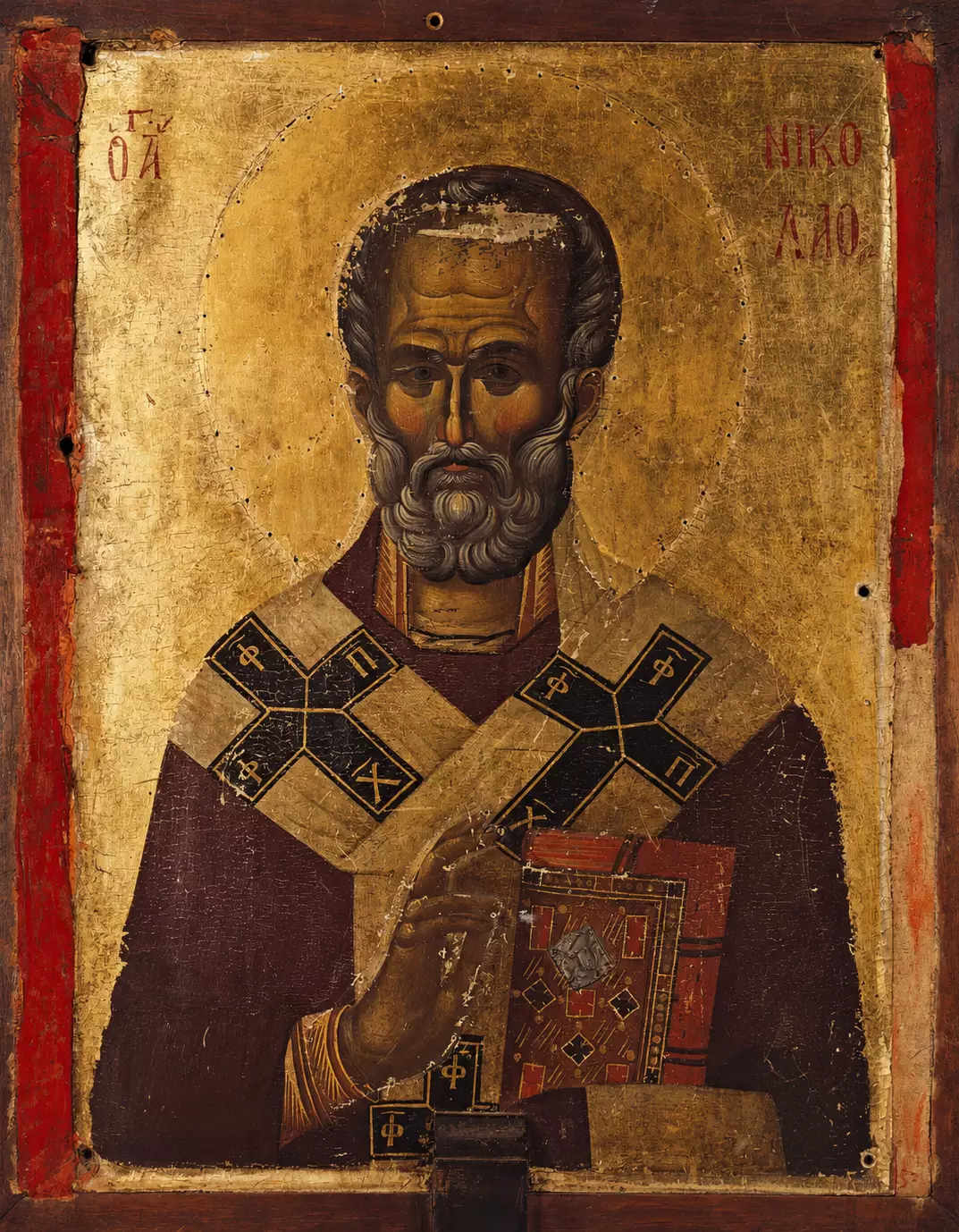
The Byzantine icon of Saint Nicholas preserved at Hilandar Monastery on Mount Athos presents the bishop of Myra in a concentrated, frontal image whose authority depends on very few elements: face, gesture, episcopal vestments, Gospel book and gold ground. Painted by an unidentified artist around 1320, the small panel, measuring approximately 42 × 31 cm, belongs to the early fourteenth century, one of the most fertile phases of Palaiologan painting. Egg tempera on a wooden support forms the painted image, while the golden field separates the hierarch from any narrative or architectural setting.
Saint Nicholas occupies almost the entire surface. His right hand rises before his chest in a gesture of benediction; with his left he supports a large, richly decorated Gospel book. A broad omophorion, marked by dark crosses, passes across the shoulders and immediately identifies the figure’s episcopal status. The remains of the Greek identifying inscription survive in the upper part of the board, divided between the two sides of the halo. Such elements belong to the established visual vocabulary of Byzantine representations of holy hierarchs, yet their handling gives the Hilandar icon its particular character.
Byzantine Icon of Saint Nicholas: Form and Palaiologan Style
Within the composition, everything is drawn toward the face. The large circular halo encloses the head almost geometrically, while the shoulders spread outward beneath it, creating a broad triangular mass that narrows toward the hands and the Gospel book. Strong frontality stabilizes the image. Even the asymmetry introduced by the raised right hand and the rectangular volume of the codex remains contained within this compact arrangement.
The painter devoted particular attention to the physiognomy. A high, furrowed forehead rises above deeply set eyes; the long nose creates a firm vertical axis, continued below by the moustache and curling grey beard. Dark underpainting remains visible around the temples, eyes and cheeks, while warmer passages across the forehead and cheekbones build the flesh through successive tonal transitions. Thin highlights define the ridges of the brow, nose and wrinkles. Some passages are sharply linear, others unexpectedly soft. This balance between graphic definition and volumetric modelling belongs comfortably within the varied classicizing language of Palaiologan art, whose relationship with older classical traditions remained complex and persistent.
Around 1310–1320, related currents were flourishing in Macedonia and the wider artistic orbit connecting Thessaloniki, Serbian patronage and Mount Athos. To precisely these decades belong the celebrated wall paintings of Saint Nicholas Orphanos in Thessaloniki, which have themselves been associated with artistic activity at Hilandar. The comparison need not imply a common painter; rather, it places the icon within an environment in which supple modelling, carefully differentiated faces and an increasingly sophisticated treatment of sacred figures circulated across media and monuments.
Episcopal Vestments and the Gospel Book
Across the darker episcopal garments, the pale omophorion provides the strongest chromatic and structural accent. Its repeated crosses break the broad fabric into angular sections, forming a visual counterpoint to the rounded halo and curling beard. The folds themselves remain restrained, with greater decorative density appearing lower down, especially around the cuffs and the Gospel book pressed against the saint’s body.
That Gospel book has considerable visual weight. Its reddish cover is enclosed by narrow borders and geometric ornament, with a central decorative element set against the darker field. The bishop’s left hand emerges from beneath it, supporting the codex firmly, while the raised right hand introduces a smaller, more intricate pattern of fingers nearby. Gesture and book together establish the familiar episcopal formula of teaching authority and blessing, without requiring additional figures or narrative attributes.
Its date also coincides with an important phase in Hilandar’s medieval history. King Stefan Uroš II Milutin was responsible for extensive building and artistic patronage at the monastery; around this period the katholikon was rebuilt, and a chapel dedicated to Saint Nicholas formed part of the expanded entrance complex. Against that background, an image of the bishop saint around 1320 belongs to a broader moment of intense artistic investment at Hilandar, even though the original commission and initial location of this particular icon are not established by the information available.
Gold Ground and the Surviving Painted Surface
Time has altered the visual balance of the icon. Abrasions, scratches and small losses interrupt the gold ground, the halo and parts of the painted figure; along the edges, the worn surface exposes the material history of the board. The face itself retains enough of its modelling for the artist’s original construction to remain legible, especially across the forehead, eyes, nose and beard. A dark red border, unevenly preserved, encloses the gold field.
Particularly revealing are the areas in which wear has reduced the brilliance of the background. The bishop consequently emerges against a mottled field of ochres, brownish gold and exposed underlying layers, while isolated passages preserve something of the original luminosity. Surface damage has also softened several contours without eliminating the essential hierarchy of the composition: halo, face, omophorion, blessing hand, Gospel. The image still depends on that severe ordering of forms, compact in scale and unusually forceful in its frontal presence.
(The translation was edited by P. Alexiou)