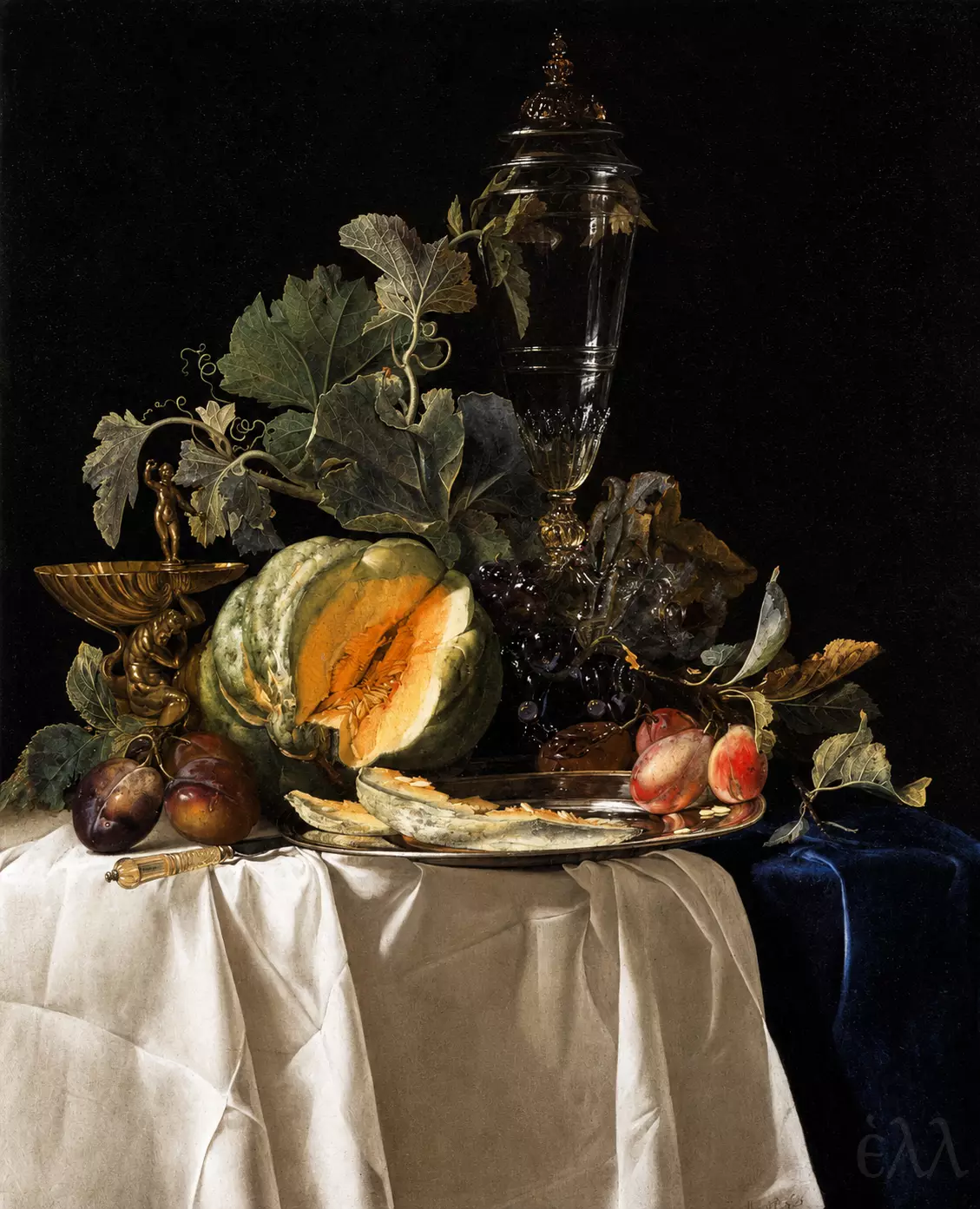
Painted in 1652, Willem van Aelst’s Still-Life with Fruit and Crystal Vase brings together fruit, glass, metal and costly textiles within a composition whose richness depends upon restraint. The work, an oil on canvas measuring 73 × 58 cm and now in the Galleria Palatina at Palazzo Pitti in Florence, belongs to the painter’s early maturity. Van Aelst, born in Delft in 1627 and later active in Amsterdam, constructs the picture vertically, allowing a tall crystal vessel to rise above the lower accumulation of fruit and tableware into a darkness that almost absorbs it.
The first visual insistence comes from lower down. A cut melon, opened towards the light, occupies the left of the central axis; plums gather beside it, while reddish fruit and further sliced pieces rest on a shallow metal platter extending across the foreground. Vine leaves spread behind them in irregular layers. Against this concentrated mass, the pale tablecloth descends in broad folds, interrupted at the right by a blue textile whose lustrous edge catches a narrow band of illumination. At the opposite side stands a small gilt vessel with a figurative stem. Near the lower-right hem of the cloth, the painter placed his signature and the date.
Light connects these different substances, yet never treats them alike. Flesh, rind, linen, glass, polished metal, leaves: each receives its own optical character.
Still-Life with Fruit and Crystal Vase: Light, Luxury and Surface
The melon establishes the chromatic centre of the painting. Its pale greenish rind opens onto warm yellow-orange flesh, with the cut surface catching a concentration of light that makes the fruit appear almost luminous against the surrounding browns and blacks. Van Aelst does not isolate it. Dark fruit presses against its lower edge, foliage folds around and behind it, the metal platter runs horizontally in front. Still, the eye repeatedly returns to this opened form. Its weight is strongly felt; so too the irregularity of its surface, from the rough exterior skin to the moist, freshly exposed interior.
Across the foreground, another kind of pictorial problem takes over. The white cloth occupies a considerable portion of the canvas, but its apparent simplicity is deceptive. Large illuminated planes alternate with narrow creases, deeper shadows and sections that disappear beneath the tableware. At the left, the fabric falls outward in an ample fold; nearer the centre, it drops almost vertically; to the right, a longer fold narrows before reaching the lower edge. These changes keep the large pale area from becoming a flat base. The tablecloth has volume, gravity, thickness. Small tonal variations give it a slightly worn material presence rather than an abstract whiteness.
The blue textile beside it changes the register abruptly. Only part of the fabric is exposed, yet the saturated colour has unusual force because so much of the surrounding field is dark or neutral. Along one fold, light travels as a brilliant, thin reflection, then disappears. Such passages demonstrate one of the essential pleasures of seventeenth-century still-life painting: the painter could set very different materials close together and make the distinctions between them intelligible almost entirely through the behaviour of light. Matte fruit absorbs it; metal returns sharper points; cloth disperses it; crystal breaks it into small, discontinuous flashes.
Most elusive is the tall vessel rising above the arrangement. Much of its body nearly merges with the dark background. Van Aelst defines it selectively, through highlights along its contours, reflections around the stem and base, and minute glints that disclose the upper sections without making the whole object uniformly visible. The result is curious. One knows the vessel is there before one can completely reconstruct its form. Transparency becomes a pictorial absence bounded by reflections.
That treatment alters the usual relation between object and background. The darkest area of the composition is extensive, covering much of the upper canvas and leaving no architectural setting to establish depth. Objects emerge from it by degrees. Vine leaves occupy the transition between the illuminated foreground and this obscurity, some plainly described, others reduced to subdued silhouettes. Their stems curve and twist through the centre, loosening what might otherwise have become an overly rigid pyramidal structure. The crystal vessel supplies a vertical axis; the foliage unsettles it.
At the left, the small gilt object introduces yet another scale of observation. Remaining partly embedded among fruit and leaves, its bowl and figurative support still catch warm points of light. The isolated prominence of a display piece, however, is something Van Aelst withholds from it; the eye discovers it only after the larger forms. This delayed visibility recurs throughout the canvas: reflections appear inside darkness, leaves overlap other leaves, dark grapes and vessels become distinguishable only after prolonged looking. Abundance is present, though the composition refuses to expose everything at once.
The historical environment in which such painting developed also matters. Seventeenth-century Dutch culture was shaped by expanding commerce, collecting and increasingly sophisticated patterns of consumption. Scholarship on the Dutch Golden Age has repeatedly examined the close relationship between material culture and a society enriched by trade, while studies of early modern commerce show how objects, specimens and luxury commodities circulated through networks reaching far beyond the Netherlands. A still life need not therefore become a literal catalogue of trade to participate in that world. The very capacity to distinguish between fine linen, elaborate glass, metalwork, cultivated fruits and richly coloured fabric assumes a viewer attentive to things and to differences of quality among them.
Yet material abundance in Still-Life with Fruit and Crystal Vase is disciplined by a surprisingly concentrated design. There is no crowded room, no continuous spread of objects across an enormous banquet table. Van Aelst compresses the display into a relatively narrow pictorial field. The mass of fruit settles around the middle; the crystal vessel rises above it; the cloth opens the lower part of the composition. Empty darkness around the upper vessel is consequently as important as the objects themselves. It gives the fragile glass room to become visible.
Colour follows a similarly controlled logic. Warm orange and ochre cluster around the melon, reddish tones in the smaller fruits answer them at either side, green-grey foliage forms a cooler middle register, and the blue textile creates a concentrated chromatic accent at the right. Against these colours the white cloth acts almost as an illuminated ground, receiving reflected browns and greys rather than remaining uniformly white. Richness accumulates in the palette through adjacency, a restraint that spares it from indiscriminate saturation.
A further distinction, between precision and hardness, matters here too. The objects are carefully delineated, sometimes minutely so, but the painting does not read as a collection of sharply separated contours. Leaves overlap the vessel; fruit touches fruit; shadows connect the platter to the cloth; transparent glass passes optically into the dark field behind it. Boundaries change according to material. This controlled variation gives the still life much of its visual credibility.
The cut fruit inevitably introduces time into an arrangement otherwise characterised by stillness. Its opened flesh records an action just completed, while the knife at the front edge of the table reinforces the suggestion of recent handling. Though nothing in the arrangement actually moves, a sense of recent handling keeps the composition from feeling untouched. The distinction is subtle. Van Aelst allows human presence to be inferred through preparation and arrangement while excluding the human figure itself.
Interpretations of Dutch still life have often moved towards elaborate symbolic readings, particularly when fruit, luxury vessels or perishable materials appear together. The visible evidence in this painting advises greater care. Ripeness, cutting, fragility and precious workmanship can certainly invite reflection on duration and material value, but the work does not require a rigid symbolic code to sustain its meaning. Its intelligence is already evident in what paint accomplishes across the surface: opacity beside transparency, softness beside hardness, brightness emerging from almost complete blackness.
At 73 centimetres high, the canvas achieves an unexpectedly monumental presence from objects ordinarily held in the hand. This transformation of scale is central to the painting’s effect. A melon acquires mass, a fold of linen becomes an illuminated plane, the stem of a crystal vessel turns into a sequence of minute optical events. The objects remain recognisable and domestic; their pictorial existence, intensely observed, is something larger. In the silence of the dark background, even a small reflection is enough to hold the eye.
(The translation was edited by A. Orfanos.)