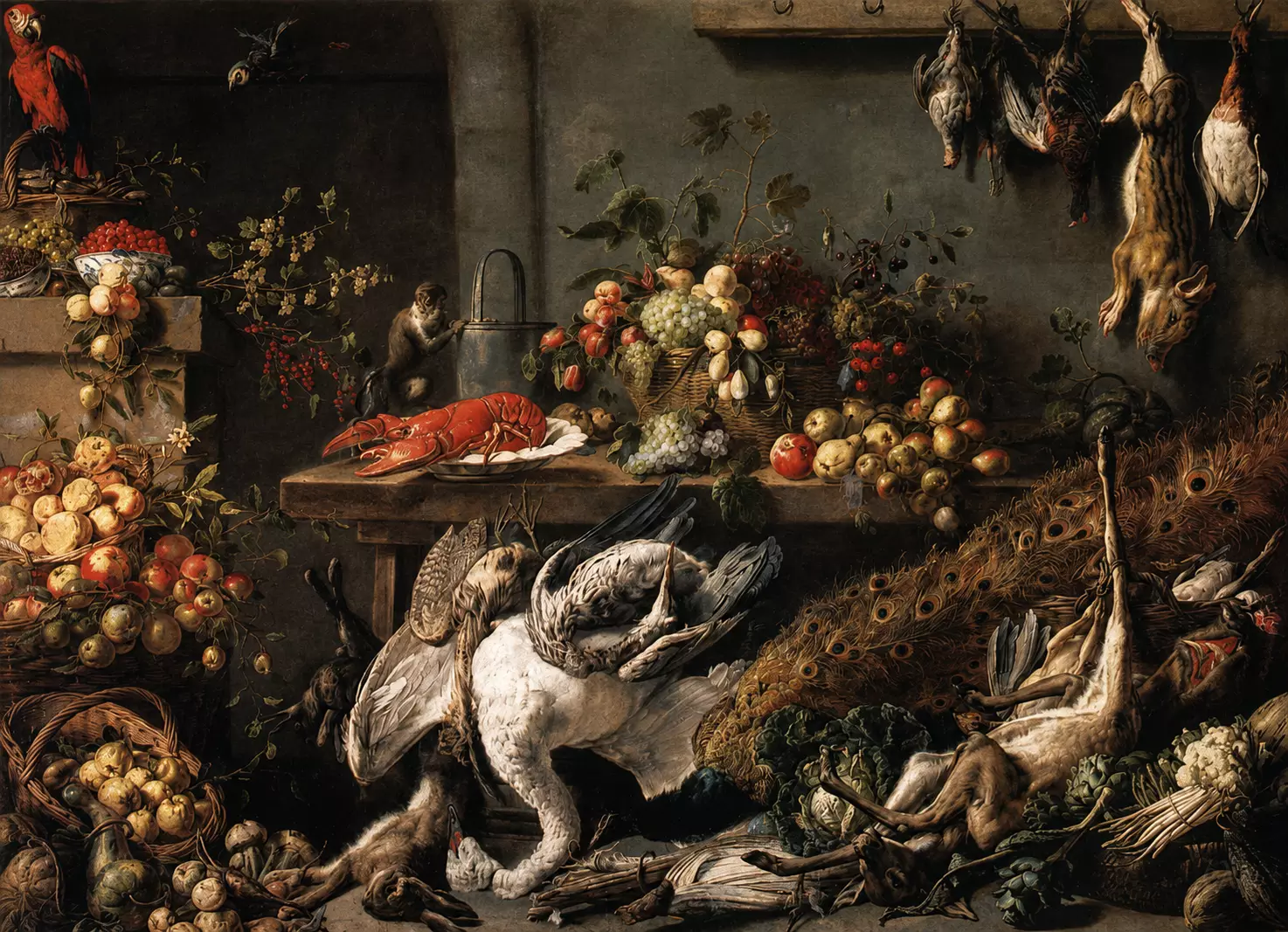
Few seventeenth-century still lifes press abundance upon the eye with the physical insistence of Adriaen van Utrecht’s The Pantry. Painted in 1642, the monumental oil on canvas measures 221 × 307 cm and belongs to the collection of the Museo del Prado in Madrid. The scale matters. Fruit, vegetables, birds, game, a lobster, baskets, vessels and living animals do not occupy a conveniently bounded tabletop; they spread across the painting, descend to the floor, rise into the shadowed upper space, hang from hooks, overlap one another. The Prado itself characterizes Van Utrecht as a major Antwerp still-life painter whose works are distinguished by large dimensions and opulent contents, qualities closely associated with the wealth and cosmopolitan culture of their owners.
Yet sheer quantity is only the first impression. What gives the picture its force is the painter’s control over this almost excessive accumulation. At the centre, a table bearing fruit and a brilliant red lobster establishes a horizontal anchoring plane. Around it the composition expands in several directions: downward into the mass of dead birds and game, sideways towards baskets of produce, upward towards suspended animals and the darker architecture of the pantry. A red macaw occupies the upper left corner; below and nearer the centre, a monkey introduces a small, alert presence among the foodstuffs. Across the lower foreground, the body of a white swan and the spreading plumage of a peacock create two of the largest and most immediately legible forms. Even so, this opulence resolves into structure rather than disorder.
Adriaen van Utrecht The Pantry: abundance under control
The first difficulty of such a composition is simple to state and difficult to solve: how does a painter fill nearly seven square metres of canvas with unrelated objects without reducing the whole to an inventory? Van Utrecht answers through visual rhythm. Large pale forms alternate with darker masses; rounded fruits interrupt the angular bodies and wings of birds; the rigid edge of the table runs against the cascading diagonals of produce and game. Areas of compression are followed by quieter passages. Even empty wall space, limited though it is, becomes useful.
From the lower left, baskets and heaps of fruit begin a rising movement towards the tabletop. Apples, pears, grapes and other produce are differentiated by changes in size, surface and local colour, yet they remain bound into a dense collective mass. Above them, blossoms and thin stems form a lighter linear network. The eye then reaches the lobster, whose saturated red creates one of the painting’s strongest chromatic accents. Behind and around it, pale fruit, grapes and foliage lead farther into the composition. The red does not remain isolated: smaller notes of similar colour recur among the fruit and berries, carrying the gaze horizontally across the table.
The foreground behaves differently. Heavy bodies occupy it—feathers, limbs, wings, antlers, vegetables, the elongated necks of birds. The swan is especially important because its pale plumage interrupts the prevailing earth tones and gives the lower centre a luminous mass. Its curved neck folds back into the surrounding forms, while the peacock beside it provides an almost opposite surface: dark, densely patterned, marked by repeated eye-like motifs in the tail feathers. One broad and pale, the other intricate and chromatically varied, the two birds hold together a foreground that could easily have collapsed into visual confusion.
Depth is built principally through overlapping. Objects conceal portions of other objects, baskets disappear behind fruit, birds are partly covered by adjacent bodies, and the table itself separates foreground accumulation from the produce arranged farther back. No single uninterrupted recession leads into the room. Van Utrecht constructs instead a succession of shallow spatial zones, one pressed against another. The result is characteristic of a picture interested less in architectural spaciousness than in the tangible presence of things.
Light makes those things distinct. It catches the smooth shell of the lobster, the bloom of grapes, pale feathers, rounded fruit, the polished surfaces of vessels. Elsewhere forms sink rapidly into brown and grey shadow. Particularly in the upper part of the canvas, suspended birds and animals emerge from darkness with selective highlights along fur, feathers or limbs. The chiaroscuro therefore has an organisational function as much as a dramatic one. It releases certain objects from the surrounding density, suppresses others, establishes intervals.
Material variety and the painter’s range
This diversity of surfaces offered Van Utrecht an extraordinary field for technical display. The Prado identifies within the work an extensive range of species and objects, including swan, peacock, turkey, pheasant, partridge, rabbit, deer, wild boar, lobster, grapes, cherries, pomegranates, apples, pears, artichokes, cauliflower and asparagus, as well as wicker baskets, Chinese porcelain and a metal container. The list is useful, yet the work’s artistic argument lies in what happens to those materials once brought together.
Feathers demand one kind of description, fruit another; crustacean shell, animal fur, leaves, porcelain, wicker and metal each respond differently to light. Van Utrecht differentiates them without giving every surface identical emphasis. Some passages are crisply delineated. Others dissolve into the surrounding half-light or are absorbed into a larger tonal mass. This variation keeps the picture from becoming mechanically descriptive.
A comparable ambition appears in Van Utrecht’s Banquet Still Life of 1644 in the Rijksmuseum. That canvas assembles costly tableware, glass, fruit, an enormous lobster and Chinese porcelain on another exceptionally large canvas, and the museum explicitly presents it as a demonstration of the artist’s ability to render radically different objects and materials. The Pantry, painted two years earlier, is earthier in its setting and more heavily populated by game and agricultural produce, but the underlying pictorial intelligence is related: profusion becomes an opportunity to display range, discrimination and control.
Living creatures introduce another register. The monkey beside the metal vessel sits upright amid a world largely composed of harvested produce and dead game; the macaw, brilliant red against the dark upper corner, offers a second animate point. Their presence breaks the prevailing stillness without converting the work into a narrative scene. No sustained action occurs. A glance, a posture, a patch of vivid plumage are enough. They sharpen the contrast between animate and inanimate forms and, at the same time, add to the impression of rarity and variety.
Antwerp still life and the legacy of Frans Snyders
Van Utrecht worked within an Antwerp tradition already transformed by Frans Snyders, whose large-scale market, pantry, animal and game paintings had expanded the possibilities of still-life painting. The connection is particularly relevant to The Pantry: the Prado describes the work as a paradigmatic example of Snyders’s influence on Van Utrecht’s monumental still lifes. Yet influence here does not mean passive repetition. Van Utrecht’s arrangement has its own weight and tempo. Movement is generated through accumulation and diagonal linkage, although the overall effect remains controlled, almost architectural in the way masses are distributed.
Born in Antwerp in 1599, Van Utrecht entered the workshop of Herman de Ryt in 1614/15, travelled through France, Provence, Italy and Germany, and became a master in the Antwerp Guild of Saint Luke in 1625. By the 1640s his command of monumental still life was fully developed. The Pantry belongs precisely to this mature phase, and its signed date—recorded on the left edge of the table as “Adriaen van utrech a. 1642″—anchors the work securely within it.
Its later history adds another dimension. The canvas formed part of the Spanish Royal Collection and was recorded in 1747 at the Buen Retiro Palace in Madrid; by 1834 it was in the Real Museo, predecessor of the Prado. The eighteenth-century inventory already described a large canvas of figures, dead game and vegetables by Adriaen van Utrecht and valued it at 12,000 reales. Such a history accords easily with the object itself. At 221 centimetres high and more than three metres wide, The Pantry was conceived for an environment capable of receiving painting on a grand decorative scale.
Its grandness, however, never depends on a single precious object. A cauliflower can demand attention beside a peacock; grapes beside a swan; a lobster beside a monkey. Across the dark pantry Van Utrecht distributes differences—smooth and rough, living and dead, cultivated and hunted, brilliant and subdued—until abundance itself acquires visual order. What initially appears almost excessive is held in a system of balances, repetitions, interruptions and shadows, so that plenty itself is disciplined into a coherent pictorial order.
(The translation was edited by F. Kalimeris.)