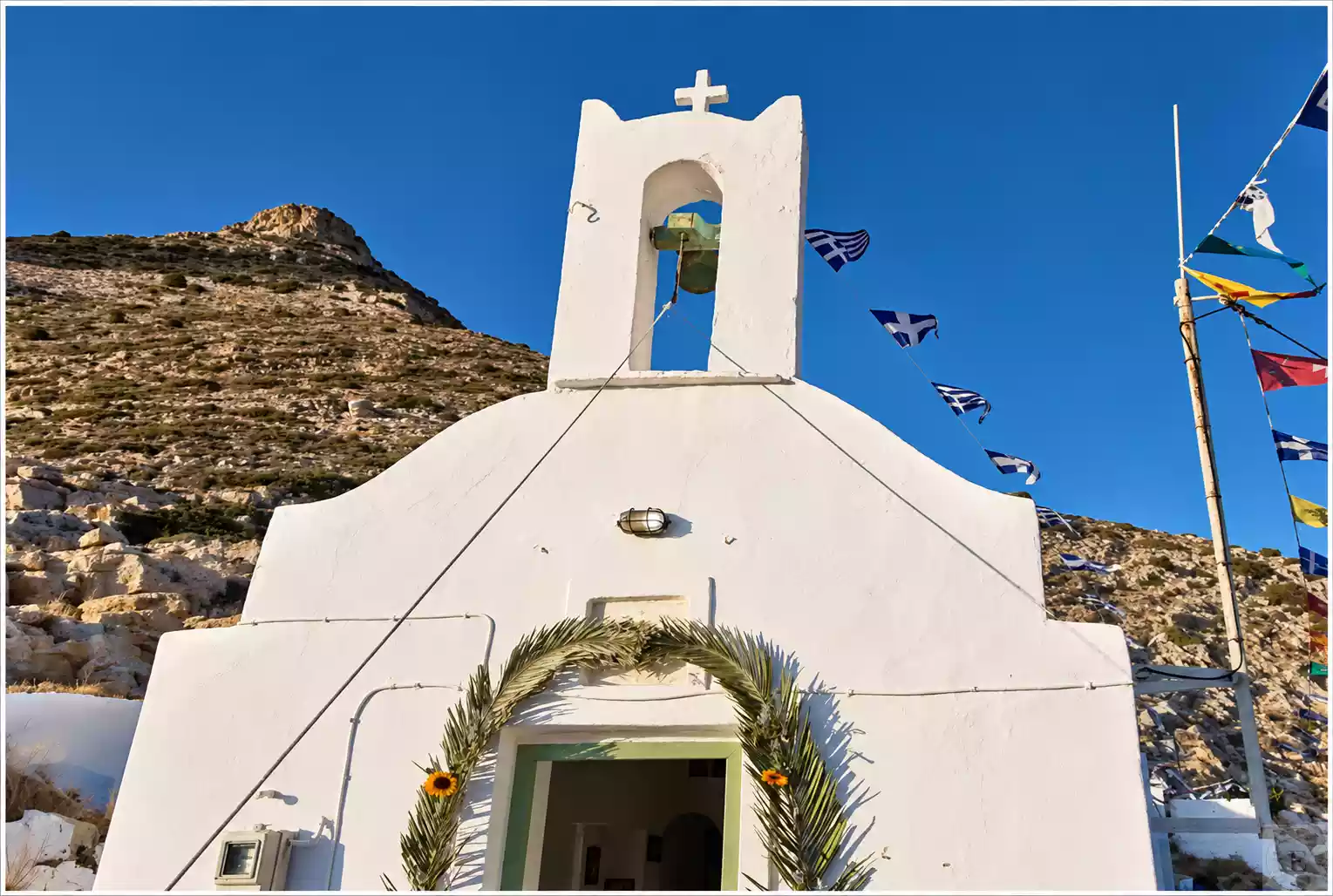
 The Church of Saint Marina at Pera Panta, across Kamares Bay on Sifnos, with its decorated entrance and Greek flags.
Agia Marina on Sifnos lies on the far side of Kamares Bay from the port’s main settlement, in the area the islanders call Pera Panta. It takes its name from the church of the same name on the hillside, a white building that ties the topography of this small seaside settlement to the religious life of the place. Between the two sides of the bay stretches the beach of Kamares.
In administrative and census records Agia Marina is listed as a settlement in its own right. The distinction matters: in everyday usage the name Kamares may take in the whole inhabited area around the bay, whereas the official records keep the settlements apart and assign them to different municipal communities.
Pera Panta on Kamares Bay
On the west coast of Sifnos, where the island’s port lies, Agia Marina occupies the opposite side of the bay. The local name Pera Panta expresses precisely this relationship with Kamares: the far shore of the same stretch of coast. The church, set higher up than the shoreline, lent its name to the inhabited area around it.
The two areas are joined by the sandy beach. The Municipality of Sifnos description also mentions reed beds and dunes with sea daffodils, features of the coastal landscape that sit alongside the growth of the settlement. Agia Marina has accommodation and places to eat, closely bound up with the sea and with the role of Kamares as the island’s gateway.
From earlier names to Agia Marina
The settlement’s official recognition is recorded on 16 May 1928, under the name ‘Kamaron’, when it was attached to the Community of Artemonas, Sifnos. This was an administrative act which fixed its place in the state registers; it does not tell us when the area was first inhabited.
The EETAA archive shows successive entries as ‘Kamaron’ and ‘Kamarai’. The renaming to Agia Marina was published in Government Gazette (FEK) 32A of 15 February 1964. Later, by FEK 156A of 30 July 1997, the settlement was detached from the Community of Artemonas and incorporated into the Municipality of Sifnos.
These dates illuminate the history of the settlement. The age of the church is another matter and calls for separate evidence, such as a founder’s inscription or archival testimony, since the official adoption of a place name may lie a long way from the building of the church to which it is owed.
Population and administrative status
According to the published census results, Agia Marina had 72 permanent residents in 2021. It is listed under the Municipal Community of Artemonas, in the Municipality of Sifnos, within the Regional Unit of Milos in the South Aegean Region. Kamares appears separately, in the Municipal Community of Apollonia, with 319 residents.
The figure refers to the permanent population. Seasonal visitors and summer traffic would need different data, so the census captures one particular aspect of life in the settlement.
Pottery in the wider landscape
Pottery workshops operate at Kamares, linking the port area with a craft of particular weight in the economic and cultural history of Sifnos. The island’s documented ceramic tradition was inscribed in 2022 on the National Inventory of Intangible Cultural Heritage of Greece. The relevant Ministry of Culture entry records uninterrupted activity over at least three centuries.
Clay was used for utilitarian wares, many of them made for cooking. Their resistance to fire depended on the composition of the material and the way it was worked, while the position of Sifnos in the Aegean made it easier to distribute them. The craft also travelled beyond the island, as Sifniot potters settled in other places.
The 2022 entry also describes traditional techniques coexisting with newer methods of production. Electric kilns have largely replaced wood-fired ones, though some of the latter are still in use, mainly for larger pieces.
The Church of Saint Marina in the photograph
In the photograph the white façade stands out, its upper outline rising in curves towards the central bell gable. A single arched opening houses the bell, and a cross crowns the top. Behind the building a rocky slope with low vegetation can be made out, while the clear sky brings the outline of the whitewashed surface into sharp relief.
The doorway has a pale green frame and is decorated with palm fronds and flowers. Greek flags and colourful bunting complete the decoration. The image allows these exterior features to be described, but it does not offer enough evidence to date the building or to establish the layout of its interior.
Lower in the frame, the open door reveals a small part of the dark interior. Above it an outdoor light fitting can be seen, and on the wall the lines of electrical cables, details of the church’s present-day use.


