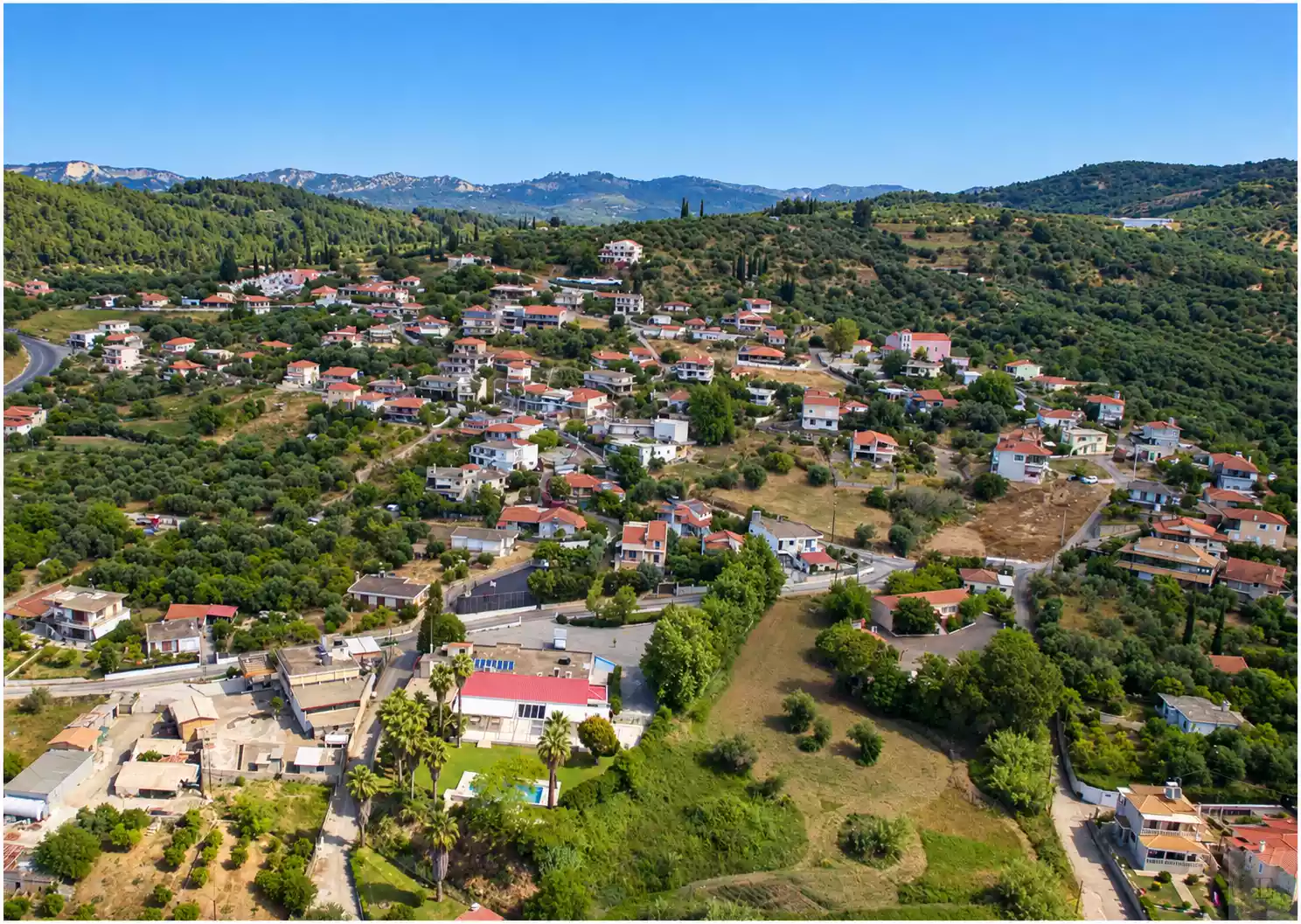
 Aerial view of Agios Georgios in the Municipality of Pyrgos, Elis, its houses spread out among cultivated slopes.
Agios Georgios is a village in Elis, in the western Peloponnese, and the seat of the community of the same name within the Municipality of Pyrgos. It belongs to the municipal unit of Pyrgos, in the Region of Western Greece. At the 2021 census the community had 668 permanent residents, which places it among the smaller settlements in the countryside around the regional capital.
From the air the village shows a loose pattern of building, its houses scattered among cultivated plots and stands of trees. Tiled roofs recur across much of the settlement, and the roads follow the rise and fall of the ground. Behind the houses the land continues in low, planted slopes, with olive trees in a good many places.
Setting and layout of the settlement
Rural and lowland: that was how the statistical classification of the 2001 census described the municipal district of Agios Georgios, and the same table gave an altitude of 60 metres. The term “lowland” belongs to the statistical classification of the area; it sits comfortably with the low rises in the landscape, such as those visible around the village.
The drone photograph makes it possible to follow how the houses relate to the surrounding countryside. Between the buildings there remain open patches of land, yards and smaller cultivated plots. In some parts the houses cluster more tightly, in others they stand further apart, and the vegetation reaches right to the edges of the roads.
This is a settlement in which the farming landscape stays in view even within the village itself. The image records that spatial coexistence, though it cannot, of course, support conclusions about the occupations of the inhabitants or their present sources of income.
From independent community to the Municipality of Pyrgos
In the administrative records of EETAA, the Hellenic Agency for Local Development and Local Government, the Community of Agios Georgios appears at first under the Prefecture of Achaea and Elis. A change published in the Government Gazette (FEK 115, Series A) of 16 April 1930 transferred it to the Prefecture of Elis. The entry concerns the reassignment of a community that already existed.
Several decades later came the reorganisation of local government in 1997. Under FEK 244, Series A, of 4 December the independent community was abolished and the settlement was incorporated into the Municipality of Pyrgos. In later censuses Agios Georgios is recorded within the municipal unit of Pyrgos, keeping its name as a distinct community.
These administrative acts provide fixed points in the village’s history within the Greek state. Dating its first settlement, however, calls for evidence of another kind: earlier censuses, or documents that refer unambiguously to this same place.
Population in recent censuses
In 2011 the permanent population of the Local Community of Agios Georgios stood at 707. The figures published by the Hellenic Statistical Authority (ELSTAT) gave the same number for the settlement itself. At the 2021 census the Municipal Community of Agios Georgios was recorded with 668 permanent residents.
| Census year | Permanent population of the community |
|---|---|
| 2011 | 707 |
| 2021 | 668 |
The difference amounts to 39 people, a fall of roughly 5.5% over the decade. The totals alone do not show how that change divides between natural increase or decrease and the movement of residents.
Some caution is also needed when older census tables are compared. The permanent population refers to the place of usual residence, whereas the de facto population counts those who happened to be in a given place on census day. The distinction affects how far the figures can be compared, particularly in small communities.
A folklore record from 1967
For the cultural history of Agios Georgios there is one specific academic source. The repository of the National and Kapodistrian University of Athens holds a folklore collection by Anastasia Alexandropoulou, dated 1967 and devoted to the village. The catalogue entry gives fieldwork as its source and classifies the manuscript under manners and customs and under popular tradition.
Such a collection opens a way into local life beyond administrative acts and census figures. Describing particular customs, though, would mean reading the relevant manuscript pages, with attention to when the record was made and to the testimony gathered at the time. The document is made available through Pergamos and the National Documentation Centre (EKT), in 43 digital image files.


