The term “Homeric epics” denotes the two great narrative poems that antiquity attributed to Homer, the Iliad and the Odyssey. They are the oldest surviving works of Greek literature, composed in dactylic hexameter and in a poetic language that was never spoken in any particular place. Ionic is the dominant dialect, though it is interwoven with Aeolic forms and with words so archaic that not even the Athenians of the Classical period could always understand them without a gloss.
The Iliad, some 15,700 lines long, does not tell the whole story of the Trojan War. It confines itself to a few weeks in the tenth year of the siege and is built around the wrath of Achilles, from his quarrel with Agamemnon to the surrender of Hector’s body to Priam. The Odyssey, of roughly 12,100 lines, follows the nostos, that is, the homecoming of Odysseus to Ithaca, and his revenge on the suitors. The division of each poem into twenty-four books is in all probability a later arrangement, the work of the scholars of Hellenistic Alexandria.
Of the poet himself we know nothing for certain. Many cities, Smyrna and Chios foremost among them, claimed him as their own, and the ancient “Lives of Homer” are fabrications of a much later date. Herodotus, writing in the 5th century BC, believed that Homer and Hesiod had lived four hundred years before his own time. Modern scholarship usually places the shaping of the Iliad in the second half of the 8th century or the early 7th century BC, and that of the Odyssey a little later. The sources do not allow any more precise dating.
The Homeric Question
For centuries the two poems were admired as the work of a single man. As early as the Hellenistic period, however, certain grammarians, among them Xenon and Hellanicus, assigned the Iliad and the Odyssey to different poets. They came to be called the Chorizontes, the “separators”. Their view remained marginal, and Alexandrian scholarship, whose leading figure was Aristarchus, rejected it.
The question was reopened in modern Europe. In the 17th century the French abbé d’Aubignac cast doubt on the existence of a single poet, but the real storm broke in 1795, when the German philologist Friedrich August Wolf published his Prolegomena ad Homerum at Halle. Wolf argued that the epics had gone through a long period of oral transmission before they were written down and assembled into unified wholes. He also drew on an ancient tradition according to which Peisistratus, tyrant of Athens in the 6th century BC, collected the scattered Homeric lays and set them in order. That tradition, however, is preserved by Cicero, who was writing some five centuries later, and its reliability remains disputed to this day.
From Wolf onwards, scholars divided into two camps. The “Analysts” combed the text for the seams, contradictions and repetitions which, in their view, betrayed several authors or successive layers of composition. Karl Lachmann went so far as to break the Iliad up into a series of self-contained lays. The “Unitarians” defended the artistic unity of the poems and saw a single creative will behind them. As has been observed, the gap between the two schools was narrower than it appeared, since most Analysts accepted some final composer and most Unitarians admitted later additions. Be that as it may, the controversy ran through the whole of the 19th century and much of the 20th.
Oral Composition and Writing
It was a young American who moved the debate onto new ground. In his doctoral thesis of 1928, Milman Parry examined Homer’s fixed epithets, expressions such as “swift-footed Achilles” (pódas ōkýs Achilleús) or “rosy-fingered Dawn” (rhododáktylos Ēṓs), and showed that they form a system of ready-made phrases, the so-called “formulae”, which serve the bard as he composes his verse in the course of performance. To test his theory against a living tradition, he travelled to Yugoslavia in the early 1930s and recorded its popular epic singers. After his untimely death in 1935 the work was carried on by his student Albert Lord, and their material is now preserved in the Milman Parry Collection of Oral Literature at Harvard University. What became known as the theory of oral composition has since been common ground in scholarship.
How and when the epics acquired written form, however, is still an open question. The Greek alphabet, adapted from the Phoenician, was in use from the 8th century BC, roughly the same period, in other words, as the composition of the epics. Only once in the Iliad is there mention of anything resembling writing, when Proetus sends Bellerophon to Lycia with a folded tablet on which “baneful signs” have been scratched (Iliad 6.168–169). Some have argued that the poet wrote the text himself, others that he dictated it to a scribe, and others again that it became fixed gradually through the performances of the rhapsodes and was written down only in the 6th century. None of these views has definitively prevailed.
The World beyond Troy
The Homeric epics know a great deal about distant lands. They are familiar with Egyptian Thebes and its hundred gates (Iliad 9.381–384), with the islet of Pharos off the mouths of the Nile, and with the wealth of a country through which Menelaus and Helen wandered before returning to Sparta. In Book 4 of the Odyssey Helen slips into the wine of her companions at table a drug that drives away grief. It had been given to her by Polydamna, the wife of the Egyptian Thon, and the poet explains that there the earth yields herbs in great abundance, some healing and some deadly, and that everyone is a physician, being descended from Paeon, the healer of the gods (Odyssey 4.227–232). Almost three centuries later Herodotus would record something similar: Egypt, he noted, was full of doctors, each one specialising in a single disease.
The coincidence is striking, and it fits what we know from the Egyptian medical papyri, such as the Ebers Papyrus of the 16th century BC, which record hundreds of prescriptions. It does not prove, however, that the poet himself travelled to Egypt. Rather, it reflects the country’s reputation as merchants, mercenaries and sailors carried it to the Aegean.
The shield of Achilles (Iliad 18.478–608) has provoked more debate. On it Hephaestus forges the entire world: a city at peace and a city at war, ploughing, the harvest on a royal estate where the king stands in silence, sceptre in hand and joy in his heart, the vintage, herds and, at the end, a dance of young men and maidens with two acrobats whirling among them. In the vintage scene a boy plays the phorminx and sings the Linus song, while the others follow him in the dance. Older scholars likened these images to the agricultural scenes in Egyptian tombs. More recent research prefers to compare them with the Near Eastern metalwork of the time, the decorated Cypro-Phoenician bowls and Geometric art. The shield is in any case a poetic construct, and no real object could have held everything the poet ascribes to it.
The Assembly in Book 2
Particularly vivid is the scene of the army’s assembly in Book 2 of the Iliad. Agamemnon, misled by a dream sent to him by Zeus, wants to attack, but first decides to test the mood of the Achaeans. He arranges with the elders that he will propose abandoning Troy and that they will then restrain the troops. The plan fails at once. No sooner has he finished speaking than the army heaves like the great waves of the Icarian Sea, whipped up by Eurus and Notus, and rushes for the ships.
At this point Athena, sent by Hera, finds Odysseus. He takes Agamemnon’s sceptre and turns the fugitives back, with soft words for the leaders and blows of the sceptre for the common soldiers. When the assembly has been reconvened, Thersites raises his voice. The poet describes him as the ugliest man who came to Troy, and he attacks Agamemnon for his greed in the harshest terms. Homer gives him neither title nor homeland; later mythographers connect him with Aetolia. Odysseus rebukes him and strikes him with the sceptre, and the Achaeans, for all their discontent, laugh. Then come the speeches of Odysseus and Nestor, who remind the crowd of the omens at Aulis and persuade it to stay.
The scene has often been read as an early image of Greek political life, a foreshadowing, that is, of the assemblies in which Pericles and Demosthenes would later speak. There is some basis for this reading, since the king has to persuade and the army responds to speech. It should not be overlooked, however, that persuasion here goes hand in hand with violence, and that the one ordinary man who dares to speak is held up to public ridicule.
The Apotheosis of Homer
In the Hellenistic period Homer’s fame was such that he came to be worshipped almost as a god. An eloquent witness to this is the marble relief bearing the signature of the sculptor Archelaus of Priene in Ionia. It was found in Italy in the 17th century, near Bovillae, passed into the collection of the Palazzo Colonna in Rome, and has belonged to the British Museum since 1819. The museum dates it between 225 and 205 BC, in the reign of Ptolemy IV Philopator, although other scholars bring it down to the 2nd century BC.
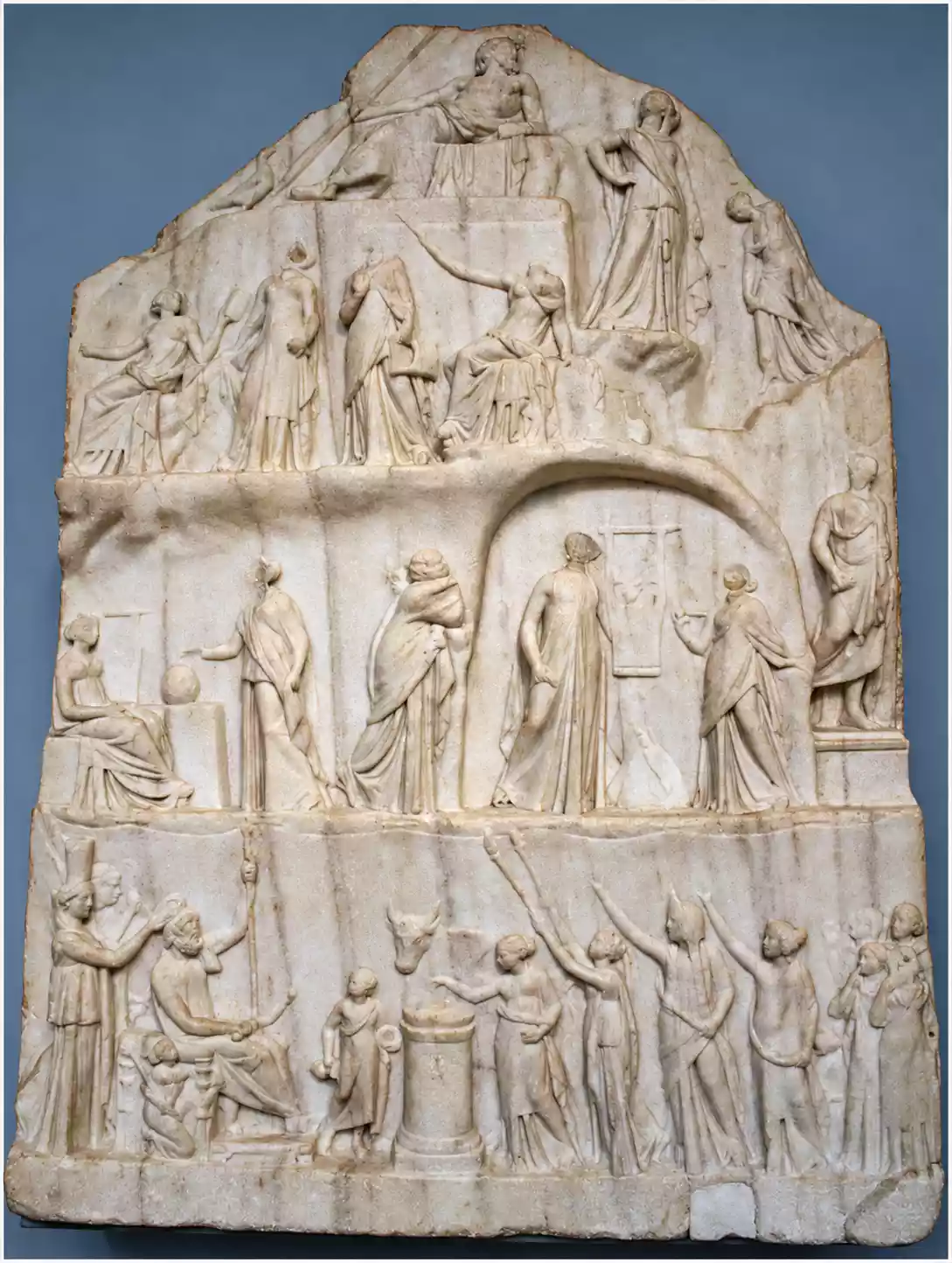 The Apotheosis of Homer. Marble relief by Archelaus of Priene, late 3rd century BC, British Museum, London. Photo: ChrisO, Wikimedia Commons
The composition unfolds in four registers. At the top Zeus reclines, and below him, on the slopes of a mountain usually identified as Helicon, are Mnemosyne, the nine Muses and, inside a cave, most probably Apollo with his lyre. In the lowest register Homer sits enthroned, holding a sceptre and a scroll. He is crowned by Chronos (Time) and Oikoumene (the inhabited world), while the personifications of the Iliad and the Odyssey kneel to the right and left of the throne. Before him Myth, History, Poetry, Tragedy, Comedy and other figures, their names inscribed in the marble, offer sacrifice at an altar. The literary genres, in other words, pay homage to the poet whom the ancients regarded as their source.
On the right, at the level of the middle register, a figure stands alone on a small pedestal. It is usually identified as the statue of a poet who had won a contest, and perhaps it was his victory that occasioned the making of the whole relief.


