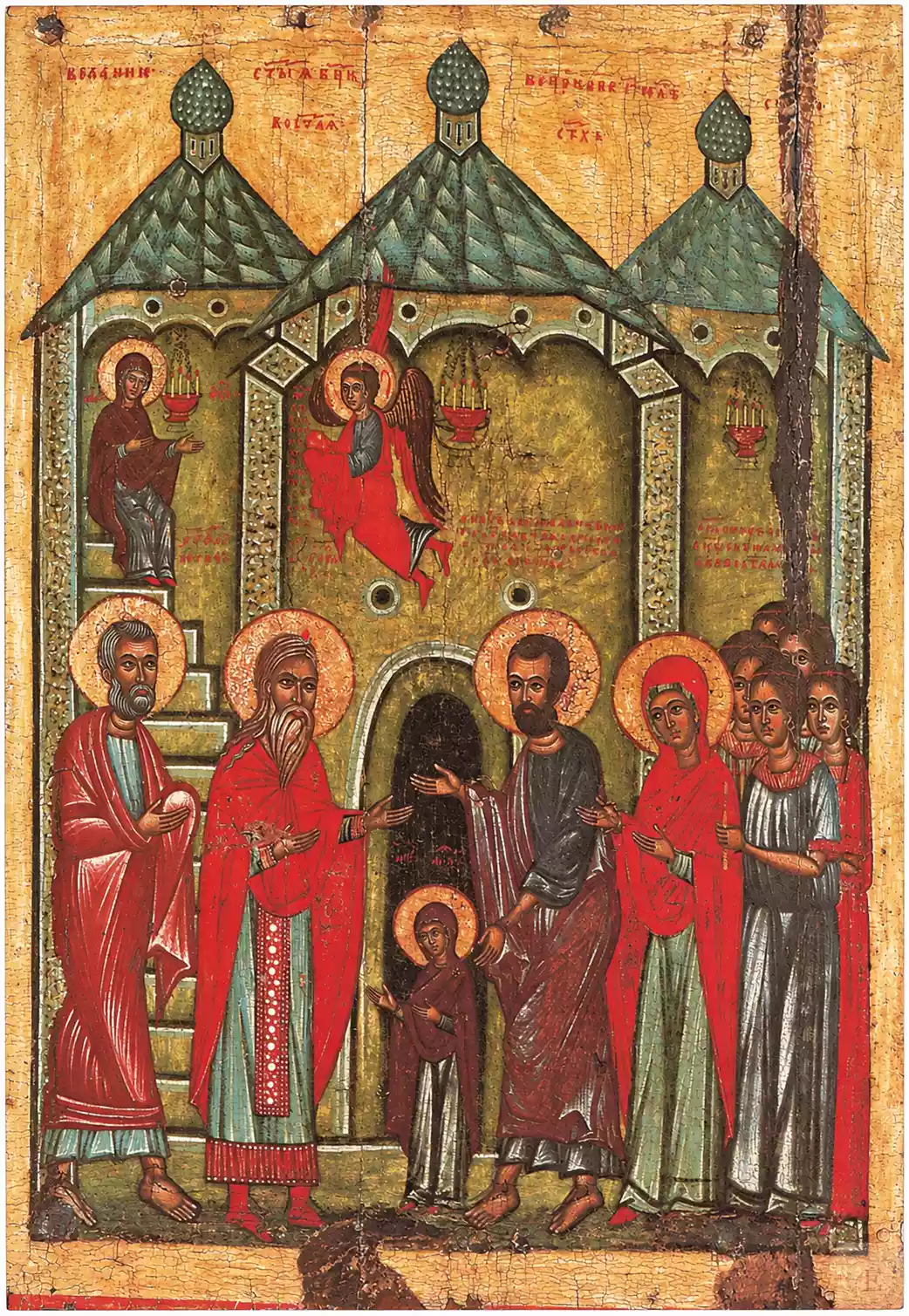
 The Entry of the Theotokos into the Temple, 14th century. From the Church of the Holy Trinity at Krivoye on the Northern Dvina. State Russian Museum, St Petersburg.
At the far left of the composition, behind the high priest Zacharias and in front of the steps that lead up into the interior of the temple, stands an elderly man with grey hair and a short beard, wrapped in a red himation. Ordinarily he has no place in the scene of the Entry of the Theotokos into the Temple. This is Joseph the Betrothed, and his presence is, according to the catalogue of the State Russian Museum, the one peculiarity of the icon kept there under inventory number ДРЖ 2724.
Painted in egg tempera on a pine panel made up of three boards and measuring 91 × 65.5 cm, the icon comes from the Church of the Holy Trinity at Krivoye (Кривое) on the Northern Dvina, in what is now the Arkhangelsk Region. It dates from the fourteenth century. Where it was painted remains an open question: the museum presents it as a Novgorod work, with a question mark, whereas Engelina Smirnova, in her monograph on the painting of Veliky Novgorod (Moscow, 1976), inclined towards a workshop somewhere in the Russian North.
From the Northern Dvina to the Russian Museum
According to Smirnova, the same Trinity church, in the rural parish centre (pogost) of Krivoye, also yielded a fine set of Royal Doors from the second half of the thirteenth century, together with a number of later icons. The Entry was removed in 1920 by an expedition of the People’s Commissariat for Education under Igor Grabar and taken to the Central State Restoration Workshops in Moscow. There, towards the end of that same year, a trial cleaning was first made on a section at the upper left; the full uncovering of the original paint layer was carried out between October 1922 and February 1923 by I. I. Suslov, while the figures of Zacharias and Joseph were uncovered by M. I. Tyulin. The boards were glued together in 1925.
In 1927 the icon was shown at the Workshops’ third exhibition of restored works, and from 1929 to 1932 it travelled with the touring exhibition of Old Russian painting through Germany, Austria, England and the United States; the catalogues for Berlin and Königsberg, Vienna, London and Chicago all include it. After its return it passed, by way of the state agency Antikvariat, to the Russian Museum in 1933.
One question concerns the icon’s original destination. Viktor Lazarev, in the catalogue of Russian icon painting published in 2000, noted that near Krivoye, at Knyazhostrov, there stood a church dedicated to the Entry of the Theotokos, and thought it probable that this was the icon of its patronal feast. The hypothesis would account for the size of the work, although we do not know when or how it would have reached the Trinity church.
Three moments in a single temple
The narrative draws on the Protoevangelium of James (chs 7–8): the three-year-old Mary is brought by her parents, Joachim and Anna, to the Temple in Jerusalem, escorted by virgins with lighted lamps; the priest receives her, blesses her and sets her on the steps of the altar, where she is to live, fed by the hand of an angel. Rather than single out one of these moments, the painter of the Krivoye icon sets all three beneath the same roof.
The handing-over unfolds in the lower register, in a single row parallel to the surface of the panel. Zacharias, in a red mantle over a light-blue chiton, his long white beard falling to his chest, wears a vertical band dotted with white that ends in a broader section at the level of his shins; he holds out one open hand towards the child. The little Mary, in a dark maphorion and with a gold halo, stands directly in front of a black arched opening, which isolates her figure at the centre of the composition. Behind her, dark-haired Joachim, in a bluish chiton and a himation of a crimson tone, stretches one hand towards the high priest and rests the other on his daughter’s shoulder. Anna follows in a cinnabar maphorion over a greenish-blue chiton, and then, squeezed in at the edge, the virgins: five of them, according to Smirnova, with earrings in their ears and candles in their hands, the foremost plainly holding a slender taper.
At the upper left, at the top of a flight of steps, Mary now sits alone inside the temple, her hands open towards the right of the picture. From the central space an angel in red garments and with dark wings descends diagonally towards her, carrying her food. The same flight of steps that supports the seated Theotokos runs down, directly behind Joseph and Zacharias, to the level of the lower scene, so that the two times of the narrative are joined by a single, simple architectural member.
Smirnova observed that this arrangement follows a type older than the icon itself, associated with the twelfth or the early thirteenth century: the principal figures at the centre, the procession of virgins behind the parents, symmetry, a lack of depth. From the late thirteenth century and throughout the fourteenth, Byzantine painting generally brought the virgins immediately behind Mary, and therefore into the centre, while pushing the parents out towards the edge, with figures in vigorous movement and a ciborium or other buildings rendered in foreshortening. At Krivoye, by contrast, Zacharias does not stoop towards the child, as convention required, nor do Joachim and Anna turn to each other in conversation. All of them stand in almost identical poses, repeating the same gestures of prayer, and it is precisely from this repetition that the row takes its rhythm.
Joseph behind Zacharias
In the Protoevangelium (ch. 9), Joseph enters the story nine years later, when the lot designates him to receive Mary, now twelve years old, from the hands of the high priest and to keep her virginity safe. Why, then, is he here? Mikhail Alpatov argued that the painter wished to gather in prayer before Mary all the persons connected with her. Jacqueline Lafontaine-Dosogne, in her study of the iconography of the childhood of the Virgin (Brussels, 1964–1965), considered a transfer from the composition of the Betrothal, which had itself absorbed influences from the Entry type and could have passed them back; she also raised the possibility that the figure is another priest. That second reading Smirnova rejected, pointing out that the figure carries an inscription with Joseph’s name.
His placing is not without consequence. Joseph stands not with the family on the right of the picture but on the side of the temple, directly behind the one who receives the child, his palm open before his chest. The arrangement allows one to read, as an interpretation grounded in the composition, the chain of the handing-over still to come: from the parents to the high priest, and from the high priest, one day, to the betrothed.
The temple with three domes
The background is taken up not by a ciborium, as in the Byzantine tradition, where the canopy over the altar table stood for the Temple of Solomon, but by a building shown at once in elevation and in section. Green arches with lobed ends form three bays, carried on colonnettes with dotted decoration and on central piers with lozenge patterns; round oculi pierce the architrave, and two more open above the black doorway. Above them rise steep grey-blue roofs marked with zigzag lines, each crowned by an onion dome on a low drum, covered with white dots like scales. In every bay a polycandelon with lit candles hangs from a chain; Smirnova made out the original design of these lamps, which does not match their final form.
Various solutions have been put forward for the origin of this setting. Nikolai Voronin and Georgy Vagner saw in it a depiction of a Russian wooden church with a conical roof. Smirnova doubted that a fourteenth-century devotional icon would render reality so directly, and proposed a composite ancestry instead: a reworking of the pointed ciborium, such as the one in the Entry at the Panagia tou Arakos at Lagoudera (1192), where lamps likewise hang; the small churches in frontal section that filled the little scenes of the vita icons of Saint Nicholas — the Krivoye icon, in her view, recalls one such scene enlarged into a work in its own right; and, more remotely, Romanesque architectural frames, familiar to the Novgorodians from works such as the bronze doors of St Sophia. The Russian character of the building comes above all from the onion domes.
A text describing such a temple also exists. Russian painters’ manuals, the so-called podlinniki, among them the Novgorod redaction known from a sixteenth-century copy, prescribe that in the Entry the Theotokos stands before the doors of the temple, which has three tops and five steps or five pillars; another speaks of a temple with three domes, inside which the Pure One sits as though in a tabernacle. Smirnova further linked the three elements of the setting, temple, door and lamp, with the metaphors of the canon for the feast attributed to George of Nicomedia, in which the Theotokos herself is likened to a temple, to a door and to a lamp shining in the house of the Lord.
Inscriptions in cinnabar, in Slavonic majuscule script (ustav), are spread across the ochre ground and the green walls of the temple: the title at the level of the domes, and short explanatory texts beside the angel, beside the seated Mary and in the right-hand bay. Much of their lettering is worn. Their unusual length led Smirnova to suppose that the model had been a manuscript miniature, and she cited for comparison the Menologion of Basil II, where the scene is accompanied by an extended text. In Byzantine painting, as Lafontaine-Dosogne showed, the image is usually entitled ‘Τὰ Εἰσόδια τῆς Θεοτόκου’ (‘The Entry of the Theotokos’) or, more often, ‘Τὰ Ἅγια τῶν Ἁγίων’ (‘The Holy of Holies’).
Wood, colour and faces
The panel is roughly hewn and full of knots. The painted field is slightly recessed to form a shallow ark (kovcheg), with canvas and gesso beneath, and on the reverse survive the channels for two inset battens that once held the three boards together; today the boards are glued at the joins and secured at the ends with iron strips.
Cinnabar dominates. The painter lays it on flat, without highlights, in the mantles of Zacharias and Joseph, in Anna’s maphorion and in the angel’s garments, and sets it against light-blue and blue fabrics, where the lights are applied in long white strokes, and against crimson ones, where the strokes turn pale blue. The green and the blue, Smirnova notes, are watery and poorly ground, and lie in an uneven layer. The haloes are gold with a red outline, the ground and the margins pale yellow, and a broad border in two tones, pink and cinnabar, runs round the whole icon.
The faces, round and calm, almost glossy, are modelled over a brown proplasmos with small, interpenetrating strokes of pinkish ochre; the white highlights are laid on in parallel or fanning out across the cheeks and foreheads. Large eyes, strongly outlined and shadowed beneath, tightly set mouths: the expression stays the same from one figure to the next, imperturbable, yet free of the severity met with in other provincial icons of the period. The small, curving folds wrap the bodies like a second skin.
The overall state of preservation is good. Along the right-hand joint between the boards, which runs vertically through the group of virgins, and in the lower margin, remnants of later overpainting and areas of infill remain; the large holes left by the batten nails, which had come through to the front, have been filled and toned in. The inscriptions are abraded.
Novgorod or the Russian North?
Few works of the period have been dated with such wide discrepancies. Vera Antonova placed it in the thirteenth century, Aleksandr Anisimov and Igor Grabar in the fifteenth; Alpatov proposed now the second half or the end of the fourteenth century, now its beginning, while Lazarev and Gerold Vzdornov opted for its first half. The confusion finds its explanation in the style itself. The small, rounded folds recall the painting of the twelfth and early thirteenth centuries, the volume of the figures and the intensity of the colour that of the thirteenth; the simplification of the forms and of the pictorial means, however, points, according to Smirnova, to a fourteenth-century work produced in a provincial milieu that held on to older models.
So long as its kindred works remained unknown, it was discussed without reservation as a Novgorod piece. Alpatov had already drawn attention to its relationship with the Nativity of the Theotokos from the former Ryabushinsky collection, now in the Tretyakov Gallery, which shares the same symmetry and the praying figures turned towards the infant; more distant is its kinship with the vita icon of Saint Nicholas from Ozerevo. The closest analogy, however, turned up elsewhere, in two icons of the Archangels Michael and Gabriel and an icon of Saints Boris and Gleb, all in private collections. What these works have in common goes beyond the facial type or the drawing of the hands and reaches the very manner of painting: the long, dense strokes of light ochre, the same shades of blue with broad white highlights. Smirnova concluded that they all come from one workshop, or from neighbouring workshops, somewhere in the Russian North.
The Dvina region, where Krivoye lies, fell within the sphere of influence of Novgorod, but also of central Russia, to which Vologda too was linked; parallels can also be traced in the Vologda circle, in icons such as the Saviour Not Made by Hands from Novlenskoye. In Smirnova’s view the icon may be connected with the provincial tradition of Vologda and not with Novgorod alone, though nothing can be ruled out, since the work is so provincial that any definitive judgement on its roots would be rash. The museum has kept that caution in the question mark beside the name of Novgorod. As for the milieu of those who commissioned it, the same scholar suggested, while stressing how conjectural the suggestion was, tastes close to those of the posad, the trading quarter of a town, or of a small, patriarchal village.


