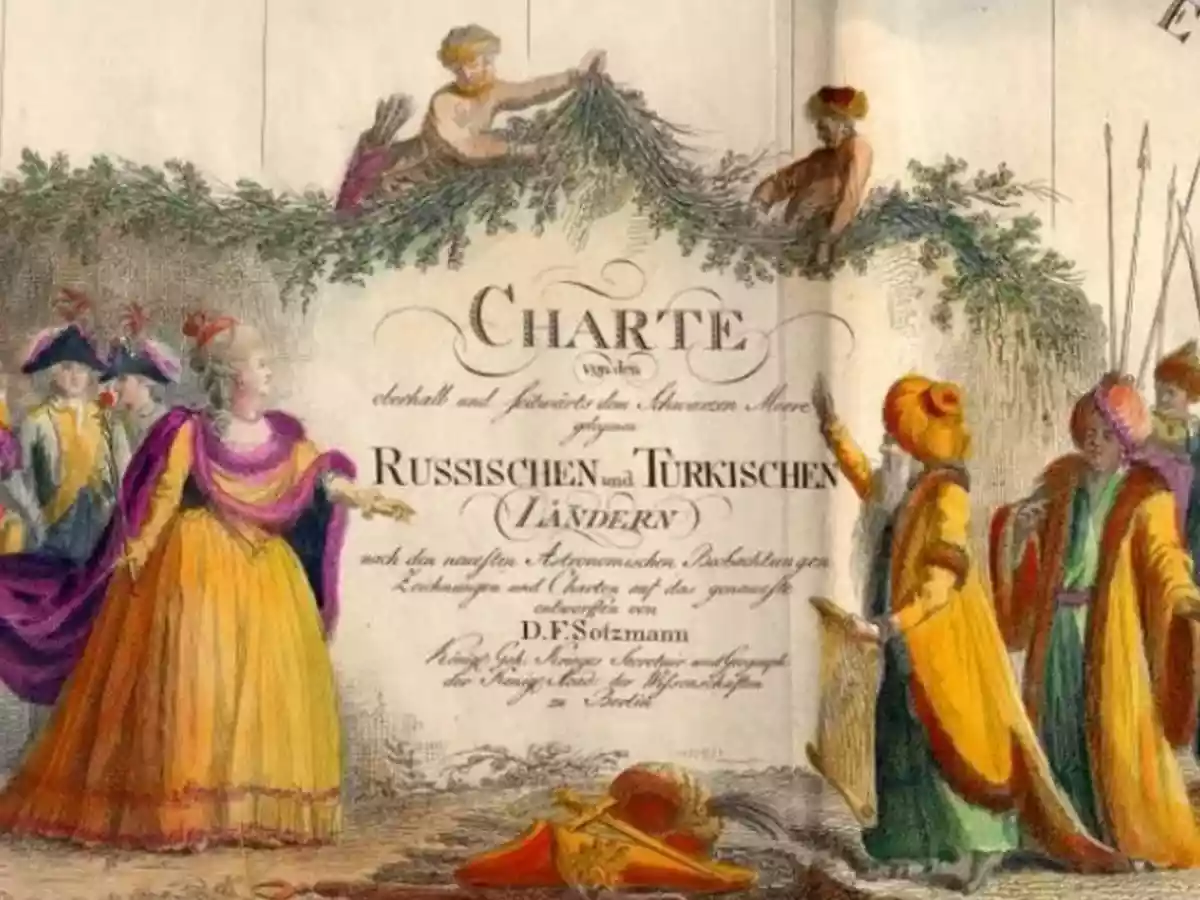
 Catherine II and Sultan Abdülhamid I in the cartouche of D. F. Sotzmann’s map “Charte von den oberhalb und seitwärts dem Schwarzen Meere gelegenen Russischen und Türkischen Ländern.” Berlin, 1788. Leiden University Libraries.
The Treaty of Küçük Kaynarca (also rendered Kuchuk Kainarji), signed on 10 July 1774 according to the Julian calendar, that is, on 21 July according to the Gregorian, brought the Russo-Turkish War of 1768–1774 to a close and fundamentally altered the terms of Russia’s presence on the Black Sea and of its relations with the sultan’s Christian subjects. The village that gave the treaty its name lay southeast of Silistra, in present-day Bulgaria, while the Ottoman delegation had been quartered in neighboring Büyük Kaynarca, only a few kilometers away (in Turkish, küçük and büyük mean “small” and “large”), as Kemal Beydilli notes in his entry on the treaty in the TDV Encyclopedia of Islam, published by the Turkish Diyanet Foundation. Most of the treaty’s provisions were clear and gave rise to no dispute. Two of its articles, however, the seventh and the fourteenth, remained a field of diplomatic contention for nearly a century, which is why later generations came to associate the treaty with the birth of the Eastern Question.
The War of 1768–1774 and the Road to Peace
The Sublime Porte declared war in the autumn of 1768, alarmed by Russian interference in the affairs of Poland and by violations of its own frontier linked to the fighting that had broken out on Polish soil. Almost from the outset, the campaigns went badly for the Ottomans. Russian armies occupied Moldavia and Wallachia, pushed on toward the Danube, and in 1771 entered Crimea, while a Russian fleet that had sailed from the Baltic appeared in the Mediterranean and, at the instigation of the Orlov brothers, stirred up the Peloponnesian rising of 1770, known in Greek historiography as the Orlov Revolt (Orlofika). The revolt was crushed, with grievous consequences for the population. In July of the same year the Russian fleet destroyed the Ottoman navy in the bay of Çeşme, opposite Chios, and for some four years thereafter kept control of much of the Cyclades.
The armistice of 1772 led to the congresses of Focșani and Bucharest. Both broke down over Russia’s insistence on the independence of the Crimean Tatars and on the cession of fortresses in the peninsula, and hostilities resumed in the spring of 1773. In the end, both sides felt the need for peace. St. Petersburg was facing the Pugachev rebellion at home, while the Porte, whose throne Abdülhamid I had ascended in January 1774, suffered defeat at Kozludzha in June of that year; the grand vizier, Muhsinzade Mehmed Pasha, then found himself hemmed in at Shumla by the forces of Field Marshal Pyotr Rumyantsev.
The negotiations at Rumyantsev’s headquarters lasted only a few days. Russian sources name Lieutenant General Prince Nikolai Repnin as the signatory for Russia, while the Ottoman delegation consisted of Ahmed Resmi Efendi and İbrahim Münib Efendi, who acted with the grand vizier’s approval. The text was drawn up in Russian, Turkish, and Italian, a multilingualism that would acquire unforeseen importance for the interpretation of the religious clauses. Even the dating is not uniform: Ottoman records settled on 26 July, the date associated with the exchange of the ratified texts.
The Principal Terms of the Treaty
The treaty comprises a preamble, twenty-eight articles, and a separate secret article on the war indemnity. Some articles dealt with matters customary in peace settlements, such as a general amnesty or the exchange of prisoners; others introduced arrangements without precedent in Russo-Ottoman relations.
The “Independence” of Crimea
Article 3 recognized the Tatars of Crimea and the neighboring regions as free and independent of any foreign power, under a khan elected by themselves from among the descendants of Genghis Khan. Political separation from the Porte did not, however, bring religious separation with it: as caliph, the sultan retained his spiritual authority over the Muslims of the peninsula, and the Friday sermon (khutba) was still to be delivered in his name. This distinction between political sovereignty and religious authority left the Porte a foothold of influence, one that proved inadequate. Short-lived was the independence of the khanate. Russian influence over the successive khans grew steadily until Catherine II annexed Crimea in 1783. The question resurfaced with the new Russo-Turkish War of 1787–1792, concluded by the Treaty of Jassy, which confirmed Russian sovereignty over the peninsula. Something of the tension of those years is caught in the decorative cartouche of the map of the Black Sea lands published in Berlin in 1788 by the cartographer Daniel Friedrich Sotzmann, in which, according to the description of Leiden University Libraries, Catherine II and Abdülhamid I are shown facing each other.
Fortresses, Frontiers, and Navigation
Under Articles 18 to 21, Russia acquired the fortress of Kinburn at the mouth of the Dnieper; the fortresses of Kerch and Yenikale, which commanded the passage from the Sea of Azov into the Black Sea; the town of Azov with its district; and Kabarda in the Caucasus, while its frontier was moved forward to the Southern Bug. Of greater consequence in the long run was Article 11, which granted Russian merchant ships free navigation of the Black Sea and the Straits with the privileges enjoyed by the most favored powers, and gave Russia the right to appoint consuls wherever it judged necessary. The right extended only to merchant vessels; warships remained barred from the Straits. Even so, the Black Sea ceased to be a closed Ottoman lake. Russia also obtained a permanent diplomatic mission in Constantinople, and the Porte undertook to accord the empress the title of padishah. Finally, the secret article provided for an indemnity of 15,000 purses, that is, 7,500,000 kuruş (piasters), payable in three installments.
The Principalities and the Aegean
Moldavia and Wallachia, together with the fortresses of Bessarabia, were handed back to the Porte on conditions that included an amnesty and the free exercise of the Christian religion, and Article 16 gave Russia’s representatives the right to speak on behalf of the two principalities. Article 17 laid down similar undertakings for the islands of the Archipelago, which Russia returned on condition that the Porte grant an amnesty to all who had sided with the Russian fleet and refrain from oppressing the Christian religion. Of interest to the Greeks, too, is Article 25, which ordered the release of prisoners and slaves without ransom and expressly named, among the Christians to be set free, the inhabitants of the Peloponnese and the islanders, as can be seen in the text of the article published by Howard S. Levie in the International Law Studies series of the U.S. Naval War College.
Articles 7 and 14 and the Question of “Protection”
In Article 7 the Porte promised to protect constantly the Christian religion and its churches, and allowed the ministers of the Russian court to make representations on behalf of the new church in Constantinople provided for in Article 14 and of those who served it, representations the Porte undertook to take into consideration as coming from the envoy of a neighboring and friendly power. Article 14 permitted Russia, in addition to the embassy chapel, to build a public church in Galata, in the Pera (Beyoğlu) district where most Europeans lived, which was to stand under the protection of the Russian envoy.
The two provisions differ in scope. The general promise to protect the Christian religion was framed as an undertaking by the sultan, whereas Russia’s right of representation referred expressly to a single church and its clergy. Did the treaty, then, grant Russia a right of protection over all the Orthodox subjects of the Porte? Nineteenth-century Russian diplomacy answered in the affirmative and repeatedly invoked the treaty to justify démarches on behalf of the Christians of the Ottoman Empire. The claim reached its height with Prince Menshikov’s mission to Constantinople in 1853, and the Porte’s rejection of the Russian demands led to the Crimean War.
A systematic critique of the Russian reading was undertaken by the American historian Roderic H. Davison, who in a 1976 article in Slavic Review re-examined the texts and the diplomatic evidence. The title of his study is taken from the verdict of the Austrian diplomat Franz Thugut, then serving in Constantinople, who saw the treaty as the product of Russian skill and Turkish imbecility, an assessment that some later historians adopted as well. In a second study Davison pointed out that the church of Article 14 is described in the Russian and Italian texts as a church of the Greek rite, whereas the Turkish text, as transmitted by the historian Ahmed Cevdet Pasha, calls it the “Dosografa” church, with no reference to the Greek rite; he also showed that later Russian claims went beyond what the treaty actually stipulated. According to Beydilli, the official French translation of 1775 rendered the building as a public church of the Greek faith, a wording that helped the broader interpretation gain currency in Europe.
This reassessment does not, of course, deny the political weight of Article 7, since the sultan’s undertaking to a foreign power to protect his Christian subjects was in itself enough to offer Russia grounds for intervention. It does, however, confine the article’s legal content to what is expressly written in it. Such claims were formally brought to an end by the Treaty of Paris and the Ottoman Reform Edict of 1856.
The Treaty and the Greek World
For the Greeks the treaty had two faces. The withdrawal of the Russian fleet left those inhabitants of the Peloponnese and the islands who had sided with the Russians exposed, with the amnesty clauses as their only guarantee, and for years afterward the Peloponnese suffered at the hands of the Albanian irregulars who had been brought in to put down the revolt.
The provisions on navigation, by contrast, opened up possibilities that were taken up only gradually. Vasilis Kremmydas, who examined the conditions under which Greek trade came into contact with Russia’s Black Sea coast in the journal O Eranistis, places the starting point of the economic relationship between Russia and the Greek world in the Russo-Turkish treaty of 1774, on the grounds that Greek ships could now fly the Russian flag and pass freely through the Straits carrying Russian wheat. Yet he regards this clause as a political one, whose conversion into commercial reality took time. The Russian flag was comparatively expensive, and Greek ships were not active on the Black Sea in any real sense before 1789, when the wars of the French Revolution, and then the Napoleonic Wars, drove up demand for grain in European markets. In those years Greek vessels came to carry almost all the wheat exported from Odessa, which is why Kremmydas ties the rise of Greek merchant shipping in the Black Sea to 1789 rather than to the treaty, which had merely made it legally possible.


