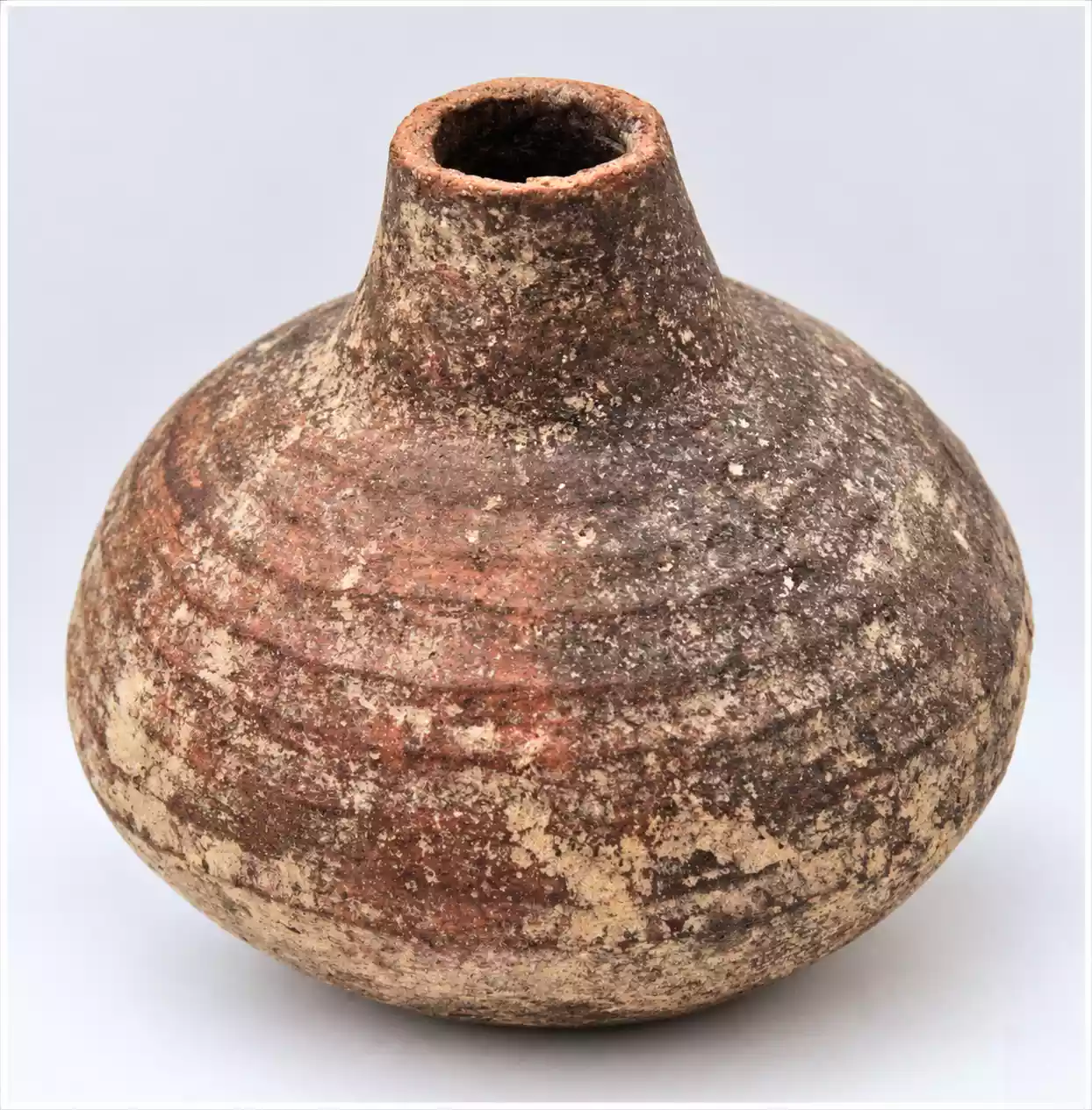
 Globular vessel with a narrow neck from Limani Pasha, between Lavrion and Sounion. Early Bronze Age (2900–1900 BC), with Cycladic influences. Archaeological Museum of Lavrion.
An old Greek handbook on ancient Hellenism, written in strict katharevousa, opens its account a long way from the Aegean. In the heart of Asia, on the Pamir plateau, there once lived, it tells us, the “noblest races” of mankind. From there two great groups set out, the Semites and the Aryans, who shared the same religious beliefs but spoke two different languages. Out of the second group, after centuries of wandering, came the “Graeco-Latin branch”, that is, the ancestors of the Greeks and the Italians.
The picture was not the invention of a Greek author. It distilled what nineteenth-century European scholarship regarded as settled. It deserves a careful look, because a genuine scientific discovery sits inside it alongside a series of assumptions that did not survive the test of time, and one of those assumptions later took a very dark turn.
The discovery that changed linguistics
Let us take things in order. In 1786 the British judge and philologist William Jones, addressing the Asiatic Society in Calcutta, observed that Sanskrit, the ancient learned language of India, resembles Greek and Latin so closely that the likeness cannot be accidental. The three languages, he concluded, must have sprung from a common source that perhaps no longer exists. A few decades later the German scholar Franz Bopp placed the comparison on a systematic footing, and comparative linguistics was born.
What exactly does this discipline compare? Not isolated words that merely sound alike, but regular correspondences of sounds and grammatical forms. Greek patḗr, Latin pater, Sanskrit pitár and English father belong to one such series. So do the numerals, the basic kinship terms, the endings of the verb. The family that emerged from this work is now called Indo-European, and it includes, among others, Greek, the Italic and Celtic languages, and the Germanic, Slavic, Iranian and Indo-Aryan languages. The old handbook’s list, with its “Brahmanic”, Persian, Greek, Latin, Celtic, “Teutonic” and “Slavonic”, is essentially correct.
The other family, the Semitic, already had a name. The term was introduced in 1781 by the German historian August Ludwig von Schlözer, who borrowed it from Shem, the son of Noah, presented in the tenth chapter of Genesis as the forefather of many peoples of the Near East. The label was thus a convention from the very start. The Semitic family includes Akkadian, the language of Babylonia and Assyria, together with Aramaic, Hebrew, Phoenician, Arabic and Ge’ez, the ancient language of Ethiopia. Among the features they share are roots of three consonants, around which words are built by alternating the vowels.
Here the old text makes a mistake worth noting. It counts the Egyptians among the peoples who spoke a Semitic language. Ancient Egyptian, first read by Champollion in 1822, is related to the Semitic languages, but only distantly. Both belong to a wider grouping that linguists call Afroasiatic, in which Egyptian forms a separate branch.
Two languages from the same plateau?
The most fragile point of the old theory is the idea that Semites and Indo-Europeans set out from the same place, with the same beliefs about God and the same traditions. The author of the handbook, to be fair, admits that he does not know how a people with a common religion came to speak two languages, nor when the migration began. The problem, however, goes deeper than a mere gap in the details.
The two families have no demonstrated common ancestor. There have been attempts to unite them in larger macro-families, the best known being the so-called “Nostratic” hypothesis, which the great majority of linguists regard as unproven. The common religion stands on even weaker ground. The Indo-European sky father, still audible in Greek Zeus patēr, Latin Iuppiter and Vedic Dyaus pitā, has no counterpart among the Semitic deities. The Pamir, finally, was one of the many makeshift answers of a nineteenth century that looked for the “cradle” somewhere in Asia, partly under the influence of the biblical image of peoples scattering from a single centre. No archaeological or linguistic evidence supports it.
The name “Aryans” and its unhappy fate
The name the age chose for the Indo-Europeans had a real historical basis. In ancient Indian and Iranian texts the speakers of these languages called themselves ā́rya in Vedic, airiia in Avestan and ariya in Old Persian, as the relevant entry of the Encyclopaedia Iranica explains. The name of Iran comes from the same root. Herodotus records that the Medes were formerly called Arioi by everyone, and in his catalogue of Xerxes’ army he also lists the Areioi, a people of the eastern Iranian lands. The Avesta, the sacred book of the Zoroastrians, speaks of Airyanəm Vaējah, the first land of the Aryans, and Indian literature of Aryavarta, the land in northern India where the Aryans dwell. Where the Avestan Airyanəm Vaējah lay, no one knows for certain. Its identification with the Pamir is conjecture.
So far we are speaking of the Indo-Iranian branch and nothing more. The nineteenth century, however, extended the name to the whole family and, worse, carried it over from languages to people. The French count Arthur de Gobineau, in his essay on the inequality of the human races, written in the middle of the century, spoke of a superior “Aryan race”. Even Max Müller, who had made the term popular, later warned that mixing linguistics with racial anthropology was a scientific blunder. The warning went unheeded. National Socialism made the “Aryan race” a central dogma, with consequences that are well known. The phrase about the “noblest races” of the Pamir in the Greek handbook belongs to the same climate, if in an innocent version.
This is why linguistics today avoids the term. It speaks of Indo-European languages and keeps “Aryan”, where it uses the word at all, for the Indo-Iranian branch. And, most importantly, a language family is not a race. Languages are handed down, adopted, abandoned. Peoples of entirely different descent may end up speaking related languages, and the reverse.
Where, then, was the homeland?
If not in the Pamir, then where? The question remains open, but the field has narrowed. Two hypotheses dominated for decades. The first places the earliest speakers of Proto-Indo-European, the reconstructed parent language, on the steppes north of the Black Sea and the Caspian, around the fourth millennium BC. The second puts them in Anatolia, at an earlier date, and links the spread of the languages to the spread of farming.
In recent years the analysis of ancient DNA has entered the debate. The study by Haak and colleagues, published in Nature in 2015, revealed a massive movement of people from the steppe into central Europe some 4,500 years ago and took it as support for a steppe origin of at least some of the Indo-European languages of Europe. The wording is cautious, and rightly so. Genes do not speak. They show who moved and who mixed, not which language was on their lips. Researchers still debate whether the original source lay on the steppe or further south, in the region of the Caucasus and the Armenian highlands.
When Greek reached the Aegean
Greek is among the earliest recorded Indo-European languages. The Linear B tablets from Knossos, Pylos and other Mycenaean centres show it already fully formed in the fourteenth and thirteenth centuries BC. Before that, the picture blurs. The language was not born in the Aegean. It arrived there at some point, and most proposals place the arrival of the first Greek speakers, or of their forebears, at the end of the third or the beginning of the second millennium BC, without any consensus.
Traces of the earlier inhabitants survive within Greek itself. Words and place names with endings such as -nthos and -s(s)os, Korinthos (Corinth), Parnassos, labyrinthos, Knossos, are regarded as a legacy of languages spoken in the area before Greek, languages we do not know today.
The genetic side of the question was illuminated by the study of Lazaridis and colleagues in 2017. According to its abstract, Minoans and Mycenaeans were genetically similar and owed at least three-quarters of their ancestry to the first Neolithic farmers of western Anatolia and the Aegean. The Mycenaeans also carried a smaller additional component, linked either to populations of the Eurasian steppe or to populations of Armenia. The authors speak of continuity but not isolation. The picture fits a language that came with relatively small groups and prevailed among a population with deep local roots, without proving it.
The vessel that accompanies this article comes, in all likelihood, from that pre-Greek world. It was found at Limani Pasha, between Lavrion and Sounion, is displayed in the Archaeological Museum of Lavrion and dates to the Early Bronze Age, with clear Cycladic influences. Even then the Lavreotiki was in contact with the islands across the water. What language was spoken by those who shaped and used this globular vessel with its narrow neck, we do not know. Most probably it was not yet Greek.


