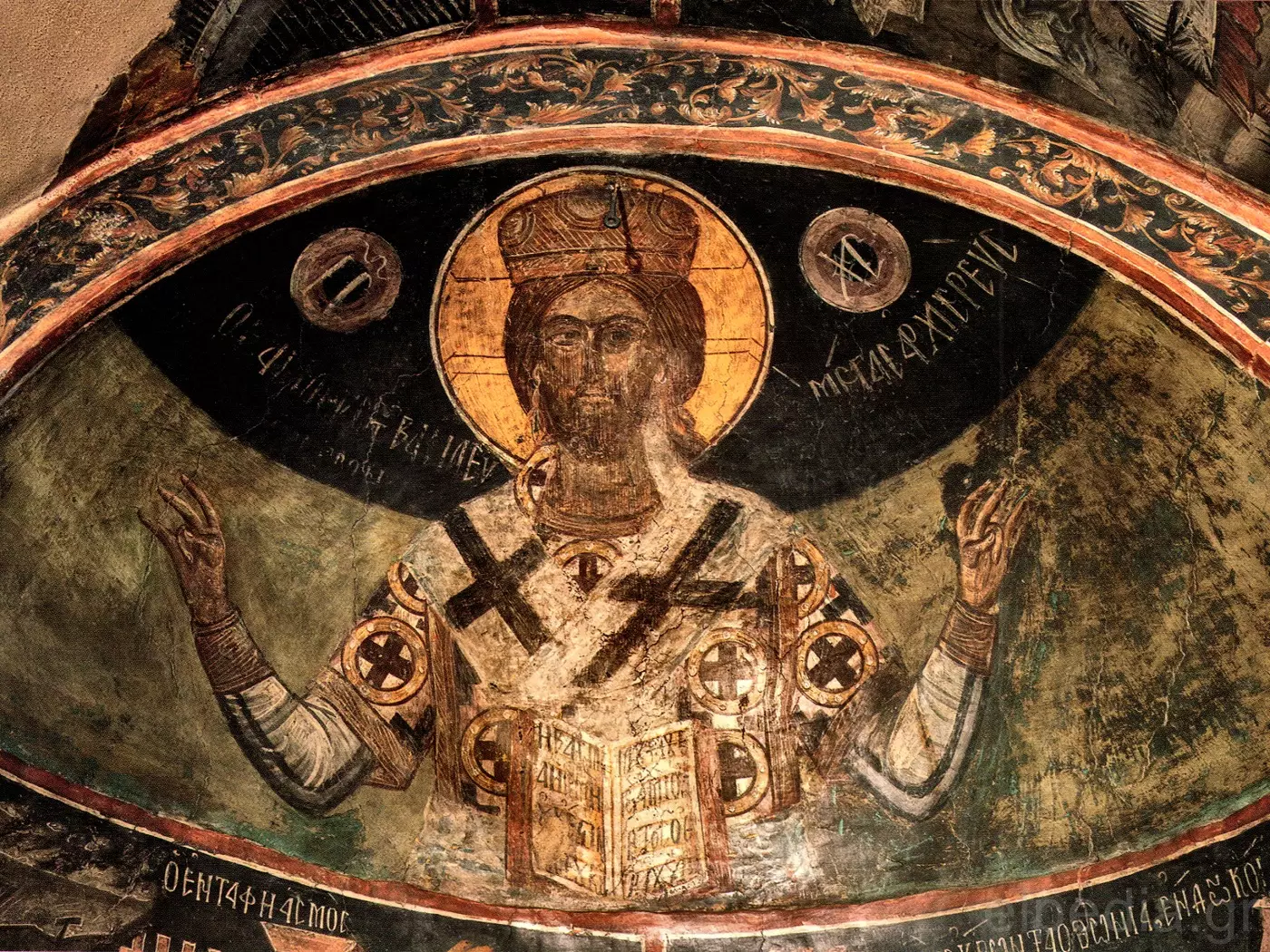
The painter Georgios Moschos, in 1620, executed within the katholikon of the Chrysapha monastery in Laconia one of the most rare compositions of post-Byzantine painting: Christ as King of Kings and Great High Priest. It is a quarter-spherical fresco within the conch of the prothesis, where the figure occupies the centre, frontal down to the waist, blessing with both raised hands. He wears the hierarchical vestments, a patriarchal sakkos embroidered with pearl-adorned circles and crosses, an omophorion with large cruciform shapes, whilst upon the head a mitre is discerned and in the ears earrings.
The monument, known today as the monastery of the Holy Forty Martyrs, is situated in the region of Chrysapha, eight kilometres from Sparta, amidst dense vegetation of holm oaks and cypresses, and is numbered among the most significant ensembles of post-Byzantine painting in Laconia. Moschos hailed from Nauplion, a city of particular economic and spiritual flourishing during the early 17th century, and together with his brother Dimitrios is numbered among the most significant fresco painters of the period. The dedicatory inscription of the church preserves his name with characteristic humility, as the ‘least of painters’, an element which was customary in the art of the epoch. The composition of the prothesis combines the royal and the priestly office of Christ in a single iconographic schema, a thing which is not frequently encountered in the monumental painting of the 17th century.
Christ the Great High Priest: Iconography and Post-Byzantine Art in the Prothesis
The figure fills almost the entire quarter-sphere. In the background, black, without any other element of landscape, only the circle of the golden halo is inscribed, emphasising by the contrast of colour the supernatural dimension of the depiction. The face, severe, with intensely delineated eyebrows and deep-set eye sockets, follows the established Byzantine type of the Pantokrator, without however the sweetness which is often rendered in other, contemporary depictions. To the right and left of the halo the monograms of the name are discerned, within circles, whilst higher up, in the dark background, extends the inscription which identifies the subject: THE KING OF KINGS, GREAT HIGH PRIEST.
The Vestments of the High Priest
The attire renders with precision the hierarchical dignity of the figure. The sakkos, heavy and rich, is covered by rows of circles with pearls which enclose small crosses, whilst the voids between them are likewise filled with cruciform shapes, creating a dense, almost fabric-like surface of decoration. Above the sakkos, the omophorion, with the large black crosses that traverse the chest diagonally, completes the image of priestly authority. The mitre upon the head, adorned itself as well, and the earrings in the ears add a note of almost imperial magnificence, an element which is not accidental in an epoch where the painter is called upon to render simultaneously the royal and the priestly dimension of the God-man.
The Open Codex
Before the figure, suspended, an open codex bears the passage from the Gospel according to John: MY KINGDOM IS NOT OF THIS WORLD (John 18:36). The selection of the passage is not decorative. It corresponds, rather, with precision to the very meaning of the composition: the kingdom which is attributed here unto Christ belongs not to the order of earthly authorities, however much the iconography borrows elements from them. The book, with its ornamented folios and painted letters, functions as the second, written declaration of the subject, in parallel with the oral, we might say, declaration of the painted inscription higher up. Alongside, in the dark partitions of the background, two further small inscriptions are discerned, illegible today, worn by time and the dampness which frequently afflicts the cavernous and semi-subterranean spaces of the ancient katholika.
The Nauplion Workshop
The execution of this composition is integrated into the broader work of a workshop which remained active for approximately forty years. Georgios Moschos, alone by 1620, as his brother Dimitrios appears to have already died, had already decorated the katholikon of the Voulkano monastery in Messenia, as well as the churches of Panagia Aimyalon and of the Dormition in Koumbari. In the same year, 1620, he painted likewise the neighbouring church of Saint Nicholas in Chrysapha.
The research which has been devoted to the workshop of the two brothers identifies influences from the painting school of Northern Greece, elements from the technique of the Cretan painters of portable icons, and also Western iconographic borrowings, a combination which does not negate, however, the severe Palaiologan character of the composition in its totality. In the same katholikon, Moschos innovated iconographically in other parts as well, such as in the rendering of scenes from the martyrdom of the very honoured saints of the monastery, an element which newer research has noted as rare for the monumental painting of the period.
The Place of the Fresco within the Iconographic Programme
The conch of the prothesis does not function in isolation within the church, but is integrated into a vast iconographic programme which covers almost the entirety of the Divine Liturgy, from the Christological cycle in the nave unto the innumerable saints, hierarchs and prophets who fill every available surface of the dome, the narthex and the walls. The figure of Christ the King and Great High Priest, exactly above the scene of the Epitaphios Threnos in the semi-cylinder of the same conch, creates a theological chain of meanings: the sacrifice of the God-man, which the prothesis recalls as the space of preparation of the Holy Gifts, is connected visually with his royal and priestly capacity, exactly above it.
The fresco is preserved today in good condition, thanks also to the conservation works which were carried out over a series of years upon the entirety of the monument, under the supervision of archaeologists of the then competent Ephorate of Byzantine Antiquities. That which survives today in the conch of the prothesis remains among the most complete examples of how a workshop of the early 17th century negotiated, with its own expressive means, an iconography which already had centuries behind it.
(Translated from the Greek text by K. Pappas.)


