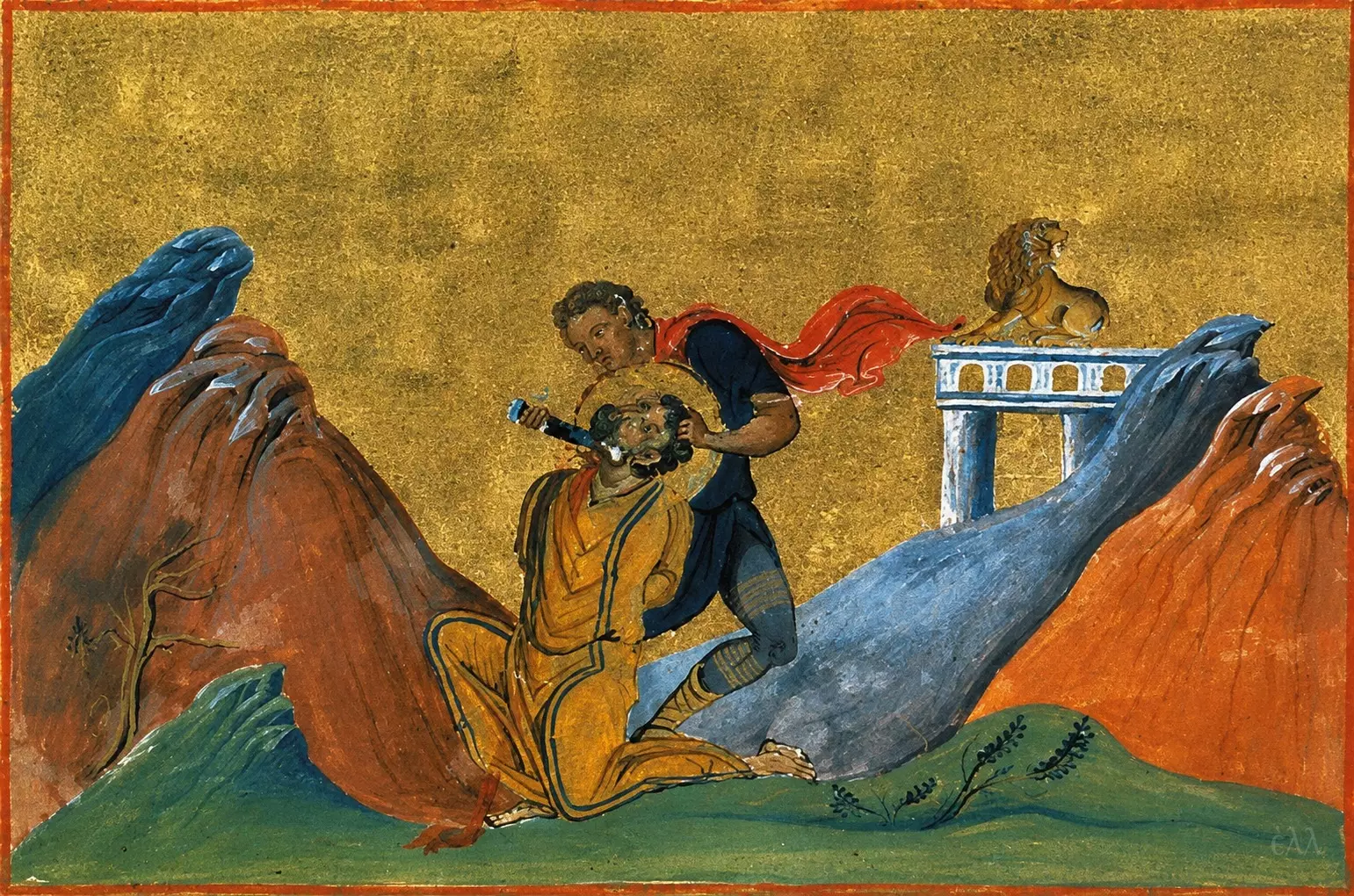
In a miniature from the Menologion of Basil II, a manuscript compiled in Constantinople around the end of the 10th or the beginning of the 11th century and now preserved in the Vatican Library, we see the final moment in the life of the Apostle James, son of Zebedee and brother of John the Theologian. An anonymous painter, a member of one of the workshops that worked for the imperial circle of the capital, rendered with spare means the scene briefly described in the Acts of the Apostles, when Herod Agrippa ordered the death of the first of the Twelve to suffer martyrdom.
This is neither a portable icon nor a church fresco. The Menologion was a liturgical book, an illustrated calendar with the lives of the saints according to their feast days, made for the emperor himself, and each of its pages combined a short text with a corresponding image. In this scene the painter organized the space between two steep mountain masses, one blue, the other tile-red, leaving a narrow valley at the center where the drama unfolds. At upper right, a small built structure with a colonnade and a lion on top discreetly alludes to the Roman authority that ordered the execution. The gold ground, with no trace of landscape beyond the mountains, places the scene outside time, in the eternity into which Byzantine understanding wished to situate every sacred figure.
Byzantine miniature art in the martyrdom of the Apostle James
Kneeling, his body turned toward the left side of the composition, James wears a chiton of deep yellow, almost ochre, beneath which a blue-green garment shows at the sleeves and lower edge. His hands are joined before his chest in a posture of prayer rather than resistance, and his head inclines slightly forward, surrendered to the moment. Behind him stands the executioner, dressed in a dark blue military-style chiton and a red chlamys that streams behind him as though to declare the momentum of the action. With one hand he grips tightly the Apostle’s hair or head covering, while with the other he brings the sword to his neck, in a gesture the painter rendered without undue harshness, almost ritually.
The green ground, sketched with a few touches of vegetation at the feet of the two figures, functions as the sole stable element amid the intense, almost abstract masses of the mountains. These mountains, with their sharp, almost crystalline peaks, do not depict any real landscape of Judea; they obey an iconographic type that Byzantine art established early on for framing scenes of martyrdom, giving the viewer a sense of isolation and dramatic tension without narrative detail. The built structure with the lion, small yet clearly visible, could refer to a public building or a symbol of imperial Rome, though its identity remains, as with so many such elements in Menologion miniatures, open to interpretation.
The episode shown here belongs to the earliest years of the Church. James, together with Peter and John, had been near Christ in moments to which other disciples did not have access, from the Transfiguration to Gethsemane. Church tradition holds him to have been the first of the Twelve to meet death for the faith, around AD 44, by order of Herod Agrippa I, as the Acts briefly record. The anonymous painter of the Menologion did not attempt to dramatize the scene beyond what was necessary; the restraint of the composition, the economy of the figures, the geometric landscape — all serve a didactic purpose, fitting for a book that was read aloud during the service, day by day, commemoration by commemoration.
The miniature technique, with a gold background and colors diluted in thin layers on parchment, follows the standards established by the capital’s painting school during the so-called Macedonian Renaissance. The figures retain proportions close to the classical tradition, with drapery that still recalls Hellenistic models, while the abstraction of the landscape already betrays a turn toward a more symbolic, less descriptive conception of space. All Menologion painting moves in the margin between narrative and symbol, and here, in so condensed a scene, one can see clearly how the artist favored the latter.


