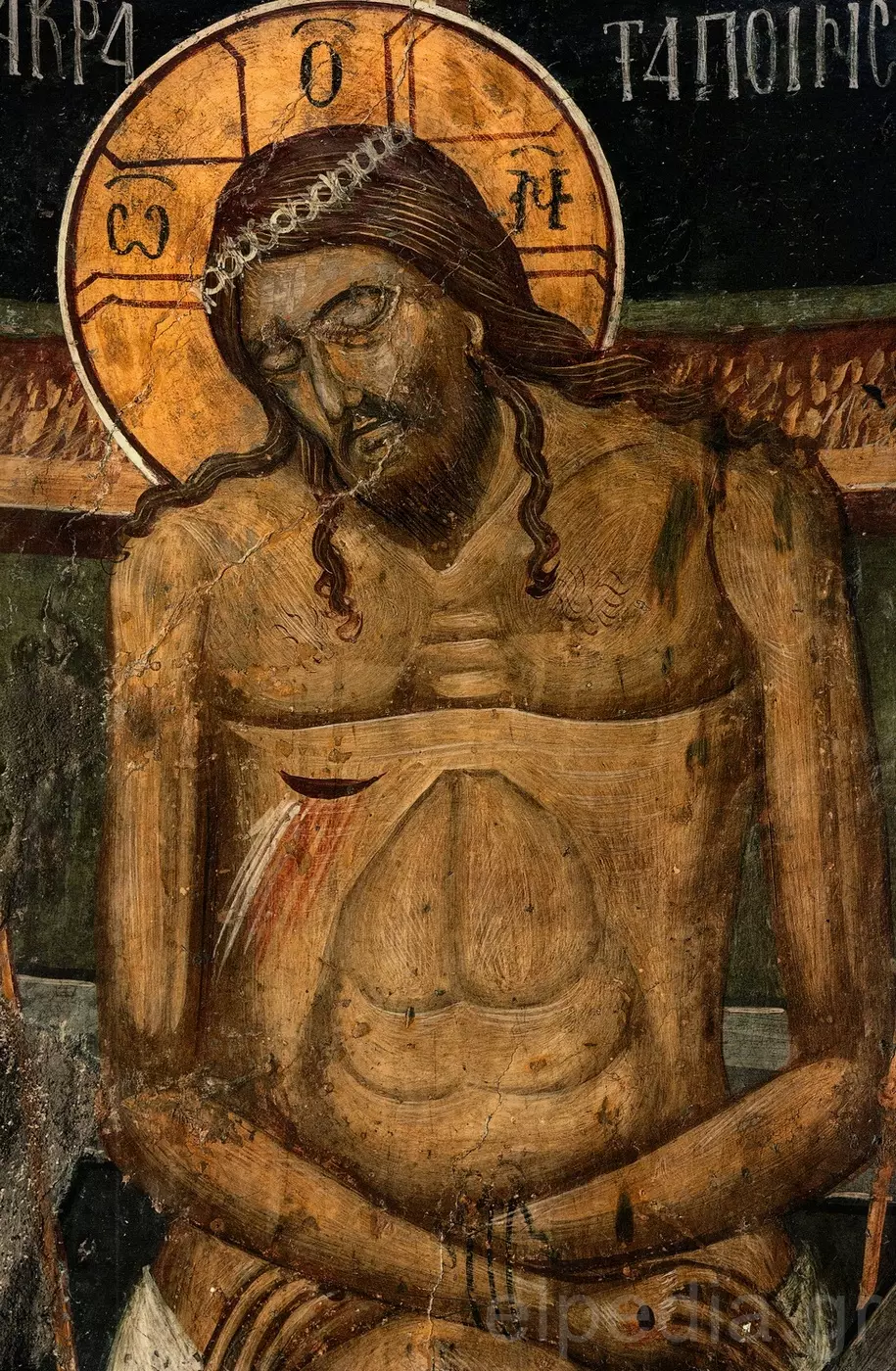
In the semi-cylinder of the conch of the prothesis, in the katholikon of the monastery of the Holy Forty Martyrs at Chrysapha in Laconia, the painter Georgios Moschos from Nafplion historified in 1620 the scene known in iconography as the Extreme Humility. It is a composition dedicated to the lifeless body of Christ, where the figure remains silent, with eyes closed, hands crossed before the body, without a cross and without a visible tomb, only the pain imprinted on the face and the naked breast. This iconographic type, known internationally also as the Man of Sorrows, was formed in Byzantine art already from the eleventh and twelfth centuries, bound to the lamentations of the Theotokos and to the service of Great Friday.
In the katholikon of the monastery of the Holy Forty Martyrs the depiction is integrated into an extensive iconographic programme which Moschos crafted together with the fathers of the monastery, among them the learned bishop of Vrestheni Parthenios, spiritual support of this monastic centre in the first decades of the seventeenth century. The figure of the painter, known today from his works in many monasteries of the Peloponnese, is closely connected to the economic and spiritual flourishing which Lacedaemonia experienced in those years, when commerce and ecclesiastical life developed in parallel under Ottoman rule. The fresco is preserved today in good condition, following a systematic conservation which revealed details hidden for decades under older overpaintings.
The Composition of the Extreme Humility: Post-Byzantine Art in the Prothesis
The body of Christ fills almost the entire visual field of the composition, from the height of the shoulders to slightly below the waist: a whitish cloth intimates, without manifesting it fully, the perizoma that covers the hips. The head leans heavily forwards, the hair falls in wavy locks upon the shoulders, while the closed eyelids and the knitted brows compose an expression that does not resemble sleep. The hands are crossed before the belly, in a gesture austere, almost geometrical, which resists every dramatisation of the moment. On the right side is discerned, rendered with austere red and white strokes, the wound of the spear, while the thoracic cage is underscored by fine lines of shadow that highlight the emaciation of the body, a thing rare in post-Byzantine painting, where Christ usually retains a more solid volume.
Behind the figure, a dark, almost black background extends over the upper section of the composition, while a narrow greenish zone demarcates the shoulders from a brownish-red surface that reaches to the base of the depiction, most probably intimating the surface of the tomb or some covering cloth. In the upper corners, on either side of the halo, there is preserved a section of the identifying inscription of the scene, with capital letters in white colour upon the dark depth, which certify the subject as the Extreme Humility. The halo itself, cruciform as befits the depiction of Christ, bears upon the three visible arms of the cross the letters Ο, Ω, and Ν, an abbreviation of the phrase “I AM” (Exodus 3:14), an inscription that steadfastly accompanies the figure of Christ throughout all Byzantine and post-Byzantine painting.
The position of the composition within the sanctuary is closely bound to its liturgical significance. The Extreme Humility is situated in the lower zone of the semi-cylinder of the prothesis, to the right of an opening that is framed on the left by the saints Blaise and Cyril of Alexandria, exactly beneath the depiction of Christ as the Great High Priest in the quarter-sphere of the conch. The prothesis, the space where the Precious Gifts are prepared prior to the Divine Liturgy, thus hosts an image that prefigures the Eucharistic sacrament itself, the body that is to be offered.
The katholikon itself where the composition was historified belongs to the so-called Athonite architectural type, with a dome, a four-columned cruciform core, and two lateral choirs that impart to the edifice a triconch aspect on the exterior. The monastery is built amidst dense vegetation and massive rocks, some eight kilometres from Sparta, in a location that favoured hesychasm and the monastic life for centuries, while the original, older monastery, known today as the Palaiomonastiro, is situated slightly further north, within a cavernous configuration of the same rock. This inaccessible location served precisely this hesychasm. The technical execution follows the customary practices of mural post-Byzantine painting: a design incised upon the damp plaster, basic colours of ochres and iron oxides for the flesh, black from charcoal or soot for the deep shadowings, and a layer of white lime for the luminous tonal elevations on the face and hands. The fine, almost calligraphic lines that demarcate the muscles and the bones of the thorax betray a painter habituated to linear sketching, a tradition that traces back to the workshops of sixteenth-century Crete and which Moschos appears to have known well, even if there survive no elements of his direct training there.
The Visage of Christ: Detail of Expression in Post-Byzantine Art
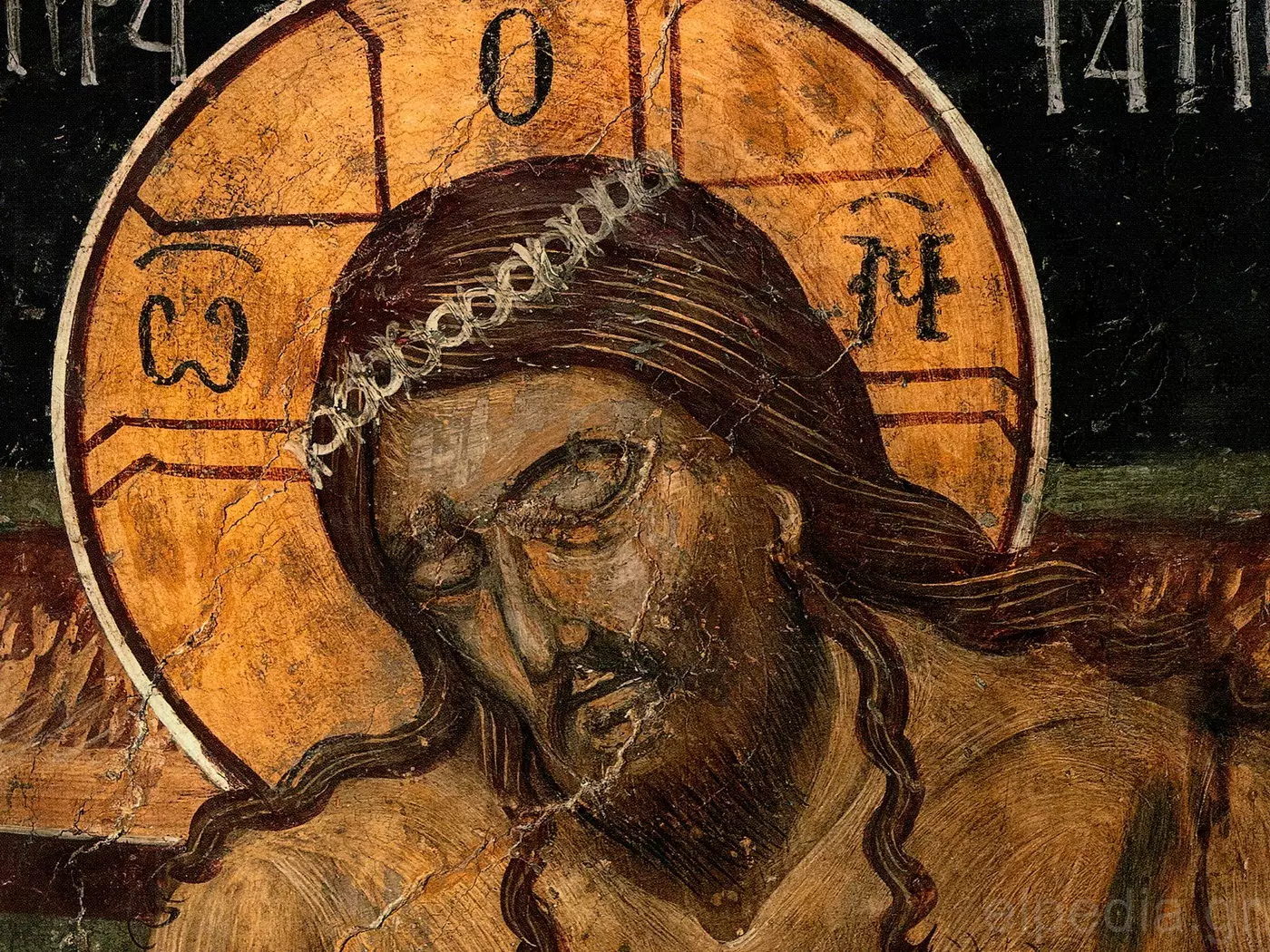
In a closer view, the face reveals elements that in the totality of the composition easily escape notice. The curls of the hair are rendered with fine, almost linear strokes in dark brown, while on the lower part of the face the beard, short and bifurcated, follows the prototypes established by the early Christian and Byzantine iconography of Christ already from the fifth century onwards. The nose is long and fine, the cheeks hollowed, the mouth small and compressed. The sum of the features composes an image of weariness rather than of agony, a thing that slightly differentiates this composition from more intense renditions of the same subject in other monuments of the epoch.
On the surface of the fresco are discerned cracks that traverse vertically the face and the halo, traces of the decay of time and of the humidity that tormented this rocky edifice for centuries, without however having severely altered the painted surface. With difficulty would one say whether this tranquillity in the face is silence or absence, a final repose or merely the moment before something else.
The Painter Georgios Moschos and the Post-Byzantine Art of Laconia
Georgios Moschos, together with his brother Demetrios, originated from Nafplion and was active as a painter of frescoes from 1606 until at least 1638, leaving his name in monuments scattered throughout the Peloponnese and the Ionian Islands. In the foundational inscription of the katholikon of the Holy Forty Martyrs he self-identifies as the “least of painters”, a customary expression of humility of the epoch, which however does not negate his technical ease nor his capacity to organise so extensive an iconographic programme. Nafplion, the homeland of the painter, maintained strategic significance already from the Byzantine period thanks to its port, passed successively into the hands of Frankish, Venetian, and Ottoman overlords, and was consolidated, in the sixteenth and seventeenth centuries, as one of the most important commercial and spiritual centres of the Peloponnese. Works of his survive also in the katholikon of the monastery of Panagia Aimyalon and in that of the Dormition of the Theotokos in the monastery of Voulkano, while together with his brother he also painted the church of Saint John of the Logothetai in Zakynthos, elements that compose the picture of a workshop with a stable and recognisable style throughout southern Greece of the early seventeenth century.
The monastery where Moschos laboured belonged already prior to 1592 to the stauropegic jurisdiction of the Ecumenical Patriarchate, a fact that rendered it independent from the local ecclesiastical authority and bound it directly to Constantinople. This status, in combination with the presence of learned monks such as Parthenios, explains in part the rich and theologically complex iconographic programme that adorns the katholikon, a programme where beside the classical scenes of the Dodekaorton there coexist rarer depictions, such as the prayer of Basil the Great or the translation of the relics of John Chrysostom.
As an iconographic type, however, the Extreme Humility was not born at Chrysapha nor in the seventeenth century. Its oldest known depiction is located on a double-sided icon of the twelfth century from Kastoria, while its connection with the lamentations of the Theotokos and with the liturgical practice of Great Friday constituted the subject of fundamental research by Hans Belting in the 1980s. Through Venice and Crete, where the commercial circulation of portable icons was particularly vibrant, this type travelled towards the West and inspired the “Imago Pietatis” of Italian and Northern European painting, one of the most disseminated subjects of devotional contemplation in the late medieval and early Renaissance art of Italy. In the National Gallery of London there is preserved indeed a painting of the late fourteenth century, attributed to a Venetian workshop with clear Byzantine origins, where the dead Christ is depicted standing upright within the open tomb, with the hands crossed and the gaze closed, in a manner that strongly recalls the composition at Chrysapha. Venice, thanks to her close commercial ties with the Greek realm, thus functioned as a bridge between two worlds of painting that are frequently studied apart, the Byzantine and the Western. At Chrysapha, four centuries later, Moschos does not invent something novel, but rewrites, with his own palette, an image that had already crossed the Mediterranean many times.
In 1879, during the abbacy of Paisios Zacharakopoulos, the Cretan hierodeacon Georgios Kalliterakis undertook the overpainting of several figures in the katholikon, following damages that had been provoked by earthquake and fire. In the conch of the prothesis his intervention was limited, and the Extreme Humility preserved to a great degree the hand of the seventeenth century, as was confirmed also by the systematic conservation of the frescoes that was realised between 1985 and 2004, under the supervision of the then 5th Ephorate of Byzantine Antiquities, with the conservators Theodoros Vachaviolos and Panagiotis Totsis. During the course of these works the newer overpaintings were removed in several places, a fact that permitted scholars to discern with greater clarity the original hand of Moschos, particularly in the faces and in the flesh of the figures. Today, within this rocky katholikon, this figure of the pained Christ remains in the same place where Moschos painted it four hundred years ago, with the fissures of time still visible upon its face.
(Translated from the Greek text by K. Pappas.)


