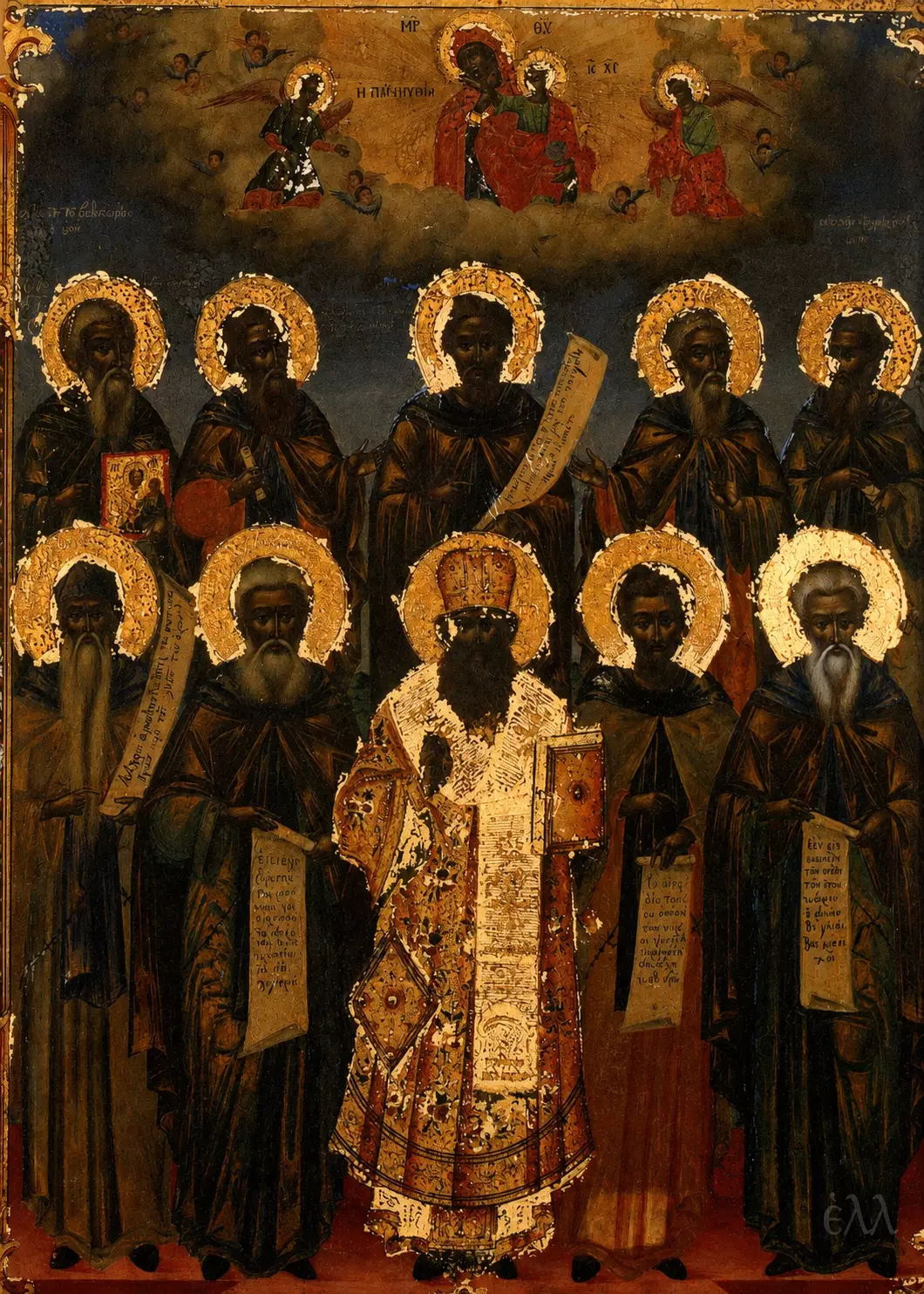
Ten monks in two rows and a hierarch at the center, larger in scale than the rest, make up the composition of this portable icon preserved at the Holy Monastery of Vatopedi on Mount Athos and dated to the 19th century. The inscription at the top of the panel names the whole assembly the Vatopedi Saints, that is, those ascetics whom the monastery’s monastic tradition associates with its history, governance, and spiritual identity—a gathering that the brotherhood itself honors each year with a special service. In the upper part of the composition, among dense clouds, the Mother of God dominates with Christ in her arms, flanked by two winged archangels turned toward her in supplication, while small angelic heads scattered across the background complete the celestial zone of the scene. The two lower rows contain the monks, dressed in dark hermitic mantles, most of them with white or grayish beards, each face encircled by a halo. Among them, the hierarch stands in full episcopal vestments, holding a closed Gospel Book, a detail that immediately sets him apart from the austerity of the other figures.
The composition of the icon of the Vatopedi Saints
In the background of the heavenly section, the familiar abbreviated forms MP THY beside the Virgin and IC XC beside the Christ Child can still be read, though faintly now—inscriptions that icon painting reproduced almost unchanged for centuries. The two angels, with wings spread and garments in vivid red and green, do more than frame the scene; they incline toward the center, hands raised in prayer, as though interceding themselves in the heavenly assembly unfolding above the figures below. Between and around them, small winged heads, colored in ochres that are almost lost in the deep gray-blue of the ground, thicken the sense of divine multitude without claiming an individual presence.
In the first row of monks, the figure at the far left holds in his hands a small icon of the Mother of God, a gesture that signals particular devotion to the Mother of God and functions, at the same time, as an image within the image. The man beside him carries in his palm a dark, round object, perhaps a skull, one of those reminders that ascetic tradition associated with the continual contemplation of death. In the center of the same row, an open scroll with verses now barely legible testifies to the monks’ familiarity with the written word, while the last two stand with their hands joined, in a posture of prayer that requires no further explanation.
Around the hierarch the second, lower row is organized; he is larger in scale, as the hierarchical perspective of Byzantine and post-Byzantine art required, where size signified importance rather than distance. He wears a white omophorion with black crosses over a rich sakkos in deep red and gold, adorned with flowers and geometric motifs, while on his head he bears an official mitre in the form of a crown. In his hands he holds a closed Gospel Book with a precious cover, symbol of his teaching office. To right and left of him, four more monks, with white or gray beards, hold unfurled scrolls on which fragmentary letters can be discerned, though they do not allow for continuous reading.
Post-Byzantine art and monastic identity
This icon belongs to a long Athonite tradition of visual narration of local sanctity, in which each monastery assembled its own pantheon of figures who had passed through its corridors and cells. The post-Byzantine art of the 19th century, less rigid in its rules than Palaiologan painting but faithful to its basic models, preserved the convention of the two symmetrical rows, the unified color field of the background, and the golden illumination of the halos—features that reach back centuries, to the monumental compositions of Byzantine churches.
Among those honored are usually included the three founders of the monastery, ascetics from Thrace who settled on Athos in the 10th century, as well as later abbots, elders, and teachers of the monastic life, whose memory remained alive in the oral and written tradition of the brotherhood. To this day the monastery celebrates their synaxis with an all-night vigil and a festal liturgy; a fact that explains why such an icon, without any prominent artistic signature, was executed with such care for their common remembrance.
The anonymous painter did not seek innovation. He copied, in the manner of generations of icon painters before him, a composition that had to remain recognizable to every monk who would stand before it, knowing each face one by one, almost as he would recognize the faces of his own brotherhood.


