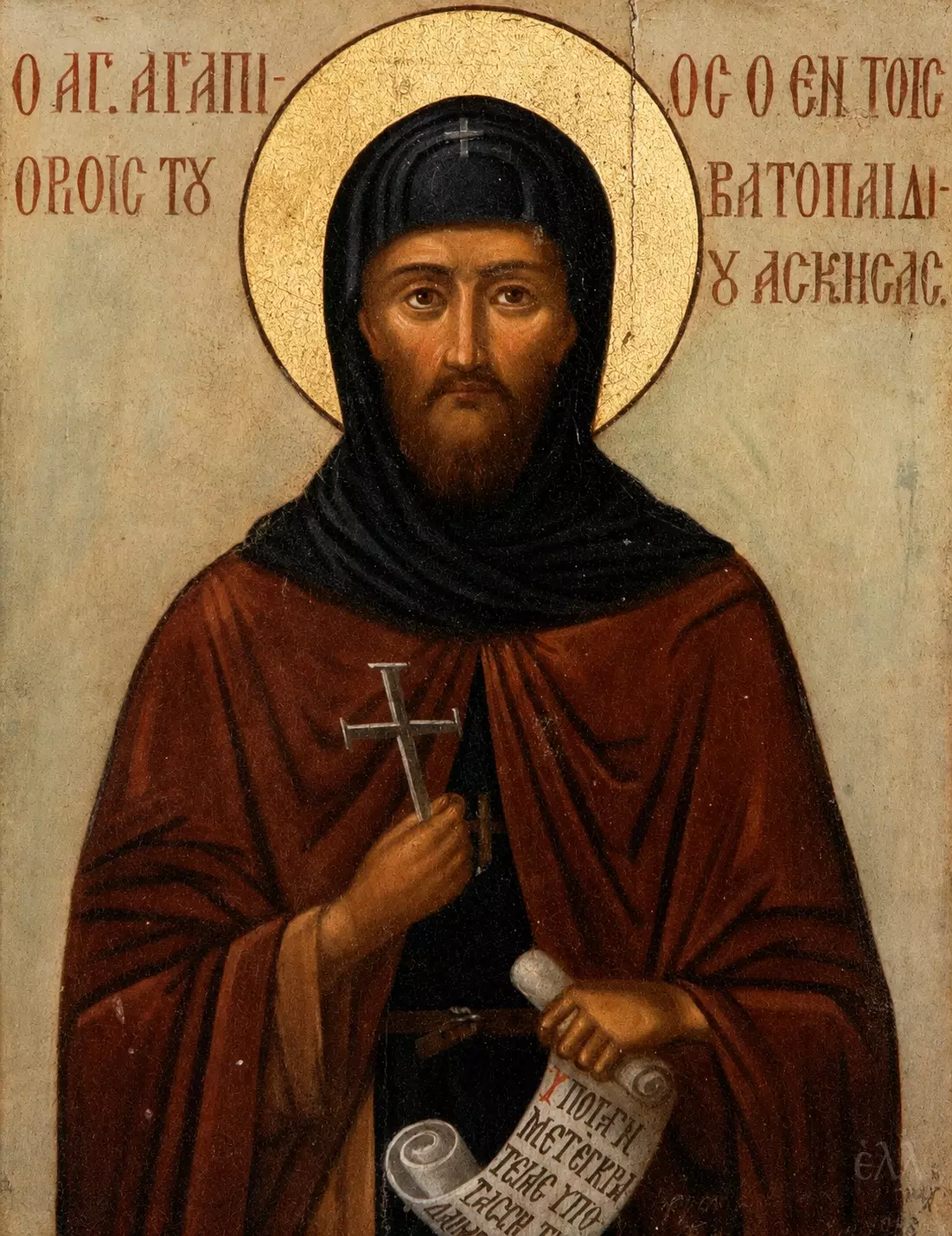
An ascetic figure, possessing a full beard and a gaze submerged in silence, forms the subject of this portable icon preserved at the Holy Monastery of Karakallou on Mount Athos, dating to 1943. It portrays Venerable Agapios of Vatopedi, a monk who according to tradition practiced asceticism within the precincts of the Monastery of Vatopedi, as explicitly declared by the inscription framing his nimbus. The iconographer, whose name has not been preserved, faithfully adhered to the post-Byzantine hagiographic tradition of Mount Athos—a style that, even well into the twentieth century, persisted in reproducing the archetypes of earlier centuries with only subtle variations. The venerable saint’s face is rendered with linear austerity and an introversion recalling the models of earlier workshops, while the reddish hue of the mantle, set against the deep dark tone of the cowl, generates a chromatic tension typical of Athonite ateliers. This icon stands as testament to the continuity of local monastic memory; through such compositions, monasteries kept alive the memory of figures who lacked broader Pan-Orthodox recognition yet remained key touchstones for this distinct geographical and spiritual realm of Athos.
The Iconographic Composition of Venerable Agapios of Vatopedi
Concealed almost entirely by the black cowl—save for a section of the forehead—the monk’s face dominates the composition, encompassed by the golden nimbus that stands behind him almost as an independent geometric presence. Dark and slightly asymmetrical in their execution, the eyes gaze directly at the viewer stripped of dramatic intensity; it is a look that asks for nothing, merely present. The beard, chestnut with reddish highlights along its fringes, descends thick to the chest, while upon the forehead one discerns the cross embellishing the inner lining of the cowl, a detail highlighting the distinct monastic habit of Athonite ascetics.
In the second depiction on the same icon, the figure is shown at greater length to reveal the hands. The right hand grips a small metallic cross between its fingers—a symbol signifying spiritual authority and the anchorite’s union with the divine—while the left holds a rolled scroll, partially unrolled, displaying an inscribed text that unfortunately cannot be read in its entirety. The cloak, executed in a deep reddish brown, falls in geometrically rendered folds, as was customary in Athonite workshops that disdained overly naturalistic volumetric modeling. Across the chest, a vertical white band of fabric—perhaps part of an inner tunic or an analavos—introduces a visual respite to the cloak’s monochrome expanse.
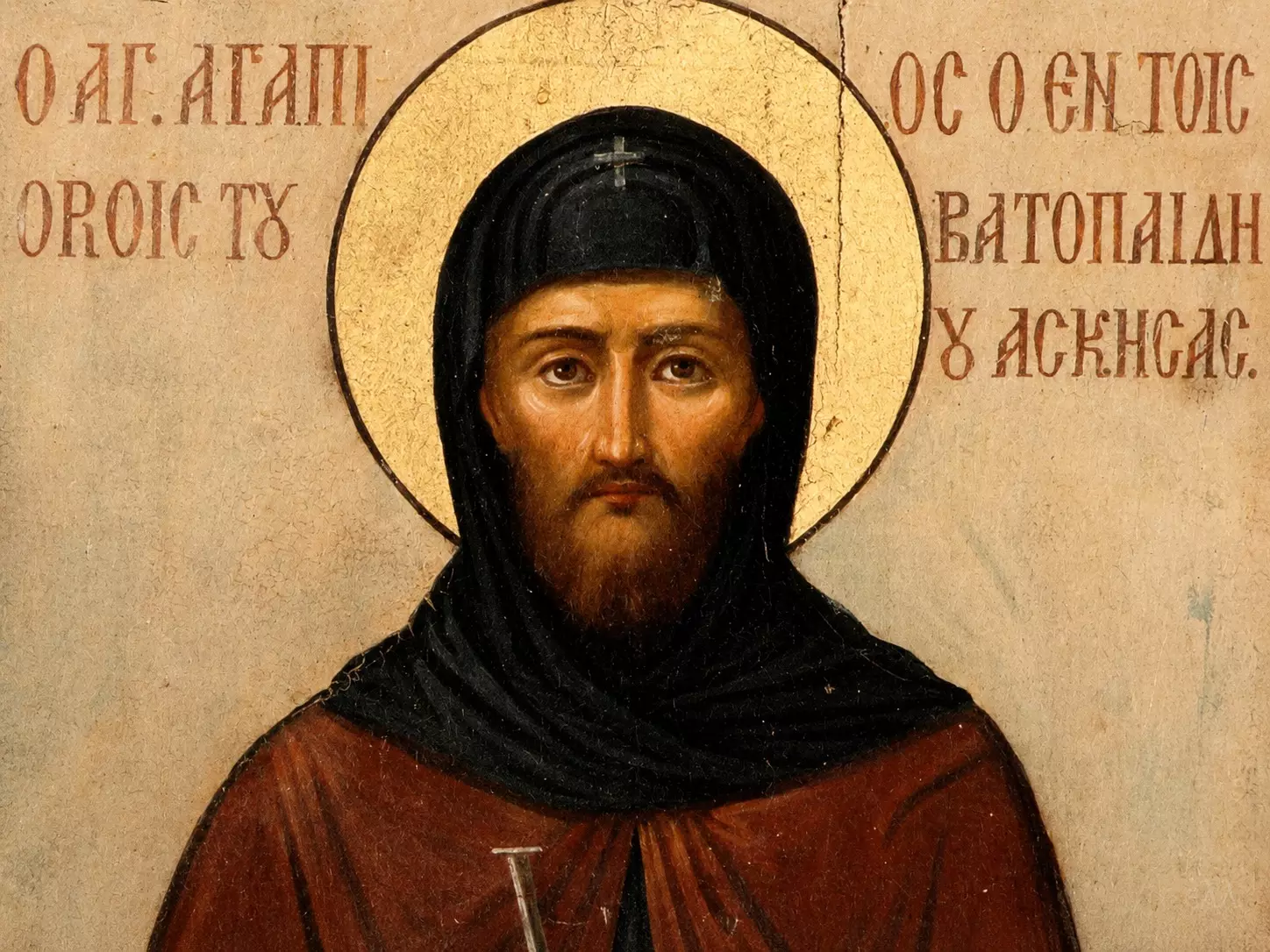
The inscription surrounding the figure, executed in red majuscule lettering, states that this is Venerable Agapios, who pursued the ascetic life within the boundaries of the Monastery of Vatopedi. This wording is significant because it explicitly anchors the revered monk within a specific geographical and monastic context, a detail frequently omitted in broader hagiographic compositions. Inscriptions of this nature served as identification for faithful who might not otherwise recognize which venerable saint was depicted, particularly in the case of figures whose veneration remained purely local. The use of majuscule letters featuring slightly archaic epigraphy aligns with the broader tendency among Athonite workshops to maintain visual continuity with earlier Byzantine script traditions, even in works produced during the twentieth century.
What renders this composition particularly compelling is not merely its technical execution, but the precise moment of its creation. In 1943, Mount Athos, like the rest of the nation, endured the hardships of war and occupation; yet monastic workshops persevered without interruption, producing icons faithful to tradition. This persistence stands in itself as evidence of how religious art functioned independently of historical vicissitudes, preserving its own internal continuity.


