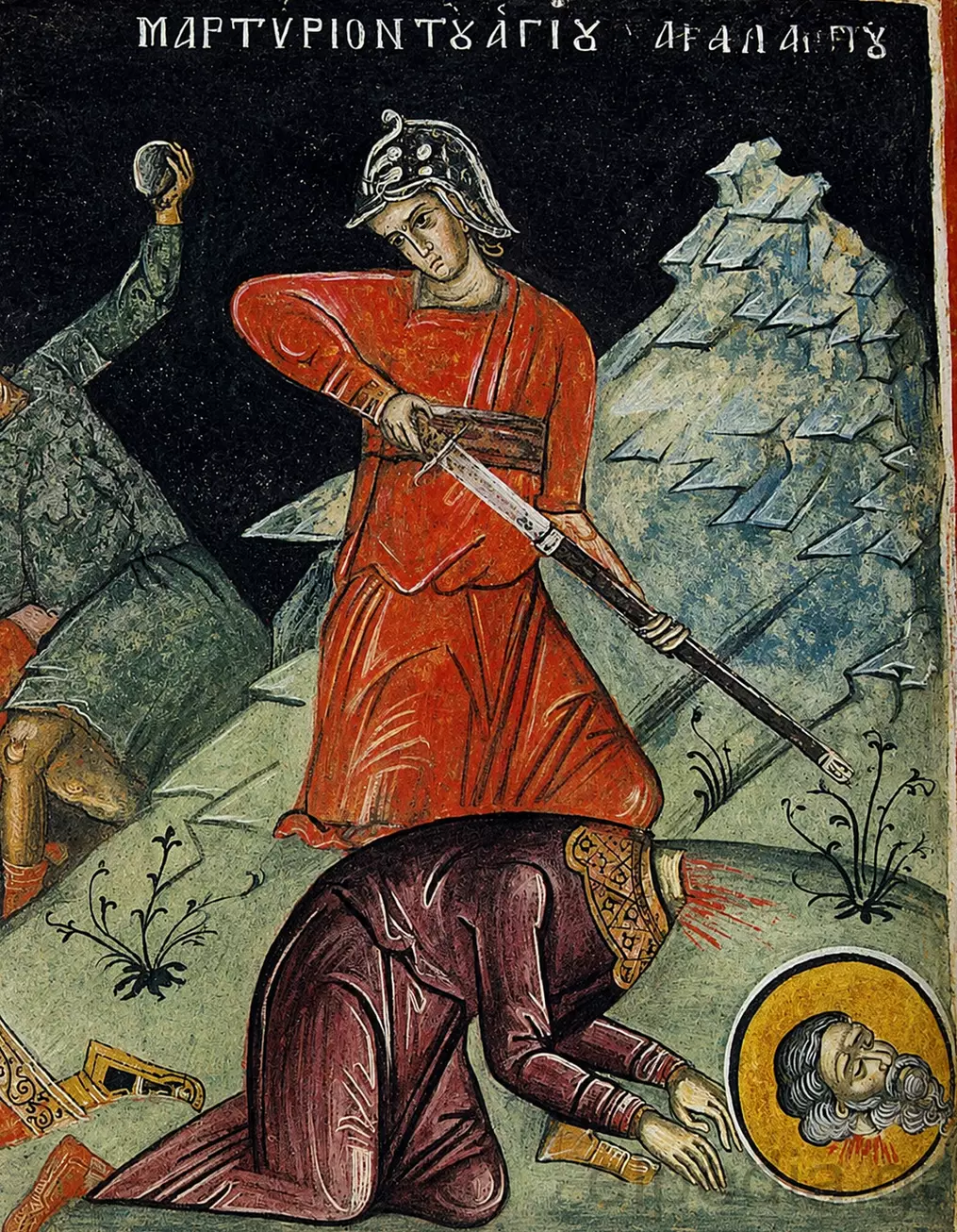
The fresco that covers part of the catholicon at the Holy Monastery of Dionysiou, on Mount Athos, is dated to 1547 and is attributed to the Cretan painter Tzortzis, a pupil of Theophanes Strelitzas-Bathas. An armed man with a pointed, metal-coloured helmet stands over a kneeling, headless body, at the moment immediately after the blow that completed the martyrdom of the priest Charalambos, born in Magnesia of Asia Minor. Red cloth clothes the executioner, while a deep purple colour covers the fallen body of the victim, a contrast of colours that the Cretan school of the sixteenth century cultivated with particular insistence.
The same monastery, with the fourteen chapels it possesses scattered throughout the complex and its enclosure, houses similar iconographic cycles dedicated to martyrs of the early Church, as is recorded also in the study on the All Saints chapel. According to later tradition, Charalambos was born around 90 AD and served as a priest in Magnesia in the years of the persecutions under Septimius Severus, before being arrested by order of the eparch Lucian and led, in deep old age, to the martyrdom that this composition depicts. The visual narrative does not confine itself to the moment of execution, since in the background, amid stars and rocky masses, a second figure may also be discerned undergoing a similar punishment, an element that broadens the theme beyond the hieromartyr himself.
The Fresco of Saint Charalambos in the Post-Byzantine Art of the Cretan School
Tzortzis, to whom the greater part of the fresco ensemble of the catholicon of the Monastery of Dionysiou is attributed, follows the language that his teacher Theophanes had already shaped, without copying it slavishly, as more recent research on the painted decoration of the monastery has shown, research that places the whole of the work around 1546 to 1547. Elongated figures, luminous reds, rocky landscapes in angular masses: the vocabulary of the sixteenth-century Cretan school, a painting that inherits the Palaiologan tradition and carries it, after the Fall, into the monasteries of Mount Athos. Post-Byzantine art, here, reworks with intensity what already existed, without needing new forms.
The Executioner, the Helmet, and the Sword
Dominating the centre of the composition is the figure of the executioner, with a helmet of metallic, pointed projections arranged in rows. His red tunic opens into rich folds about the legs, while with his right hand he grips the hilt of a long sword that descends diagonally towards the kneeling body. His gaze does not meet his victim. He looks elsewhere, as though the deed were already finished.
The Body of the Hieromartyr and the Halo
The body of Charalambos occupies the lower part of the composition, wrapped in a deep, dark red garment with a gold-embroidered element at the level of the hip, a trace of his priestly office, given that Charalambos was a priest in Magnesia and not a simple believer, a fact that also explains his later veneration as a protector against infectious diseases. Kneeling, with shoulders bowed and without a head where one would expect to find it, the body leaves one hand touching the ground, while a thin red line marks, without insisting, the point of the blow. In the corner, within a golden medallion, the head of the hieromartyr remains alive, with a rich beard and a calm gaze, cut off from the violence the body suffered and admitted now to another order of images, that of the saints whom the halo recognises independently of what happened to their flesh. Two images of the same person, two times, one fresco.
The Rock, the Stars, and the Second Punishment
In the background, amid stars scattered upon a black sky, there rises a rocky mass in blue-green hues, built up of angular planes that Byzantine and, afterwards, post-Byzantine painting preferred in order to suggest the landscape without copying it realistically. On the left, half-hidden, a second figure has already collapsed to the ground, with a green garment and red footwear visible beneath her body, while above her a hand rises holding a stone. This parallel punishment is not further explained within the fresco itself, yet its presence recalls that martyrdom, within the iconographic programmes of the Athonite monasteries, rarely concerns one single person.
At the upper part of the composition, within the black depth of the night sky, an inscription in white capital letters names the scene, Martyrion of Saint Charalambos. Without this written identification, one would scarcely recognise, from the depiction alone, who exactly it is that kneels beneath the sword.
(Translated from the Greek; translation by K. Pappas.)

