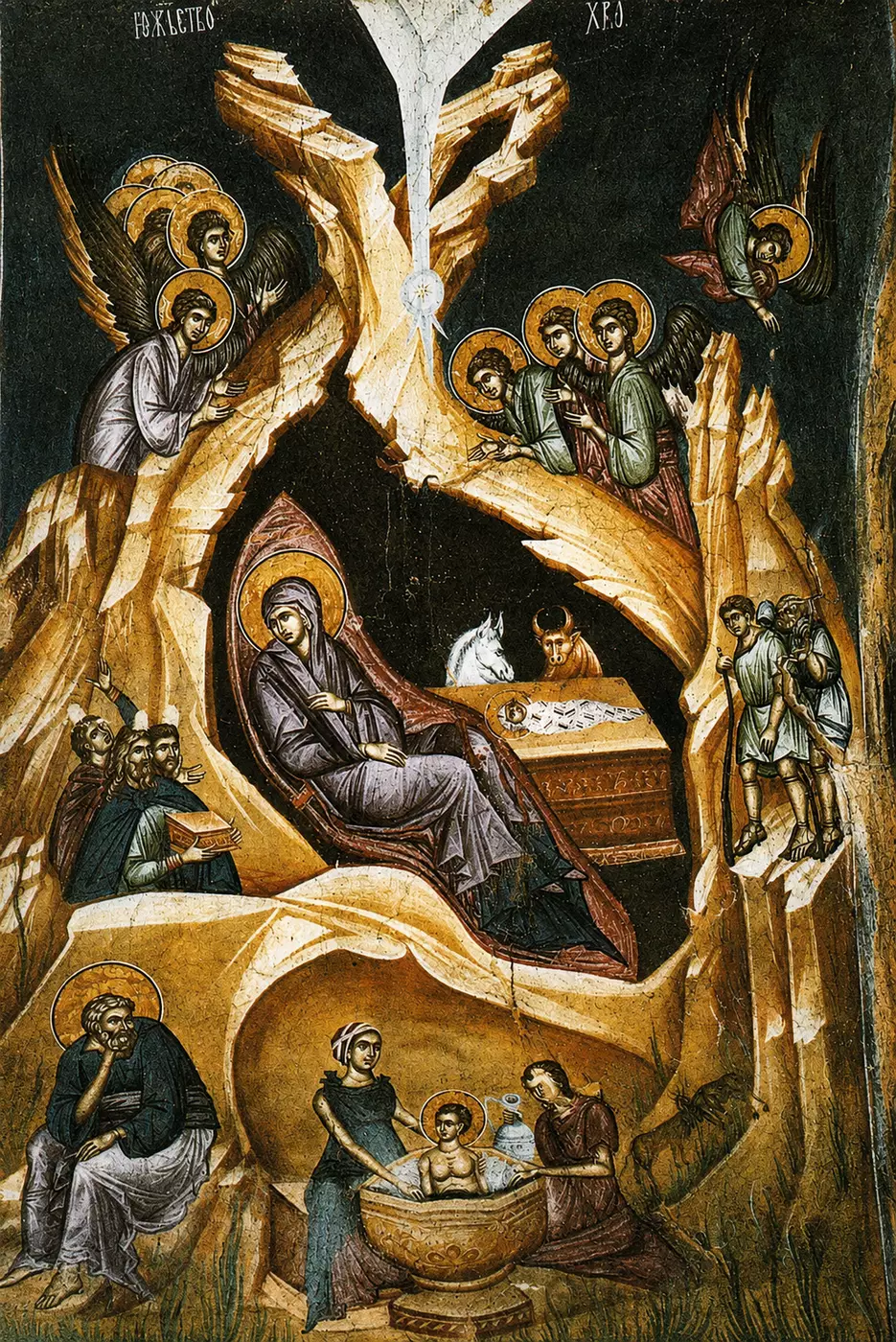
The fresco of the Nativity of Christ, executed around 1335 in the church of the Panagia Hodegetria, within the monastic complex of the Patriarchate of Peć, in present-day Kosovo, belongs to that generation of monumental ensembles by which Byzantine art passed beyond the borders of the empire and took root in the Orthodox lands of the Balkans. The church was built around 1330 by Archbishop Daniel II, beside the older church of the Holy Apostles, and its painted decoration was completed a few years later by artists who, judging by their accomplished command of the Palaiologan idiom in drawing and in colour, appear to have trained alongside major Greek workshops. The inscriptions above the scene were written in Old Serbian, yet the iconographic programme remains faithful to solutions that had been established centuries earlier in Constantinople and in Thessalonica.
The scene extends across three interlinked zones, from the starry sky down to the foot of the rock, following an iconographic tradition of the Nativity that combined gospel passages with elements drawn from apocryphal texts, a practice already customary from the earliest centuries of Christian art. The result is not to be read merely as a religious composition. It functions, above all, as testimony to how the painterly language of a great centre was carried, adapted, and spoken anew in a church thousands of kilometres from its birthplace.
The Nativity fresco in the cave of Bethlehem
At the summit of the composition two immense wings rise like a torn sail, forming an arch through which a white ray descends vertically as far as the cave, a reminder of the star that guided the travellers from the East. Nothing here is accidental or decorative. This geometry, which the painter repeats in many of its contemporary monuments, translates into visual form the very moment of theophany, that rupture between heavenly and earthly time which the hymnography of the feast attempts, in its own ways, to explain.
On the left, three angels with their wings still half-open bend their gaze towards the depth of the rock, the hand of the first raised in a gesture of wonder. On the right, a denser group of four figures repeats the same movement, with a more intense and hurried inclination downward. Higher still, in an isolated corner, an angel flies alone, wings open to their full span, ready, one might think, to depart towards the shepherds in the fields.
Above their heads a portion of the original inscription can still be made out, written in Old Church Slavonic, the remnant of a phrase that the ravages of time have cut in half. A small detail, perhaps, yet it recalls that the workshop which painted Peć was not writing for Greek-speaking readers, however much its painting still spoke the Palaiologan language of Constantinople.
At the centre, within an almond-shaped opening recalling a small cave within the greater one, the Virgin lies upon a red, heavily folded mattress, her hands crossed upon her breast. She does not look at the infant. This turning away, elsewhere almost imperceptible, becomes programmatic in this composition, since the painters of the period preferred a Theotokos who is weary, absorbed in her own thought, almost detached from the very event she had brought into the world.
Behind her, within the darkness of the cave, the heads of the ox and the ass can be discerned bowed over the manger, animals that no gospel names but that tradition has held fast in the scene, borrowed from a verse of Isaiah concerning the ox that knoweth its owner and the ass that knoweth its master’s crib. The rock around them is not rock in the natural sense of the word. It is a series of sharp, gilded masses rising in layers, a convention of landscape that seeks not at all to appear real, but only to sustain, through its line, the weight of the figures.
The colour, throughout this whole extent, moves between a few, carefully calculated contrasts. A deep green-grey covers the night sky, a background which the ravages of time have left bare in places down to the original plaster. Above it, the gilded ochre of the rocks gleams with a warmth that is almost metallic, while the garments of the figures maintain a more restrained scale, white and blue-green on the angels, deep red and dark lead-grey on the Virgin. This is not an ensemble rich in shades. Its strength lies elsewhere, in the manner whereby a few colours, well placed, suffice to hold upright so populous a narrative.
The Doubt of Joseph: a human element in Byzantine art
Low on the left, isolated from the rest of the composition, sits an old man with a long beard, his chin resting upon his hand, his gaze lost somewhere outside the scene. It is Joseph. His posture is not a chance choice of the painter, but belongs to an iconographic type which scholarship calls the “Doubt of Joseph”, based on apocryphal texts in which the betrothed doubts what he hears concerning the conception. Beside him, a second old man, wrapped in a heavy mantle, sits stooped, almost in dialogue with him, a presence which tradition has often read as the personification of doubt itself.
Nothing heretical shows through behind this detail. The theology of the fourteenth century had already learned to coexist with human doubt, to place it somewhere at the margin of the image, without denying it, and Byzantine art found here a way to give flesh to this disquiet without disturbing the doctrine.
The bathing of the infant and the midwives of tradition
In the lower part of the composition an entirely different scene unfolds, with its own rules of narration. Two female figures attend to the infant within a round basin. One tests the temperature of the water by dipping in her hand, the other holds a vessel ready to add water. These midwives are nowhere mentioned in the canonical gospels.
They derive from the Protevangelium of James, a second-century text which ecclesiastical tradition never recognised as canonical, but which painting embraced at once, perhaps because it offered the Nativity something the official narrative lacked, a tangible, everyday care surrounding the body of an infant. Flesh, water, the body of an infant who feels cold and is washed like any other infant in the world.
On the right, along a precipitous path, a small group descends towards the cave, first among them a young shepherd carrying an animal upon his shoulders. The image recalls, without of course openly claiming it, the ancient Kriophoros, that youth with the lamb upon his shoulders whom Greek art painted centuries before Christ and whom more recent scholarship has repeatedly linked to the genealogy of Christian iconography. On the left, three more figures hold closed books, their hands raised towards the angels, as witnesses to a prophecy that has just been fulfilled before them, perhaps an echo of the Old Testament predictions which the iconography of the Nativity almost never fails to recall.
Three zones, then, from heaven down to the water of the bath, with none of them overshadowing the other. Whoever stands today before this wall at Peć sees a world organised with an almost mathematical rigour, filled at the same time with small, human fissures. An ox that knows, an old man who doubts, two women who wash a child as though he were any other infant in the world, at the edge of a rock which painting has clothed in gold so that it should not resemble rock.
(Translated from the Greek text; translation by K. Pappas.)

