
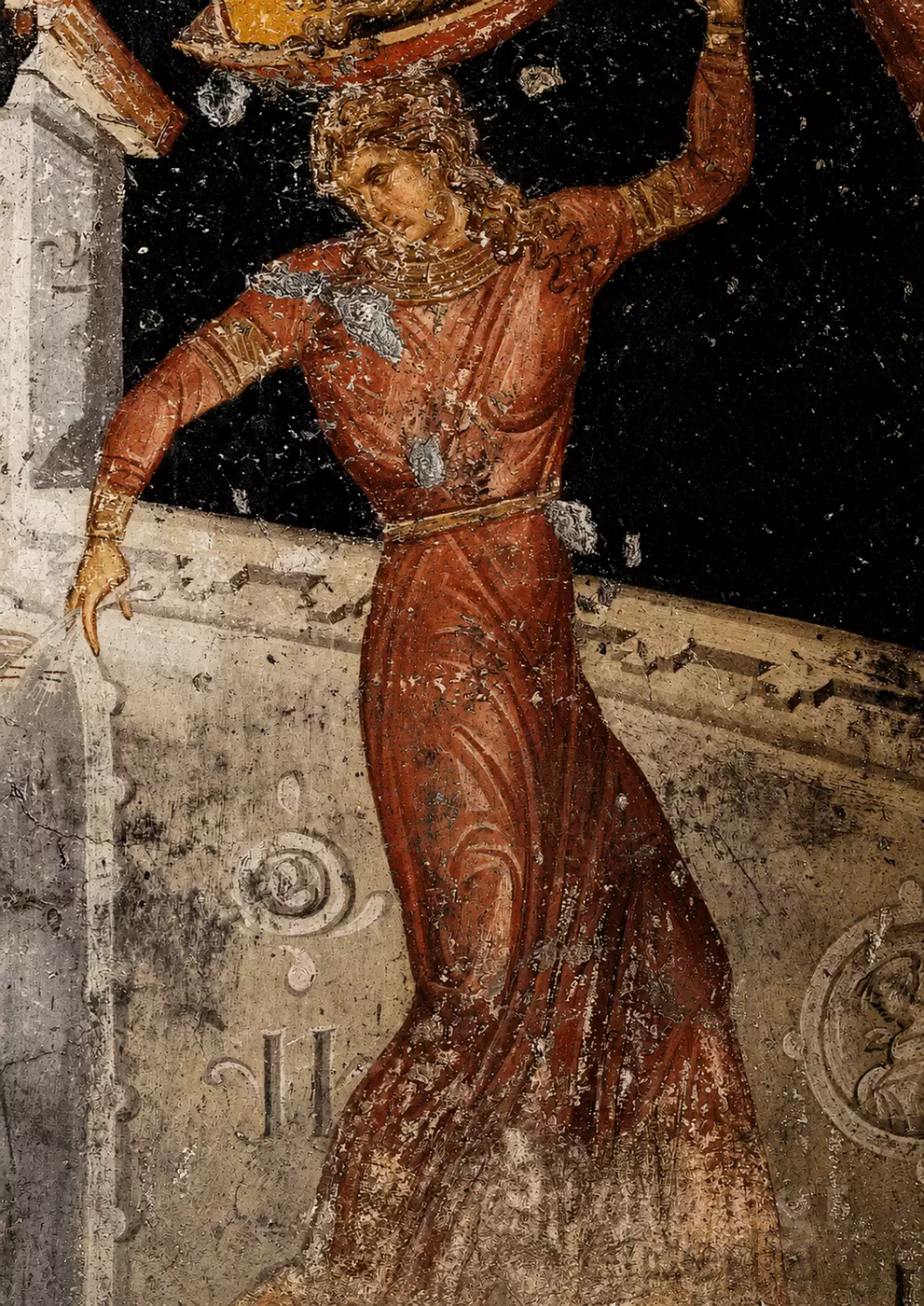
The abbot Paul, a disciple of Patriarch Niphon I, undertook around 1310 to continue the painted decoration of the chapel of the Forerunner, in the monastery of the Holy Apostles of Thessaloniki, a work which his teacher had left unfinished after his deposition from the patriarchal throne in 1314. Within the framework of this undertaking, a group of painters of probable Constantinopolitan training depicted on the northern wall of the tympanum one of the most disquieting scenes of Palaiologan painting, the dance that granted the young Salome the head of John the Baptist. The daughter of Herodias, according to the Gospel narrative, danced at the banquet of Herod with such grace that the tetrarch promised her whatsoever she might ask of him, and she, guided by her mother, asked for the head of the Forerunner upon a platter. The place of the woman within such scenes draws its interest not only from the narrative, but also from the manner in which Byzantine painting mobilised the movement of the body in order to speak of moral fall, continually setting it against the countenance of the virtuous martyr.
The dating of the ensemble remains an open question, precisely because the deposition of Niphon cuts vertically across the span of his patronage. The frescoes of the church, however, have repeatedly been linked with those of the monastery of the Chora in Constantinople, inasmuch as they exude an air of idealism, nobility, grace, and serenity that refers directly to metropolitan art. The scene, divided into two episodes by a window at the centre of the wall, is set up with the precision of a theatrical stage-set, with Herod enthroned at one end and the slender Salome dominating the other.
Movement and Stance in the Dance of Salome
Upon a low marble parapet, adorned with round relief rosettes and with traces of an inscription which decay has left incomplete, Salome balances at the culmination of her movement. Her red garment, deep in the colour of ripe wine, falls in long spiralling folds which, further down, dissolve into the worn surface of the plaster, with a sense that the painting itself retreats before the ravages of time. One of her hands lightly touches the edge of a small column, securing her balance, while the other is raised above her head, holding a light-coloured cloth that flutters, an echo of the dancing kerchief that accompanied such performances. Her face turns towards the point where the hand is raised, in a turn that gives the whole body an intense diagonal tension. In the background, a continuous wall, barely suggested within the dark colour of the field, defines the limits of the scene, while at the edge a tiled roof may be discerned, a hint of the architecture of the palace.
The two circular reliefs at the base of the parapet, one beneath the dancer’s hand and the other further off, function as antique-styled ornaments borrowed from the late Roman sculptural tradition. It is one more element that shows how close Palaiologan painting stands to the models of antiquity, whenever it seeks movement and volume upon a two-dimensional surface.
The Dancer’s Garment and Jewellery
At her wrist, a golden bracelet fastens the sleeve of the tunic, while about her neck stretch successive golden chains, recalling a multi-stranded necklace, denoting wealth and high social standing. A golden belt tightens her waist, emphasising the slenderness of the body, while her hair, auburn and wavy, falls freely to the shoulders, without a covering, an element that in Byzantine iconography lends the figure a tone of sensuousness unusual for the mores of the age. The white patches scattered over the cloth record the loss of colour over time, small wounds upon a body which the painting had fashioned with rare lightness.
The Head of the Forerunner: The Dark Side of the Dance of Salome
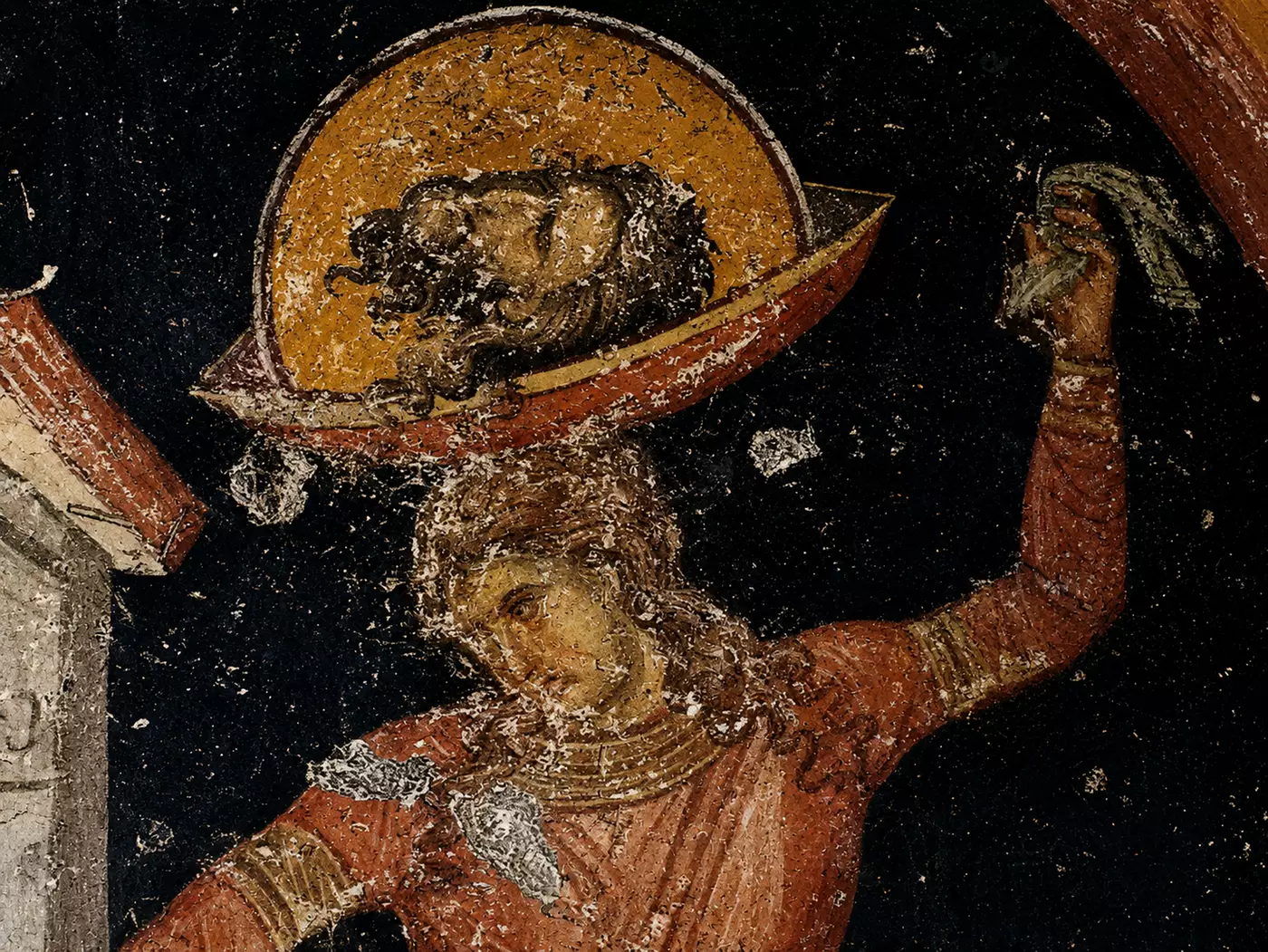
Upon the great round platter that balances above her forehead, illumined by a yellowish halo that seems almost to burn within the dense black background, rests the head of John the Baptist. His hair and beard, dark and dishevelled, frame a face that bears no trace of pain, the eyes half-closed, the mouth calm, as though death had already yielded its place to holiness. The contrast between the dreadful act and the serenity of the face constitutes perhaps the boldest achievement of the whole composition, since the painter refuses to dramatise the blood and prefers to leave the viewer before an image that is almost liturgical.
The face of Salome, directly beneath, betrays no emotion. Her eyes look sideways, meeting neither the viewer nor the head above her, and her lips remain closed in an expression that could pass for indifference or for absolute concentration upon the dance. Between the two faces, that of the dead saint and that of the living dancer, the light is treated in the same manner, the same golden colour clothes both, a choice that seems to signify that holiness and sin share the same light, without this making them equal.
This scene does not stand alone. It belongs to a wider cycle devoted to the life of the Forerunner, in which are also depicted the vision of Zacharias and his birth, elements that frame the drama of his death with the memory of his miraculous birth. The whole of the church’s frescoes was gradually uncovered from 1926 onward, with the cleaning works being completed only in the early 2000s, after centuries beneath whitewash, while the building served as a mosque. What we see today in the Dance of Salome is, in other words, the result of a double rescue, that of the art of Paul first, and that of the patience of the conservators afterward.
(Translated from the Greek text; translation by K. Pappas)

