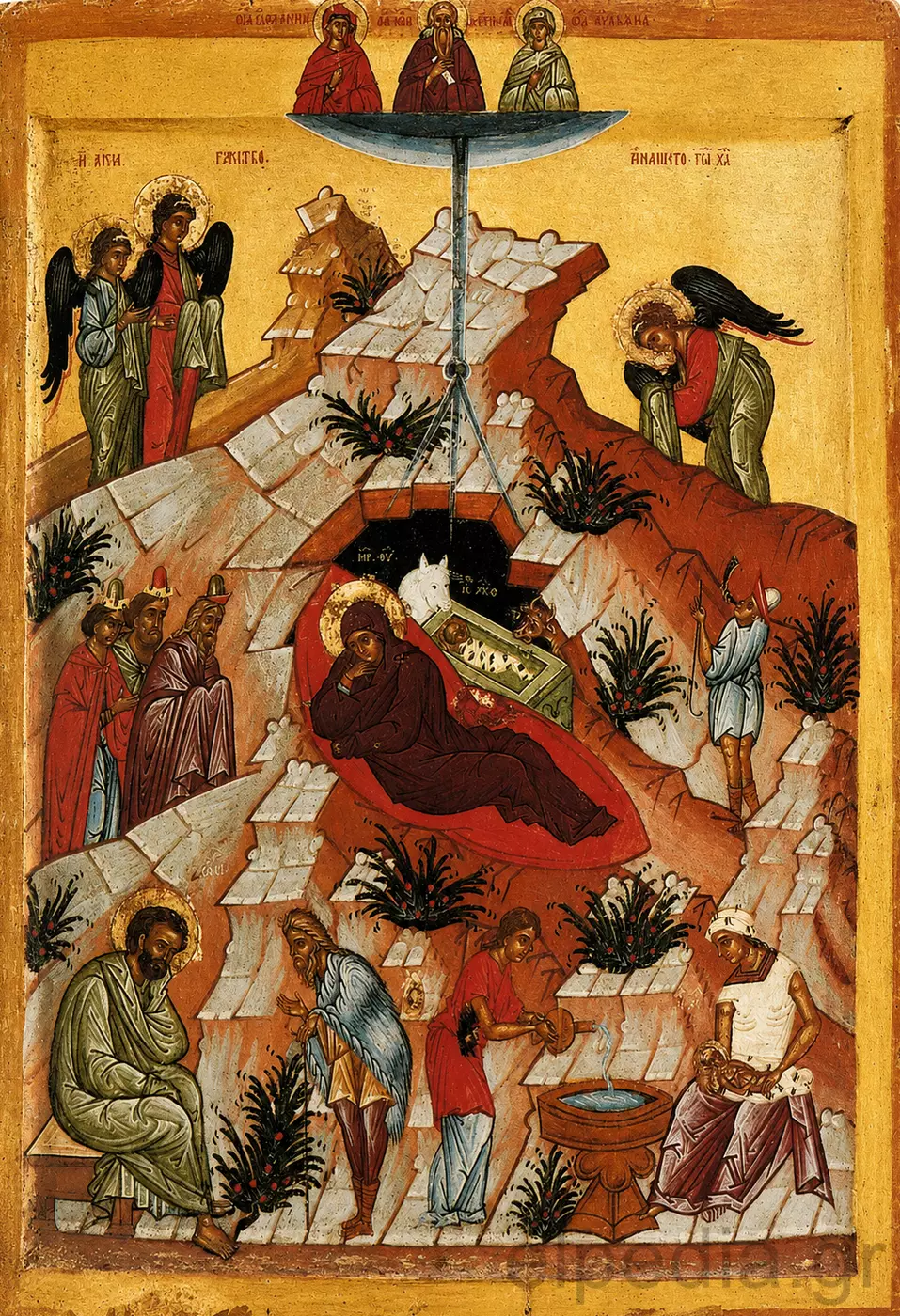
In the Tretyakov Gallery in Moscow is preserved an icon of the Nativity of Christ, the work of an anonymous painter of the school of Novgorod, dated to the fifteenth century. Three figures of saints, Eudoxia, John Climacus and Juliana, frame in small medallions the uppermost edge of the composition, an indication that the panel was commissioned for particular persons, with the patron saints of their family incorporated into the same pictorial whole. Beneath these medallions there unfolds a dense narrative, full of episodes, as the Russian painters of the late Middle Ages loved to compose it: the infant in the manger, the Mother of God lying before the cave upon a red cloth, the shepherds receiving the tidings, the magi descending from the mountain, Joseph sunk in thought, and the first bathing of the newborn by the midwives, an episode borrowed not from the canonical Gospels but from the apocryphal Protoevangelium of James.
This is not decorative excess. This pictorial density rests upon a long iconographic tradition, which Novgorod, a city of developed scholastic tradition and commercial connections as far as the West, knew well and assimilated in its own manner. The pictorial language of the city, with its intense reds, its clear outlines and the spare, almost geometric rendering of the mountains, gives to this icon an identity immediately recognisable among the other schools of Russian iconography.
The iconographic composition of the Nativity in Russian art
The school of Novgorod, in comparison with the contemporary painting of Pskov or Moscow, always preferred a language simpler in forms and bolder in colour. The figures here do not seek the refinement of Constantinopolitan models, which in any case a provincial painter of the fifteenth century would hardly have known at first hand. They pursue something else, an immediacy almost popular, without this meaning any lack of theological precision in the rendering of each figure and each scene.
Red, the colour that dominates the whole composition, from the cloth of the Theotokos to the garments of the shepherds, is not an arbitrary choice of palette. In Novgorod this colour, usually made from cinnabar, functioned as a mark of recognition of the local workshop tradition, so much so that today art historians can, in a good number of cases, attribute an icon to a Novgorodian workshop from the intensity and quality of the red alone.
The mountain, as the painter has shaped it, is not a single relief but a series of successive tiers, reddish-brown in colour, with white lines forming the outlines of the rocks, a technique typical of Russian iconography of the late fifteenth century. At its summit, within a blue shape recalling an upturned boat, a ray descends towards the earth, the light of the star, rendered not as a simple line but as a constructed element, as though the painter wished to bind visually the heavenly world of the three saints with the event taking place in the cave below.
The cave and the Theotokos: the Byzantine origin of the icon of the Nativity
Within the dark opening of the cave, the Mother of God neither sits upon a throne nor stands upright. She is reclining, turned towards the infant, her body wrapped in a deep reddish-brown maphorion, resting upon a red cloth that spreads like a pillow beneath her body. Her face looks towards the manger, where the infant lies wrapped in swaddling-clothes, within a rectangular trough recalling a small sarcophagus rather more than a child’s cradle. The ox and the ass, the two animals which tradition adds to the scene though the official evangelical narratives make no mention of them, bow their heads over the manger, according to the familiar Byzantine scheme by which the two animals recognise the Lord, while men remain in ignorance of Him. This iconographic type derives from Constantinopolitan painting, whence it reached Russia by way of Byzantine and Balkan models, already from the eleventh and twelfth centuries, with firm adherence to the established forms of the Byzantine prototype.
The hesitation of Joseph
At the lower left edge of the composition sits Joseph, clothed in an olive-coloured himation, his head bowed and his gaze lowered, in a posture which the pictorial tradition of the East employs to signify inward struggle, doubt, hesitation before an event surpassing human reason. Before him stands a second figure, stooped, wrapped in a fleece with dark markings, a figure which the interpretative tradition often identifies with temptation, presented here as an old shepherd who comes to sow doubt in the soul of the righteous man. It is added, as is the bathing of the infant further below, by that same apocryphal tradition which enriched the iconography of the Nativity with aspects human, almost dramatic.
Angels, shepherds and magi
In the upper left section, two angels, one with dark wings open backward, turn downward with their hands in a posture of speech, conveying to the shepherds the tidings of the Nativity. At the opposite edge, a shepherd, with long dark hair and a red tunic, brings his hand near his face in a gesture of astonishment, as he receives the same message from on high. Lower down, three figures in eastern garments and tall head-coverings advance in diagonal course towards the manger, the magi, whom tradition has identified with rulers coming from afar, following the star.
On the right side, lower still, another shepherd, in a white tunic, stands upright holding a staff, his animals outlined behind him among the rocks. A figure linking the heavenly annunciation with the everyday, earthly reality of the place. Between the two poles, the heavenly and the earthly, the painter arranges his figures with a logic almost cartographic, as though the mountain functioned simultaneously as landscape and as narrative diagram, where each tier hosts a different episode of the same night.
The bathing of the infant and the three saints at the summit
In the lower section of the composition, between two female figures, unfolds the first bathing of the infant. One midwife holds the child above a round font, while the other pours water from a small vessel, a scene borrowed, like the temptation of Joseph, from the Protoevangelium of James and not from the canonical texts of the New Testament. Beside them, a third figure, kneeling, arranges a cloth, perhaps preparing the swaddling-bands, in a scene which fifteenth-century Russian iconography renders with an intimacy almost domestic, far from any magnificence.
Above, in the medallions over this whole scene, Eudoxia, clothed in red, John Climacus, the ascetic of Sinai who composed the Ladder and led as abbot the monastery of the mountain for nineteen years, and Juliana, in a dark garment, watch over the event as witnesses of another order, outside time. Rarely was such a triad of figures chosen at random. In Russian practice of the period, such figures in medallions above a great feast usually corresponded to the namesake saints of the members of a family or a brotherhood, so that the icon might function at once as a liturgical object for the church and as a personal, almost private, invocation of protection.
Their presence recalls that this icon served two purposes at once, the narration of a theological event and the memory of particular persons, whose names we no longer know today, but who once prayed before this panel, recognising in the three saints their own protectors. The cinnabar has faded here and there, the gold of the background has darkened, yet the composition preserves intact its logic, tier upon tier, figure upon figure, as it was designed by a painter whose name history did not trouble to keep.
(Translated from the Greek. Translation by K. Pappas.)

