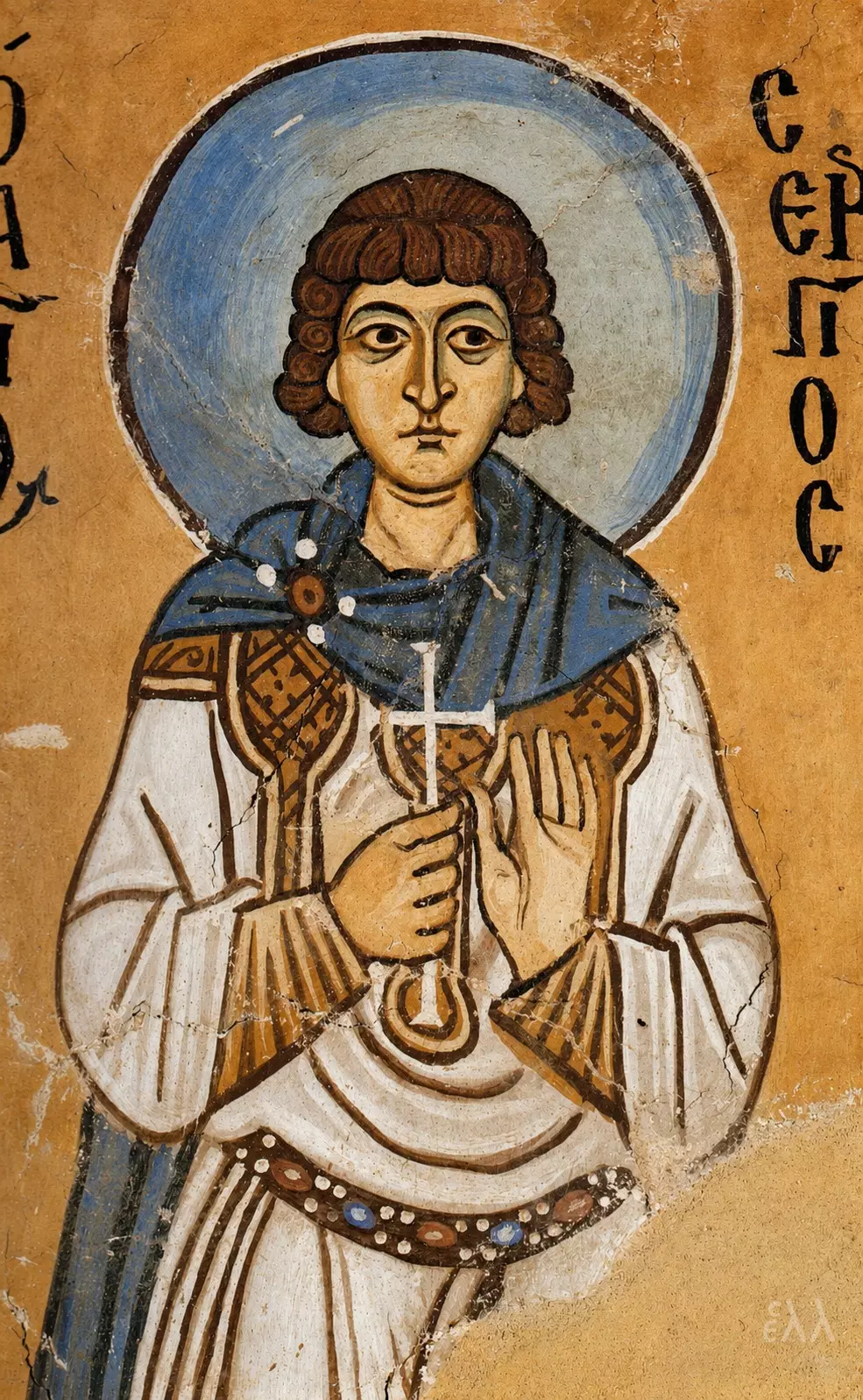
In the southwestern chapel of the katholikon of the monastery of Hosios Loukas, in Boeotia, there dominates on the northern wall a triad of military saints, painted around the third quarter of the 11th century, when the monastery was already renowned as one of the richest imperial monasteries of the empire. Sergius, Nicetas, and Bacchus, officials of the Roman army who were put to death for their faith at the beginning of the 4th century, are depicted standing and frontally within dark-coloured frames, which project them as independent icons upon the yellowish, golden surface of the wall. Among them Saint Sergius stands out, senior in rank to his two companions, since he served as primicerius in the emperor’s schola of the gentiles.
The choice to be rendered with the monumental power of a full-length icon, and not on a smaller scale among other figures, reveals the significance that the sponsors of the church attributed to the two adolescent martyrs, known throughout the Christian East for their close friendship and their shared martyrdom. Their pictorial language, with the imitation of marble revetment in the zone beneath the figures and the luxurious decorative elements that organise the surfaces, follows faithfully the system of decoration of the mosaics of the main church, in an era when the fresco painting of the chapels sought to imitate the brilliance of the more expensive material.
The Saint Sergius fresco: Byzantine garment and gesture
Saint Sergius wears an attire of courtly luxury, borrowed from the ceremonial uniform of the higher officials of the empire. On the shoulders of the light-coloured tunic the paragaudia are discerned, embroidered appliqués with a golden hue that form a rhomboid design, while a jewelled belt tightens around his waist, with multicoloured gems running across its surface. His right hand holds before his chest a thin, silver-coloured cross, the established emblem of his martyric status. The left is raised beside it, showing the open palm in a posture of supplication, a symbol of virginity and ascetic purity that accompanied the iconography of many young martyrs. A precious fibula, adorned with pearls, fastens on his left shoulder the light blue mantle, the folds of which fall with geometric strictness upon the white garment.
Detail of the face: the art of Byzantine portraiture
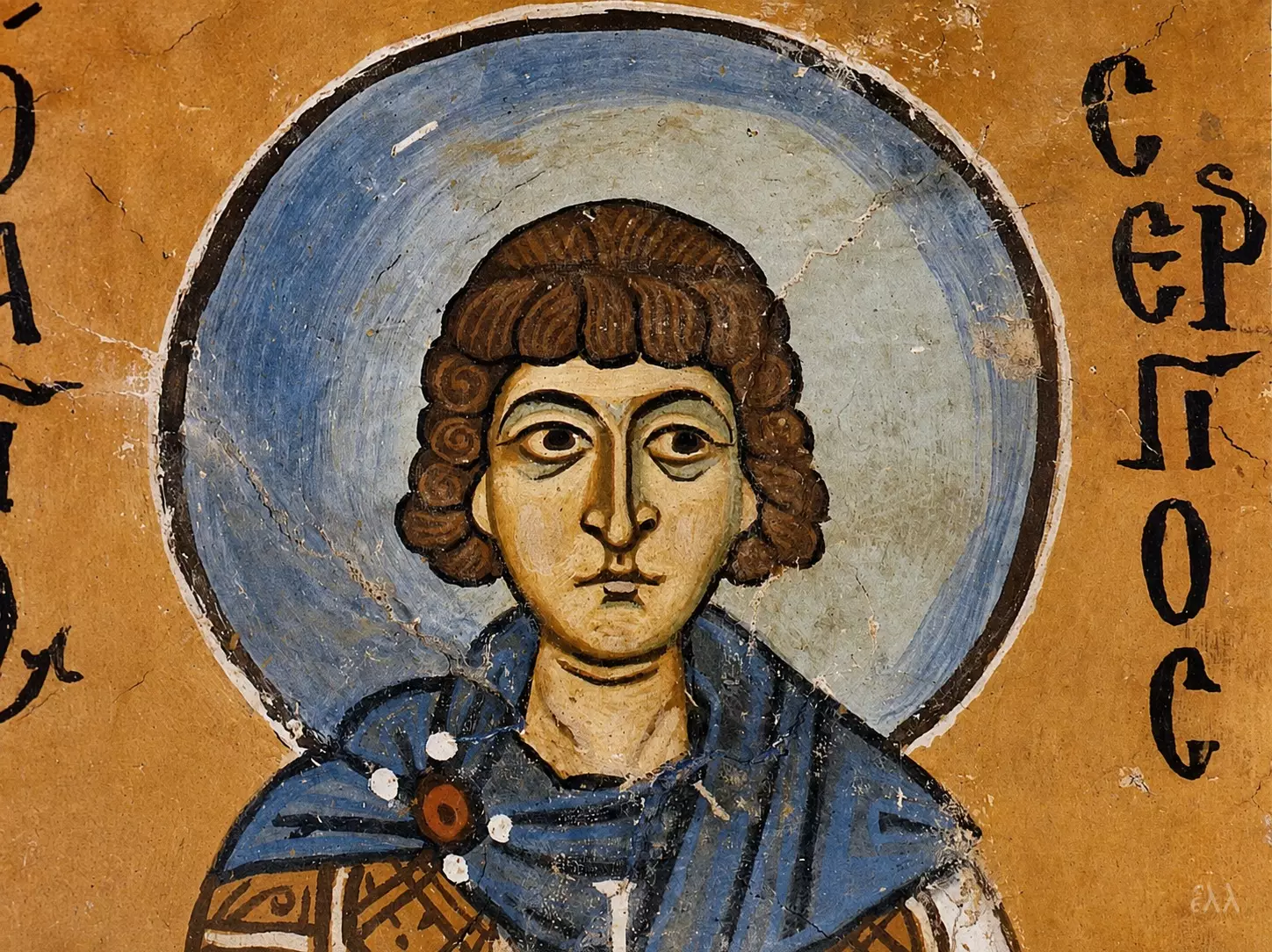
The face of the saint, framed closely, reveals the quality of Byzantine portrait art in the late stages of the 11th century. The hair, auburn and curly, forms at the temples small spirals which are rendered with thin, dark-coloured lines upon a lighter background. The halo, in a bluish colour with tonal gradation from the dark outline towards the centre, converses harmoniously with the green shadows around the eyes and with the soft blush of the cheeks. The gaze, serious and fixed frontally, reinforces the sense of spiritual vigilance that the painter sought in the figures of the saints of that era. To the right of the figure, a vertical inscription records the name of the saint, a necessary element for his identification within the group of the three martyrs.
This composition, isolated today from the whole of the triad that accompanied it originally, maintains however intact its testimony of a world of visual conventions which Middle Byzantine Greece cultivated with rare consistency, between the imitation of the precious mosaic and the economy of a technique less costly but equally ambitious.
(Translated from the Greek text by K. Pappas.)


