
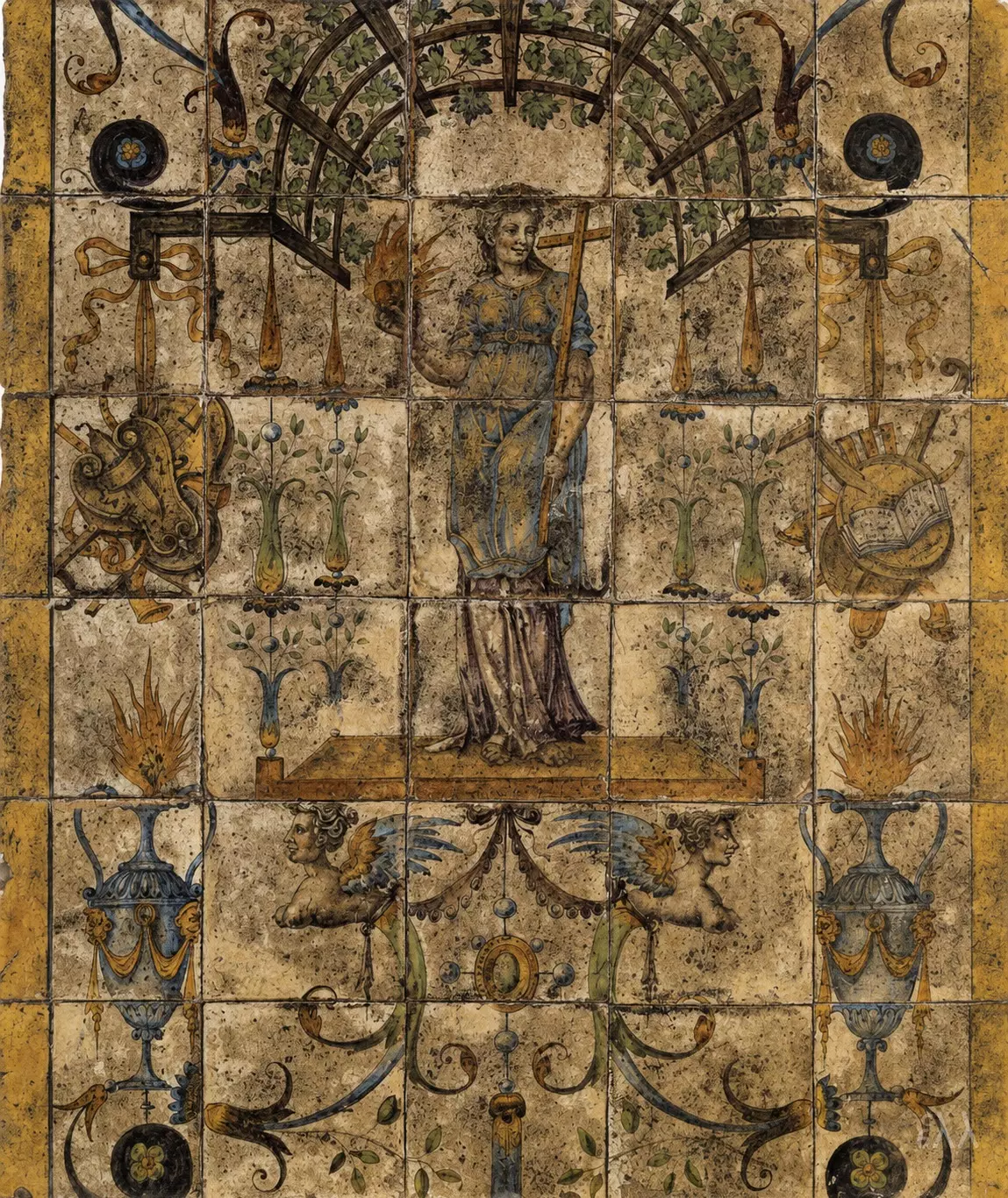
An assembly of small glazed tiles, fitted together within a square frame, constitutes the Renaissance ceramic floor which Masseot Abaquesne delivered in 1557 unto Claude d’Urfé, ambassador to Rome and thereafter superintendent of the children of Henry II. This is a fragment of the altar step in the chapel of the château of Bastie d’Urfé, in the region of Forez—that part which was judged precious enough to conclude today in the halls of the Louvre.
Masseot Abaquesne, born around 1500 in Cherbourg and established in Rouen, is considered the first significant French ceramist of the Renaissance, known for the polychrome floors and the pharmaceutical vessels of his workshop, unto his death in 1564. The composition that follows combines vegetal motifs and a central female figure, within a language borrowed from the Italian decorative vocabulary of the era.
The Art of the Renaissance Ceramic Floor
In the centre, a female figure stands upright upon a low pedestal, clothed in a blue long-sleeved garment, the one hand holding a long rod-like trunk that reaches unto the tiles at her feet, the other raised near the shoulder with something resembling a flame. From above extends an arched pergola of dark wood, clothed in vine leaves in bunches, an element that refers to those models which Raphael established in the Vatican Loggias. Bows and hanging conical ornaments frame the edges; two small pots with blue fruits stand on either side of the pedestal, with a spiralling scroll on the left and a winged emblem with a crown above an open book on the right.
Lower down, two flowered vessels with a blue neck support the corners, whilst two winged figures with human faces frame face-to-face a hanging garland that ends in a wreath, with coiling vegetal designs unto the lower corners, where two dark rosettes close the composition. The wear of the glazing removes nothing from the vividness of the yellow of the ceramic earth, of the blue of the cobalt, of the green of the leaves. Colours fired in the technique of the grand feu—that which endured more than four centuries beneath the feet of those who ascended toward the altar.
(translated from the Greek text by K. Pappas)


