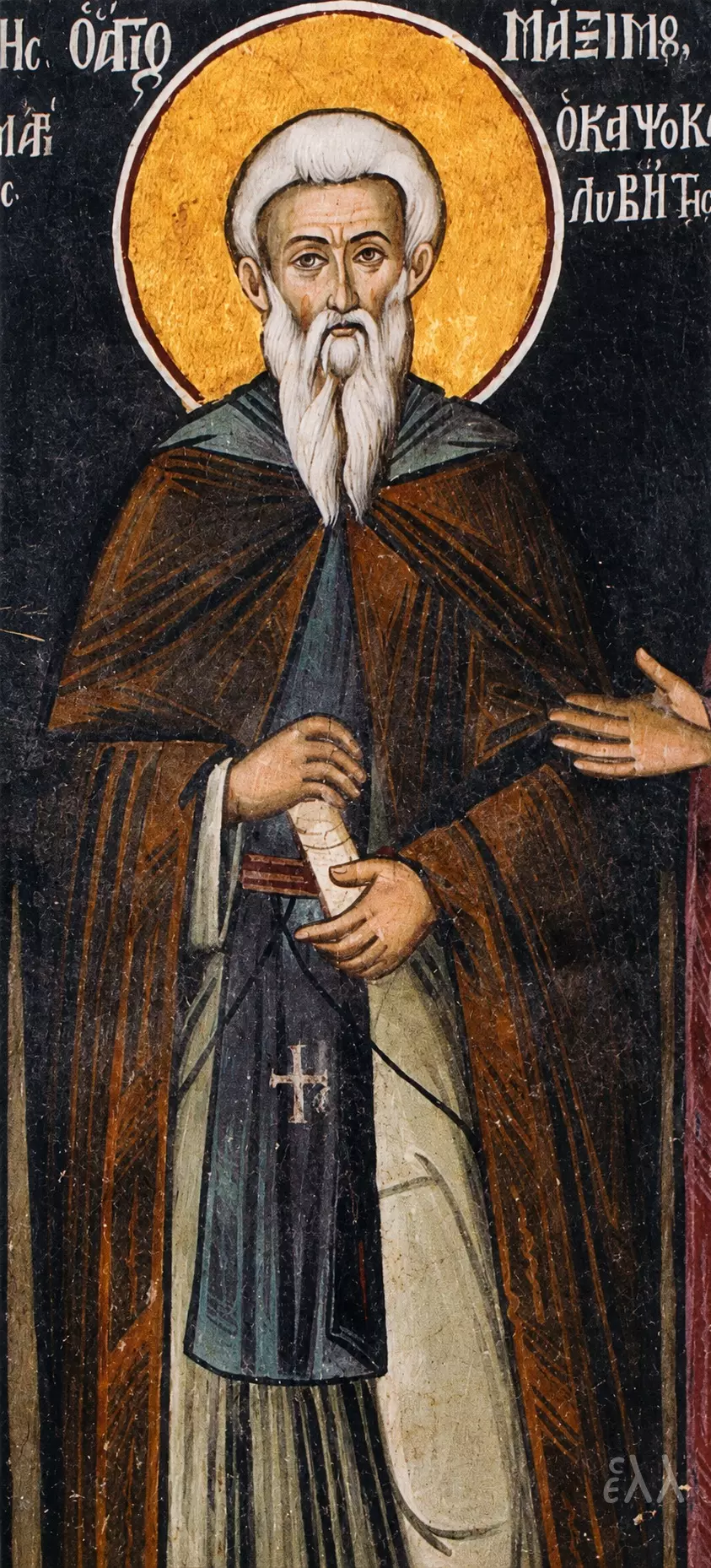
An elder with an all-white beard stands among other figures of ascetics, his face etched by decades of prayer and privation, in a fresco that adorns the narthex of the catholicon of the Xeropotamou Monastery on Mount Athos. This is the depiction of the venerable Maximos Kavsokalyvis, a fourteenth-century ascetic, whose surname came from his habit of repeatedly setting fire to the makeshift huts where he dwelt, so that no material possession might bind him. The fresco that depicts him dates to the eighteenth century and is included in the iconographic programme executed around 1783, when the catholicon of the monastery, renovated thanks to the efforts of the learned monk Kaisarios Daponte, acquired the form it retains to this day.
The post-Byzantine art of Mount Athos preserved with remarkable consistency the iconographic types of the ascetic tradition. The venerable Maximos is included in a long line of Athonite fathers who customarily adorn the narthexes of the catholica, the point of first contact for pilgrims with the history of monasticism before entry into the main nave. In this specific fresco the venerable one holds a rolled scroll, an indication most likely of the texts and the hymnology that were associated with his person, while beside him is discerned the hand of a neighbouring figure, proof that the composition continued into a whole series of Athonite ascetics.
Maximos Kavsokalyvis in the post-Byzantine art of Mount Athos
The catholicon of the monastery, built between 1761 and 1763, acquired its iconographic decoration in 1783 from a workshop of iconographers originating from Korçë, among them Konstantinos, Athanasios, and Naoum, painters who continued the long tradition of the post-Byzantine workshops of northwestern Greece. The face of the venerable one is dominated by deep wrinkles that traverse the forehead and the cheeks, traces of an aging which the painter rendered with fine, dark-coloured lines upon a light brown background of skin. The eyes, sunken beneath thick eyebrows, look straight toward the viewer, without any tendency toward idealisation of old age. The beard, all-white and bifurcated, reaches down to the chest, worked with fine lines that distinguish individual tufts of hair upon a greyish underlayer.
Over a dark-coloured, bluish mantle the venerable one wears a second, outer mantle in a brownish-red hue, where dense parallel lines represent the numerous folds of the ascetic garment, a characteristic element of the monastic attire in post-Byzantine art. Beneath this is discerned a dark-coloured garment with a cross painted at the level of the chest, an element that refers to the analavos of the great schema and denotes the higher degree of monastic dedication. Both his hands clasp a rolled parchment scroll, bound with a reddish ribbon, at the level of the belly. A posture frequent in depictions of ascetics who left behind them a written word of spiritual guidance. At the right edge of the composition appears the hand of a neighbouring figure, a detail which reveals that the venerable one did not stand alone in the narthex but among other fathers of Mount Athos. Above his head, white capital letters upon the dark background preserve his name, written in the angular manner of writing that the painters of the period adopted for the inscriptions of the saints.
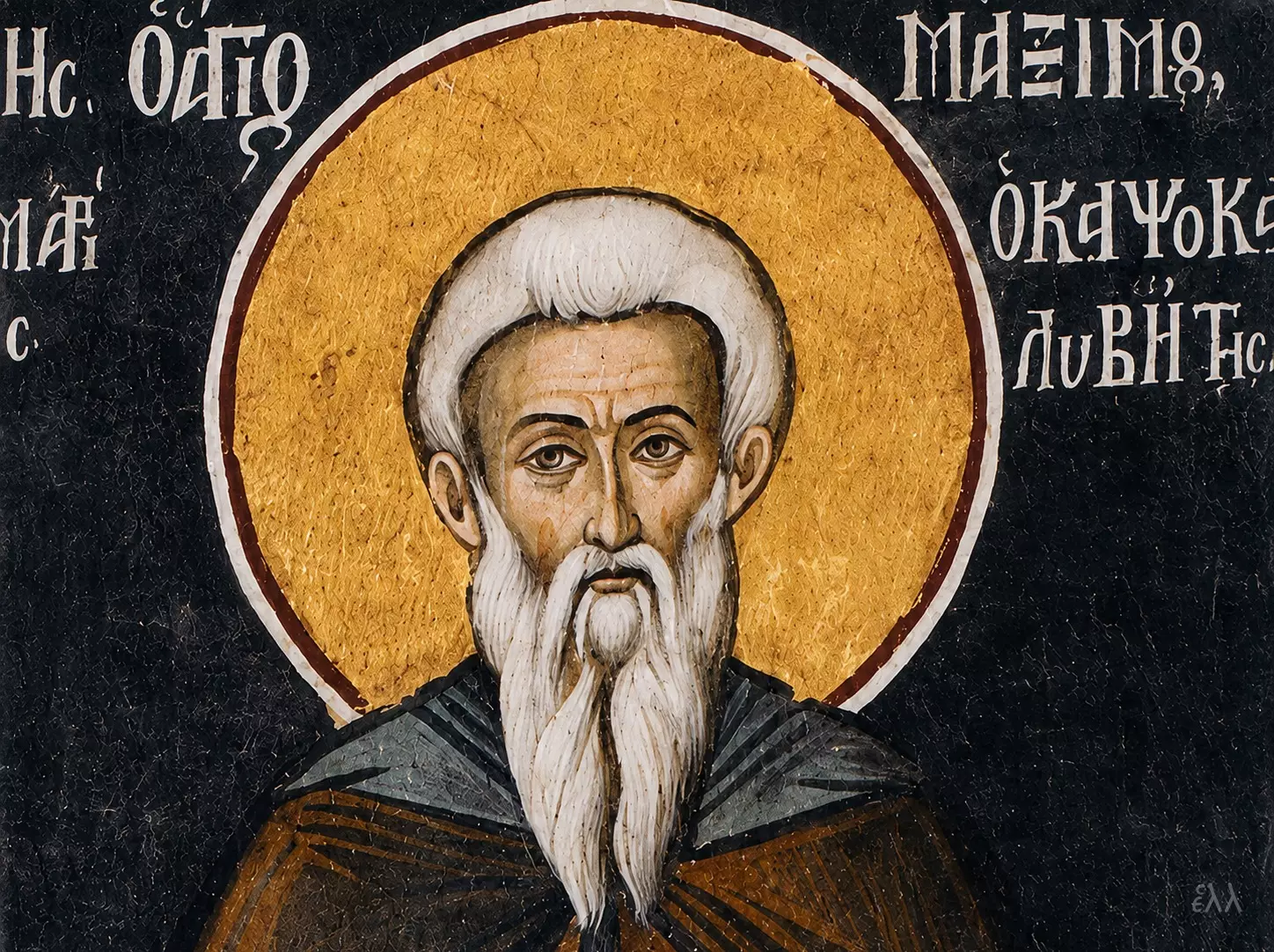
Detail: the face and the halo
In enlargement the face reveals elements that escape at first glance. The red brushstrokes that emphasise the apples of the cheeks. The fine white down of the beard that stands out one from the other, the asymmetrical line of the eyebrows that gives to the gaze an intensity almost piercing. The halo, a deep yellow of ochre that approaches gold, bears slight cracks upon its surface, traces of the aging of the mortar, and is surrounded by a dark red band which is followed by a thinner white line, a combination that is frequently met in Byzantine and post-Byzantine art for the rendering of holiness.
This close look permits one to discern better the inscription as well, the letters more legible at this distance, an element precious for the study of the iconographic workshops that were active on Mount Athos during the eighteenth century. Such frescoes, works of guilds of painters who moved from monastery to monastery, gradually composed a visual code of recognition of the Athonite ascetics, a code which each generation of iconographers received and adapted to its own technical capacities.
(This is a translation from the Greek text and the translation was done by K. Pappas.)


