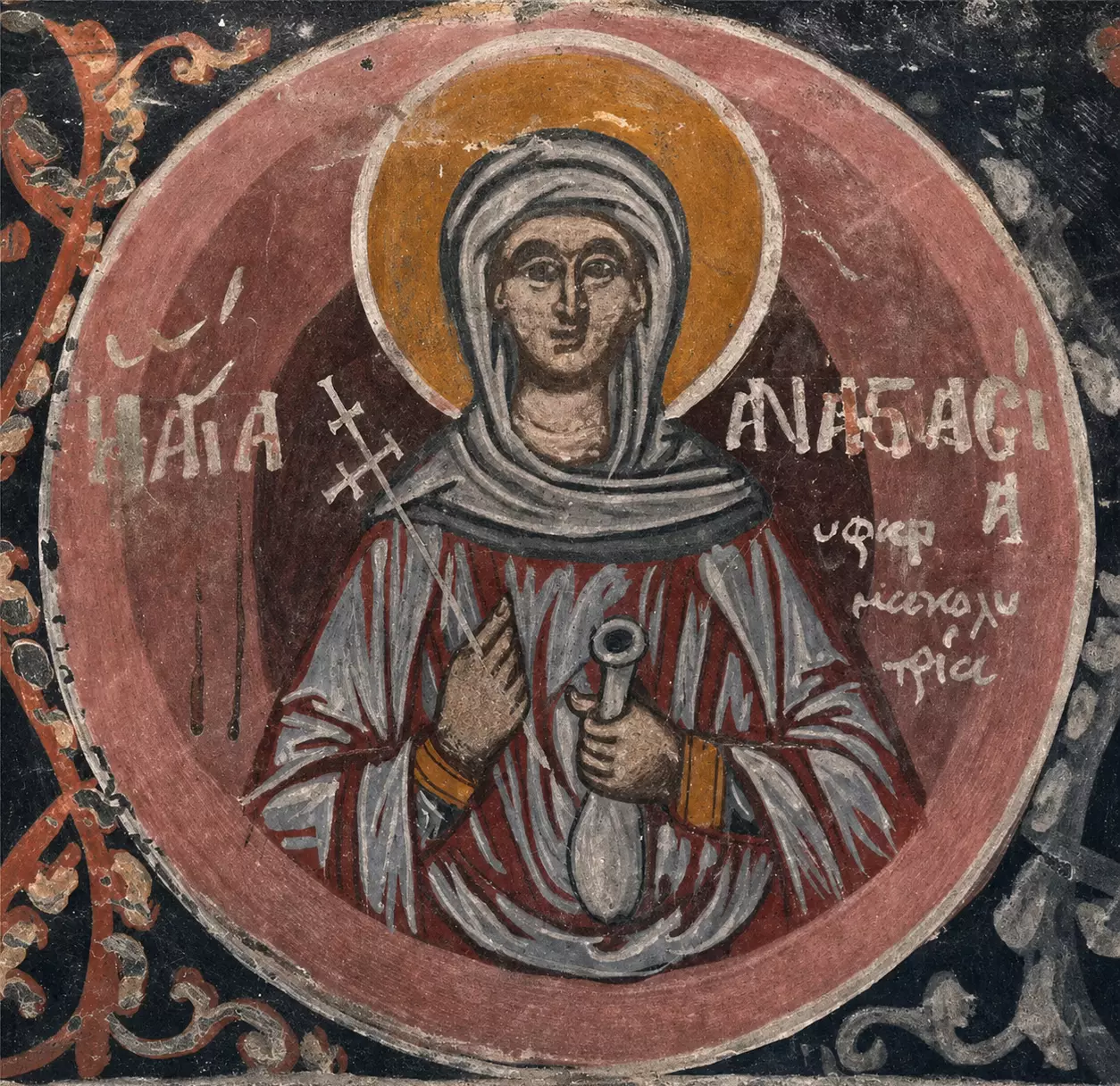
Within the Church of Saint Paraskevi at Anavra, the mountain settlement historically known as Goura in the Almyros region, the Saint Anastasia wall painting presents the saint as a frontal, half-length figure enclosed within a large circular medallion. The church belongs to the group of ecclesiastical monuments preserved around Anavra, several of which retain painted decoration.
Against a deep reddish-brown field, Saint Anastasia occupies the central axis with marked stillness. A broad ochre halo surrounds her head, while a grey head covering descends in repeated dark and light bands around the face and shoulders. The painter builds the features through firm contours: long nose, arched brows, enlarged eyes, small mouth. Little effort is made toward extensive volumetric modelling; instead, line establishes the physiognomy and gives the face its grave, concentrated expression.
Her garments combine muted grey with dark red, enlivened by ochre cuffs and sharply placed pale highlights. In her left hand she holds a small vessel associated with her identification as Anastasia Pharmakolytria, while the raised right hand forms a restrained gesture close to the body. Painted lettering occupies the field around the figure. The larger inscription identifies her as Saint Anastasia, while the smaller accompanying words preserve the epithet Pharmakolytria.
Saint Anastasia Wall Painting and Provincial Ecclesiastical Art
The circular frame gives the figure an emphatic visual independence. Such medallions allowed individual saints to be incorporated into broader decorative programmes while retaining the concentrated character of an iconic image. Around this roundel, fragments of vegetal ornament survive against the sombre surrounding field, their curling forms introducing movement beside the rigid frontality of the saint.
Especially striking is the directness of the execution. Broad outlines, abbreviated flesh modelling and schematic garment folds point to a painter working with a compact visual vocabulary derived from established Byzantine and Post-Byzantine conventions. The result retains its own local character: uneven lines, compressed forms, strong chromatic divisions, an expressive face whose intensity depends largely upon the eyes.
Losses and abrasions interrupt the pictorial surface, particularly across the garments and inscriptional field. Limited areas of exposed substrate appear as irregular pale patches, yet the principal iconographic elements remain legible—the halo, frontal posture, identifying inscription and vessel. Within this weathered surface, the image preserves evidence of the way established Eastern Christian iconography continued to be interpreted by painters serving smaller regional communities.