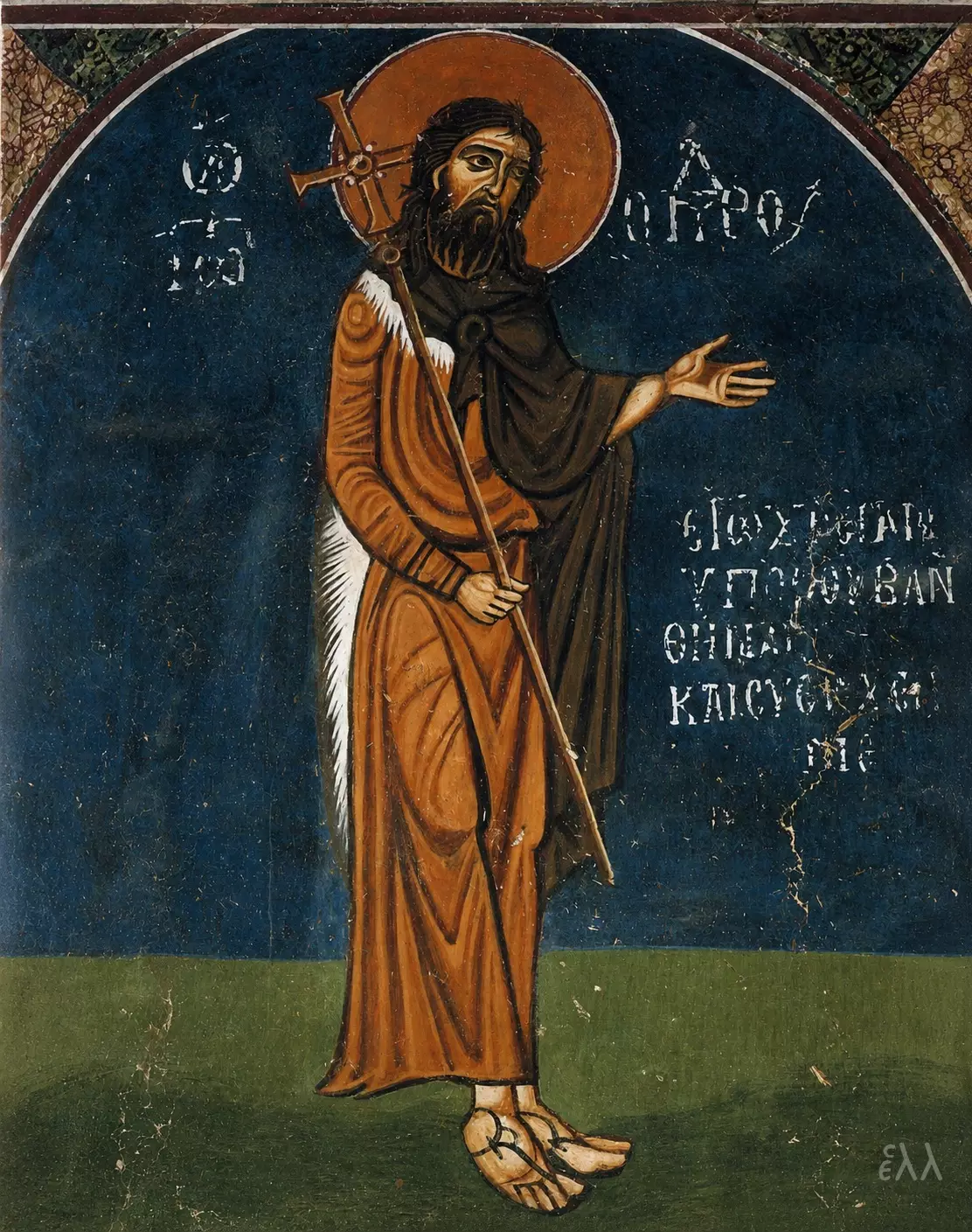
In the south-western chapel of the katholikon at the Monastery of Hosios Loukas in Boeotia, a full-length figure of Saint John the Baptist forms part of an eleventh-century painted ensemble associated with the encounter between the Forerunner and Christ before the Baptism in the Jordan (Matthew 3:13–17). Dating from the third quarter of the century, the wall painting occupies the upper zone of the chapel: John stands on the northern wall, while the corresponding figure of Christ belongs to the eastern side. The arrangement gives the two figures a spatial relationship across the architecture, each placed beneath an arched opening supported by slender colonnettes.
Hosios Loukas is celebrated especially for the gold-ground mosaics of its katholikon, yet painted decoration also survives in its subsidiary spaces, preserving another aspect of the monument’s Middle Byzantine artistic language. The monastery, together with Daphni and Nea Moni of Chios, forms part of a UNESCO World Heritage property recognized for the exceptional importance of its Byzantine monumental decoration. Wall painting at Hosios Loukas shares with the mosaics a disciplined treatment of line, frontal presence and sharply organized sacred imagery, qualities particularly evident in the eleventh-century decoration.
The saint depicted here is isolated against a deep blue pictorial field above a narrow band of green ground. Architecture and landscape have been reduced to the minimum required by the composition. Against that broad, dark surface, the elongated body, ochre garment, orange-gold halo and pale flesh acquire an unusual clarity.
John the Baptist Hosios Loukas Fresco and Its Iconography
John stands with his body slightly turned towards the side occupied by Christ in the larger ensemble. One hand steadies the long cross-staff that rises diagonally past his shoulder; the other extends outward, the fingers opened in a measured gesture. That movement is essential: it establishes a relation with the unseen companion figure and gives the saint a quiet sense of expectancy, appropriate to the moment immediately preceding the Baptism.
The cross-staff provides the strongest diagonal in an otherwise predominantly vertical composition. Its shaft passes from the lower part of the body towards the halo, ending in a cross whose broadened arms are articulated with small circular details. Because the cross rises behind the head, it can initially appear integrated with the nimbus. Close examination separates the two elements clearly: the halo is a broad circular disc of warm ochre-orange surrounded by narrow contrasting contours, while the cross belongs to the staff carried by the saint. This distinction matters in Byzantine iconography, since John does not possess the cross-inscribed halo reserved for Christ.
His clothing reinforces his identity. The camel-hair garment traditionally associated with the Baptist is rendered in warm ochres and earthy orange-browns, its surface crossed by repeated linear folds. At the shoulder and along one side of the body, an irregular white shaggy edging evokes the rough texture of animal hair. Over this garment falls a very dark mantle, gathered near the chest and descending in long, heavy folds, its ochre, black-brown, white, blue and green tones forming a limited palette strongly separated into broad areas.
The feet remain exposed in simple sandals tied with dark straps. Their elongated treatment belongs to the same formal logic as the body: the painter gives priority to the expressive contour, the direction of the limbs and the legibility of the figure at architectural scale. A few dark strokes establish toes, straps and the separation between the feet. Above them, the lower hem descends through a succession of narrow, almost calligraphic lines.
Gesture, Ascetic Identity and the Figure of the Prodromos
The open hand introduces a quieter rhythm beside the rigid staff. Palm and fingers are carefully separated, with the wrist emerging from the dark mantle before the forearm enters the blue field. Within the visual language surrounding ascetic saints, the exposed palm can also evoke bodily purity and the ascetic life; within this scene, its immediate pictorial role is directed towards the approaching Christ.
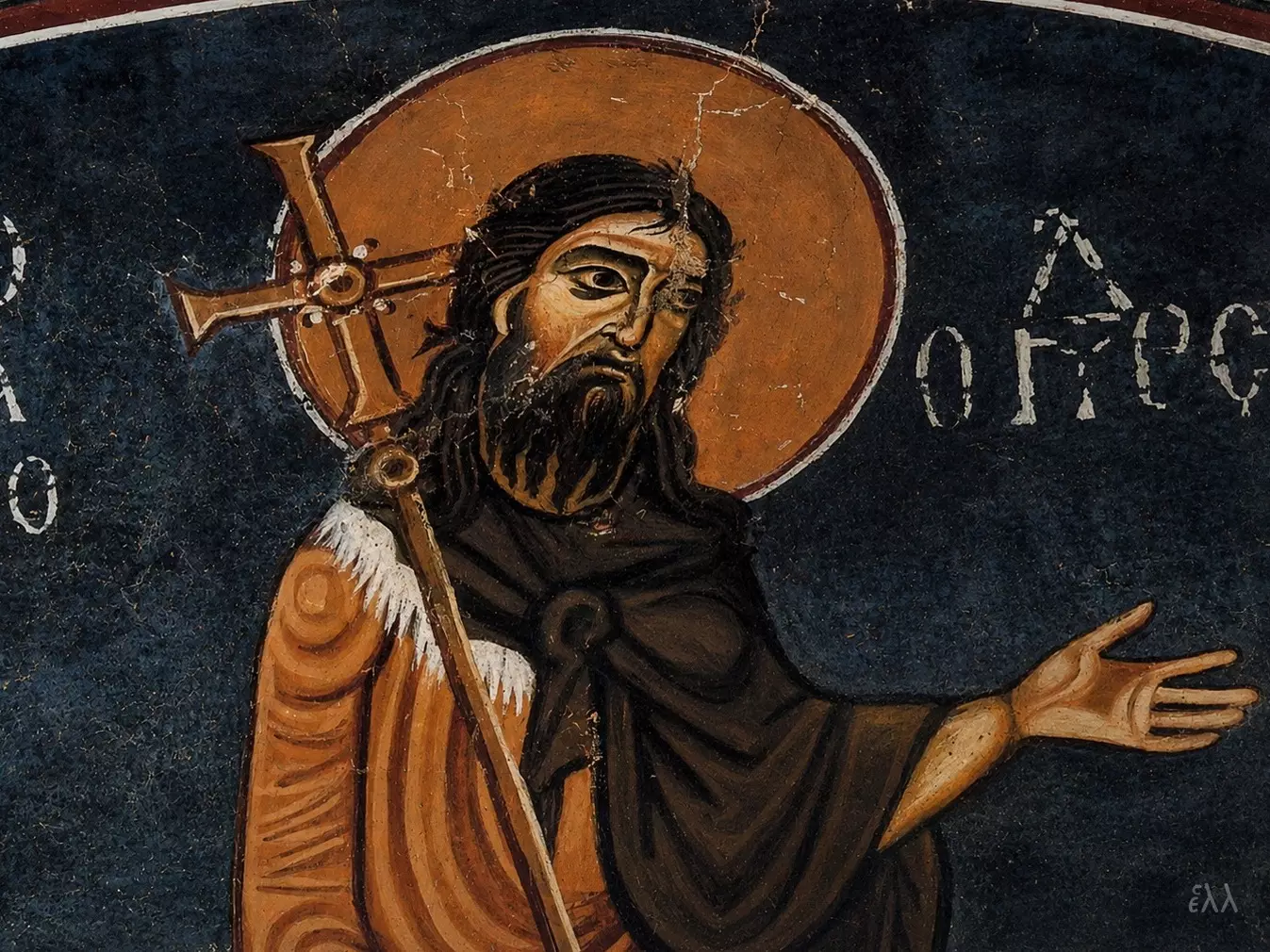
John’s physical type intensifies that ascetic character. Long dark hair falls around the neck in separate locks, while the beard breaks into pointed strands descending over the chest. The narrow face, prominent nose and concentrated gaze give the saint a severe, alert presence. Little emphasis is placed on bodily mass. Instead, contour, gesture, clothing and attribute construct the saint’s identity almost at once.
This economy belongs comfortably within the monumental language of Middle Byzantine church decoration. Human figures occupy the principal visual role, projected against comparatively abstract backgrounds and organized according to the architecture of the church. In the eleventh century especially, Hosios Loukas preserves an important example of the hieratic tendency in which sacred figures gain force from concentrated silhouettes, controlled gesture and an intense frontal or near-frontal presence. The wider tradition of Byzantine wall painting also used the uniform background field as a means of integrating figures and scenes with the surrounding architectural surfaces.
The Face of Saint John the Baptist
At close range, the face reveals how much of its effect depends upon line. A dark contour runs along the brow, nose, cheek and beard, while lighter ochre and cream strokes pick out the forehead, bridge of the nose, upper cheek and area surrounding the eye. The transitions remain sharply articulated. Flesh is constructed through compact passages of warm brown, orange and pale highlights, creating a face that appears modelled and graphic at the same time.
Particularly forceful is the eye. Large and almond-shaped, enclosed by a strong dark outline, it turns towards the direction of the encounter. The eyebrow rises in a long curve above it. Around the temple, short dark strokes articulate the hair; the beard below is treated through thicker, branching forms. Minute irregularities of the painted surface remain visible—fine cracking, abrasions and scattered losses—without obscuring the main structure of the physiognomy.
Across the forehead and nose, the highlights follow the bone structure with considerable precision. A narrow band marks the ridge of the nose, another catches the brow, smaller touches animate the cheek and area above the mouth. The painter therefore achieves expressive intensity through a restricted set of means: dark contour, warm flesh, concentrated illumination. The result suits John’s established Byzantine facial type while retaining considerable individuality in the disposition of the features.
The halo provides a broad chromatic counterweight. Its warm orange-ochre field frames the dark hair and beard, separated from the blue ground by concentric pale and dark outlines. Several cracks cross its surface, among them a more prominent fissure in the upper part. The cross-staff passes immediately behind it, creating a dense meeting of circular and diagonal forms around the head.
Inscriptions and the Painted Setting at Hosios Loukas
White painted lettering survives on both sides of the upper body. Near the head, the fragmentary identifying inscription preserves part of the title Prodromos, the Greek designation of John as the Forerunner. Lower down, further lines belong to the textual exchange associated with the meeting preceding the Baptism (Matthew 3:14–15). Their surviving condition is uneven: some letters retain strong white strokes, others have been reduced by losses and abrasion.
Word and figure consequently occupy the same blue field. The lettering remains visually subordinate to the saint, yet it supplies identification and narrative context, an established feature of Byzantine monumental painting in which inscriptions could name holy figures, clarify scenes or introduce spoken and scriptural texts.
Within the chapel, John’s direction of movement still depends upon the larger arrangement. The slight turn of the body, the sideways gaze and especially the extended hand lead beyond the boundaries of his individual section towards Christ on the adjoining wall. Above the Baptism scene, the two standing figures create a preparatory episode through architecture itself: one image on the northern surface, the other on the eastern, the intervening space made part of their encounter.
For a monument whose gold mosaics have long dominated its art-historical reputation, these painted areas are especially valuable. Hosios Loukas preserves mosaics and wall paintings within a single major Middle Byzantine complex, allowing different monumental media to be understood within the same architectural and liturgical environment. Modern scholarship likewise treats the monastery as a central surviving witness to eleventh-century Byzantine monumental decoration. In the figure of the Prodromos, that broader artistic culture becomes visible through a few emphatic elements — the dark blue field behind him, the earth-coloured garment, the cross-staff, the open hand, the severe face, and the worn white letters that still cling to the plaster around him.