
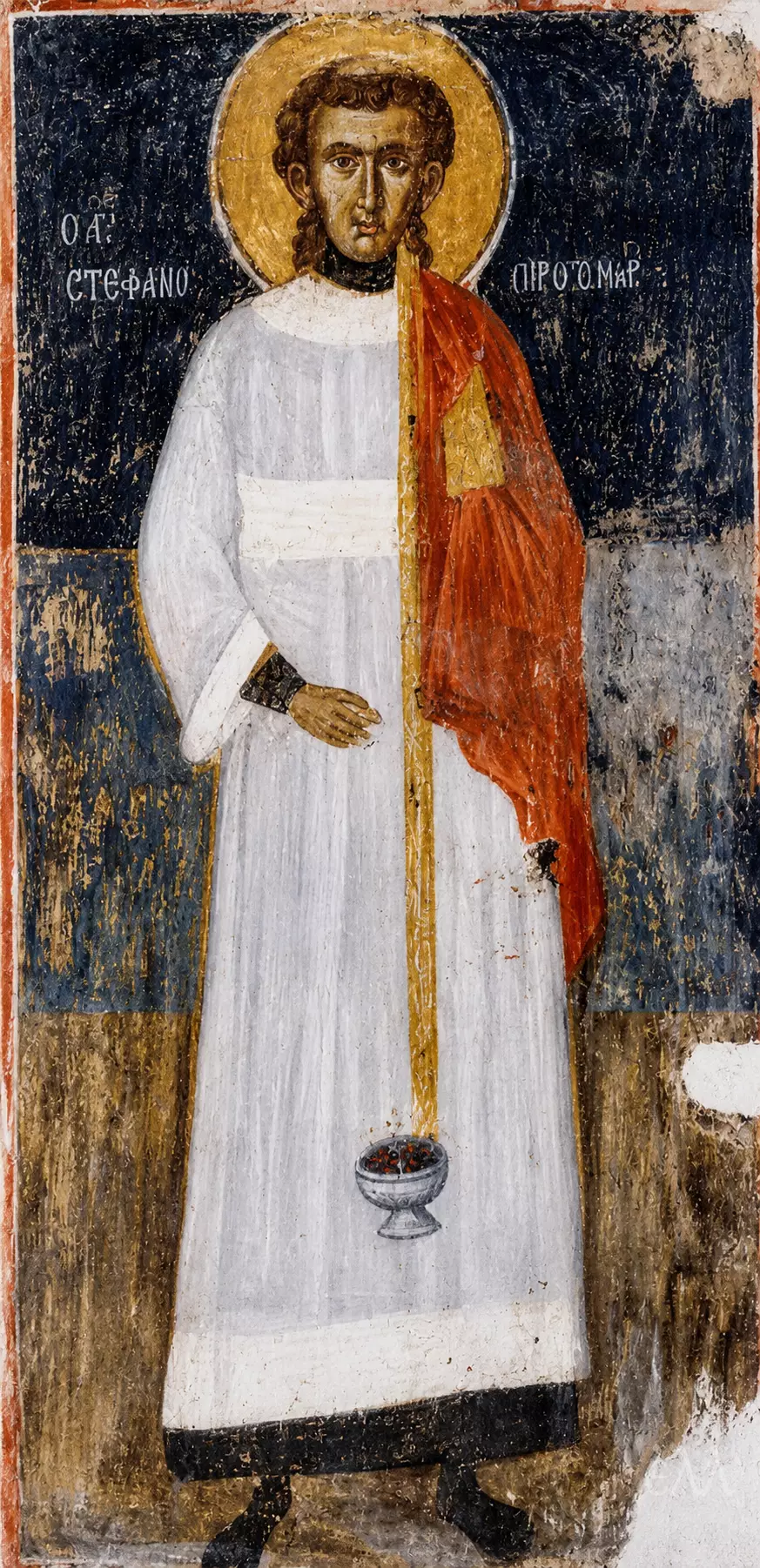
The Saint Stephen Byzantine wall painting at Valsamonero Monastery presents the Protomartyr as a young deacon, standing frontally beneath an unusually large golden halo and set against a deep blue ground. The work belongs to the painted decoration of the monastic church of Panagia Hodegetria in Crete and is generally placed in the early fifteenth century. Valsamonero itself developed through successive building and painting campaigns extending from the fourteenth into the fifteenth century; its surviving katholikon contains an exceptionally rich ensemble of wall paintings. The official monument record notes that the decoration was carried out progressively, while recent scholarship stresses both its high quality and the importance of Constantinopolitan artistic models in Crete during the first half of the fifteenth century.
Stephen is identified through the concentrated visual language of the standing saint. The painted inscriptions beside his halo give his name and the title Protomartyr, while his liturgical dress and censer establish his diaconal identity. A long white sticharion covers almost the entire body, falling in broad vertical folds whose restrained modelling keeps the figure visually stable. Over it, a red-orange vestment descends from his left shoulder and creates the principal chromatic accent of the composition. Its warm colour interrupts the extensive white surface and leads the eye downward towards the suspended censer. That object is small in relation to the figure, yet unmistakably prominent: a long chain extends almost to the saint’s feet, ending in a rounded bowl whose dark interior is punctuated by small red forms.
Saint Stephen Byzantine Wall Painting: Vestments, Colour, and Pictorial Surface
The painter organises the image around a strong vertical axis. Stephen stands nearly motionless, the feet aligned above a dark strip at the base, while the ample sticharion enlarges the body into a pale, almost columnar form. No architectural setting competes with him. Behind the lower body, broad horizontal zones shift instead from dark blue to grey-blue and earthy ochre, creating shallow pictorial space without recourse to linear perspective. Against this restricted field, the halo becomes almost architectural in scale. Its circular form, edged by a shadowed contour and a lighter outer line, encloses the head while separating it decisively from the near-black blue of the background. This integration of sacred imagery with broad painted surfaces reflects a familiar convention of Byzantine monumental decoration, one already visible in the treatment of the halo itself.
The close view of the face reveals how much of the painting’s expressive force depends upon line. Short brown-red curls form a compact mass above the high forehead; the eyebrows bend strongly over large, direct eyes, and the elongated narrow nose descends towards a delicate closed mouth. Deeper strokes reinforce the cheeks, jaw and areas of facial hair, while lighter passages across the forehead, nose and upper cheeks provide economical tonal modelling. Individual features remain sharply articulated, yet they have been disciplined by the frontality and spiritualised physiognomy of Byzantine sacred representation. The gaze is steady and somewhat severe, intensified by the symmetry of the halo and the deep-toned expanse surrounding it.
Across the painted expanse, age has become part of the appearance of the work. Numerous fine abrasions and minor losses interrupt the blue background and the face; larger worn passages affect the lower field and sections of the vestments. These disruptions leave the composition entirely legible. In places they also make its material history unusually apparent, distinguishing surviving areas of stronger colour from weakened passages and exposed sections beneath the paint layer.
The red-orange drapery remains particularly effective, its warm tonal range held between the expansive white garment and the cooler ground.
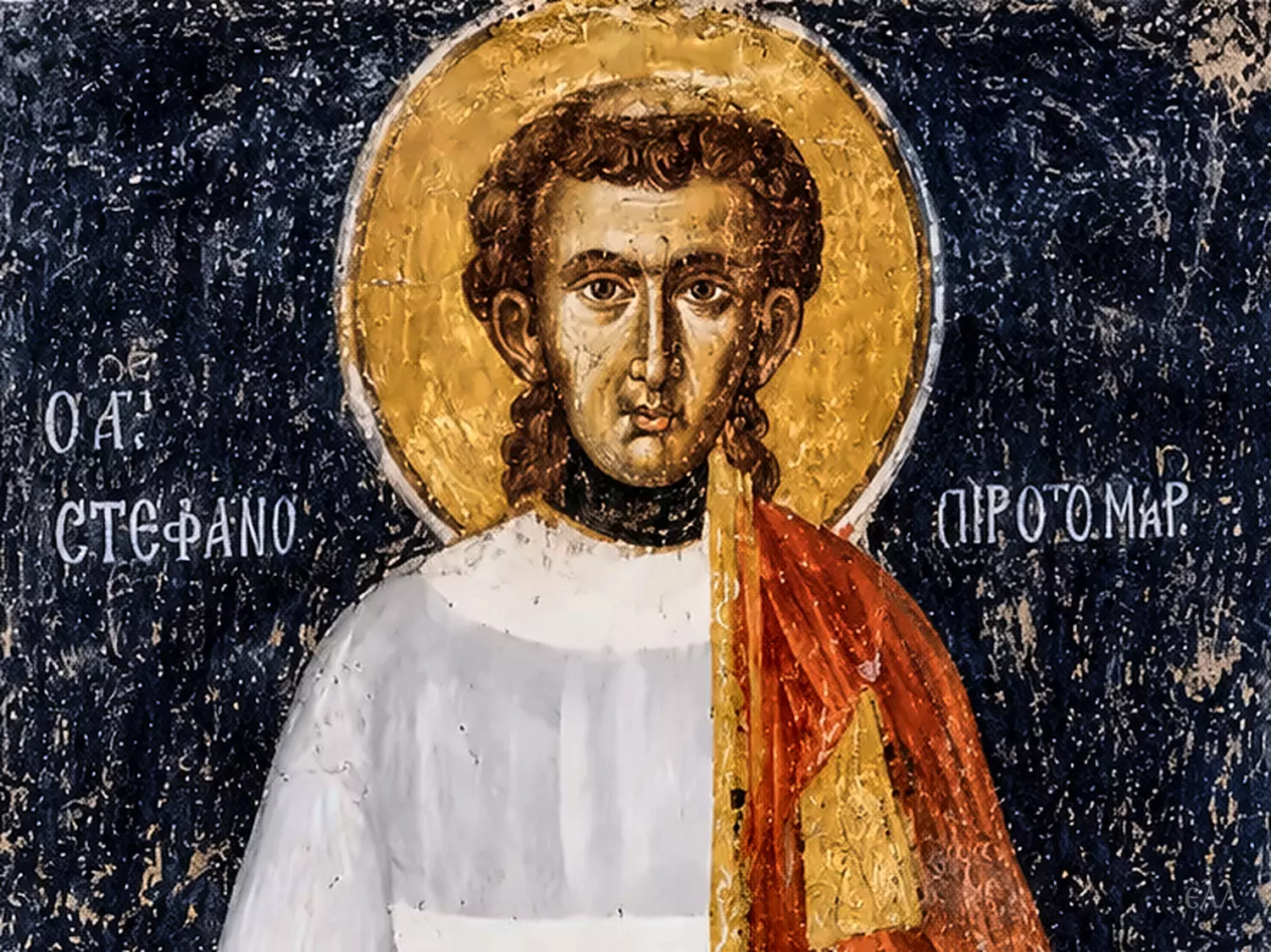
Saint Stephen Byzantine Wall Painting: Historical Context and Iconography
The historical setting sharpens the significance of the work. Flourishing as a monastic foundation during the Venetian period, Valsamonero produced paintings of a quality that has led scholars to emphasise its place in the artistic developments of Crete during the first half of the fifteenth century. Constantinopolitan influence is especially important within this discussion. Yet the ensemble belongs to a local environment already developing its own vigorous pictorial culture.
Within Christian iconography, Stephen’s youthful appearance, diaconal vestments and censer refer to the account of his ministry and martyrdom (Acts 6:1–7:60), in which he appears among the seven men appointed to serve the earliest Jerusalem community and becomes the first martyr described in the narrative. The Valsamonero painter omits the episode of his death. Stephen is shown permanently vested for liturgical service, his identity concentrated in clothing, inscription, stance and object, and this restrained full-length image draws its authority from stillness and clarity rather than from narrative incident, taking its place within the fertile artistic culture of fifteenth-century Cretan painting.
(The translation was edited by P. Alexiou.)