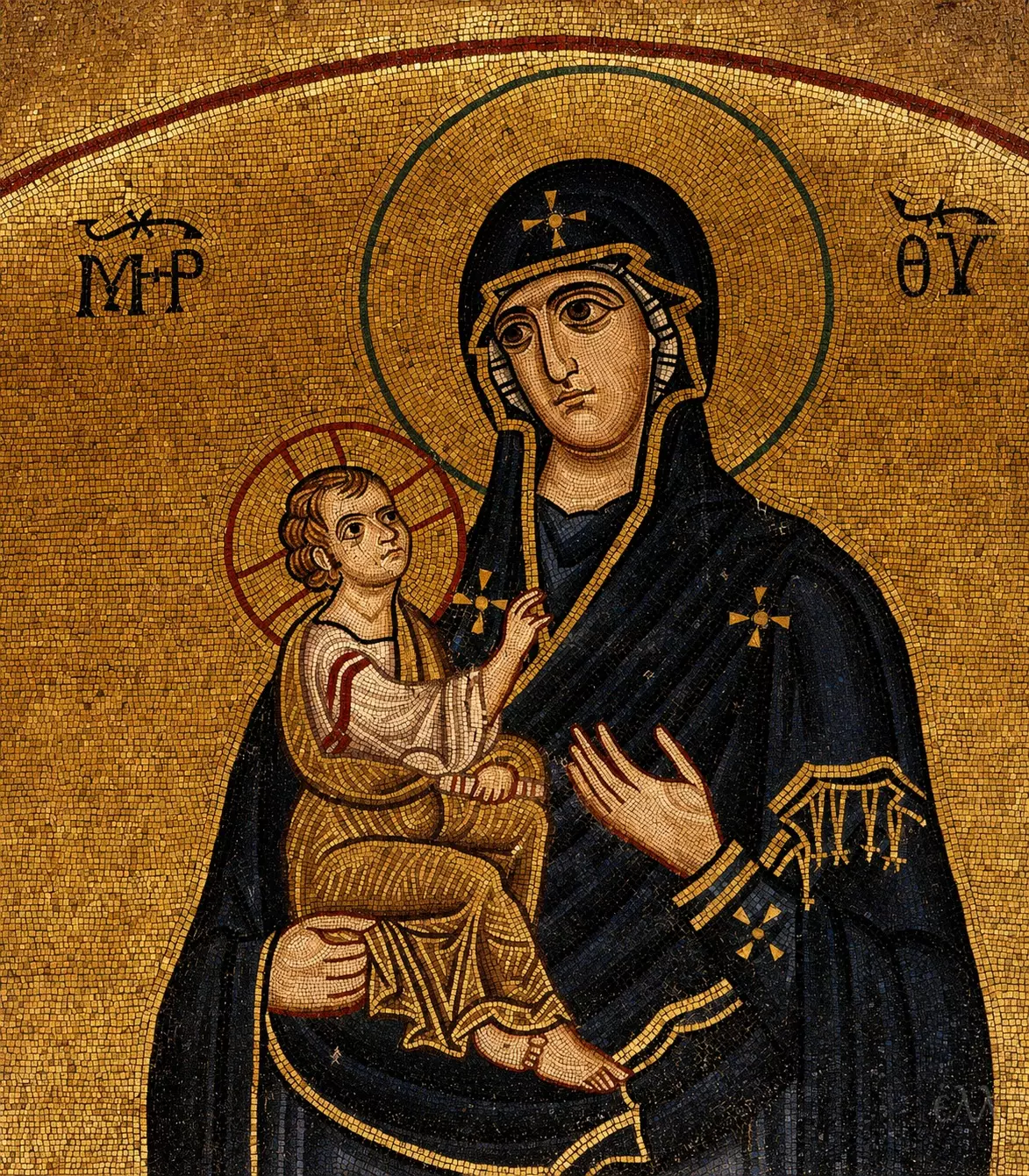
The position of the Christ Child gives the Hosios Loukas Hodegetria mosaic its first distinction: he rests on the Virgin’s right arm, creating the dexiokratousa variant of one of the most enduring Marian types in Byzantine art. Executed during the first half of the eleventh century for the katholikon of the Monastery of Hosios Loukas, on the western slopes of Mount Helicon in Boeotia, the composition occupies the eastern lunette of the south cross-arm, above the zone of marble revetment. The mosaic belongs to the great Middle Byzantine decorative ensemble for which the monastery is celebrated, an ensemble UNESCO places among the major achievements of Byzantine monumental art in Greece.
Dating the katholikon and its decoration has produced more than one scholarly chronology. An early construction date around 1011 has been associated with Abbot Philotheos, while other arguments place important work, including the mosaics, closer to the 1040s. The Hodegetria itself is consistently identified as an eleventh-century mosaic, and specifically as a Hodegetria dexiokratousa. The name of its mosaicist is unknown. In style and conception, however, the work belongs securely to the artistic world traditionally described as the Macedonian period, or, with greater historiographic caution, the “Macedonian Renaissance.”
Hosios Loukas Hodegetria Mosaic: Composition and Gesture
The Virgin emerges at large scale from an uninterrupted gold ground, her dark maphorion creating a broad, almost triangular mass around the smaller figure of Christ. Three gold cross-shaped ornaments punctuate the garment, while narrow gold borders trace its edges and cuffs. Against this dark field, the exposed flesh of the faces and hands becomes especially prominent. The Mother of God supports the Child firmly on her right arm; her free hand turns upward toward him in the identifying gesture of the Hodegetria, presenting Christ as the visual and theological centre of the type.
A subtle departure from strict frontality changes the emotional temperature of the image. The Virgin inclines her head toward the Child and directs her eyes toward him, while Christ turns upward to meet her gaze. His raised hand reaches toward the deep fold of the maphorion near her chest. The gesture reads as an act of contact, with little resemblance to a formal benediction. Within a type governed by hieratic clarity and controlled spatial relationships, the small movement introduces a quieter relation between mother and son, concentrated in the narrow interval between his fingers, her hand and the dark edge of the veil.
The arrangement remains highly disciplined. The Virgin’s large circular nimbus, outlined by a fine green band, establishes the principal geometric field; below it, the smaller cruciform halo of Christ is articulated with red lines against gold. Around both figures the tesserae follow curved paths, their andamento tightening around contours and changing direction at the faces, halos and garment edges. The gold ground therefore has a structure of its own. Rows bend, meet, separate and catch light at slightly different angles, creating the shifting reflective surface characteristic of monumental mosaic. Hosios Loukas preserves extensive gold-ground mosaics across the upper zones of the katholikon, integrated with marble revetment below and contemporary wall painting in adjacent spaces.
Colour is concentrated into a narrow but forceful range: deep blue-black in the maphorion, warm ochres and browns in Christ’s garments and hair, cream and rose tones in the flesh, red accents in the Child’s halo and tunic. The dark mantle absorbs much of the composition’s weight. Small gold lines and ornaments interrupt it sparingly, so that the garment reads first as mass, then as a surface crossed by restrained linear detail. The Child’s lighter clothing, by comparison, breaks into shorter folds and denser changes of direction.
A Detail of the Faces
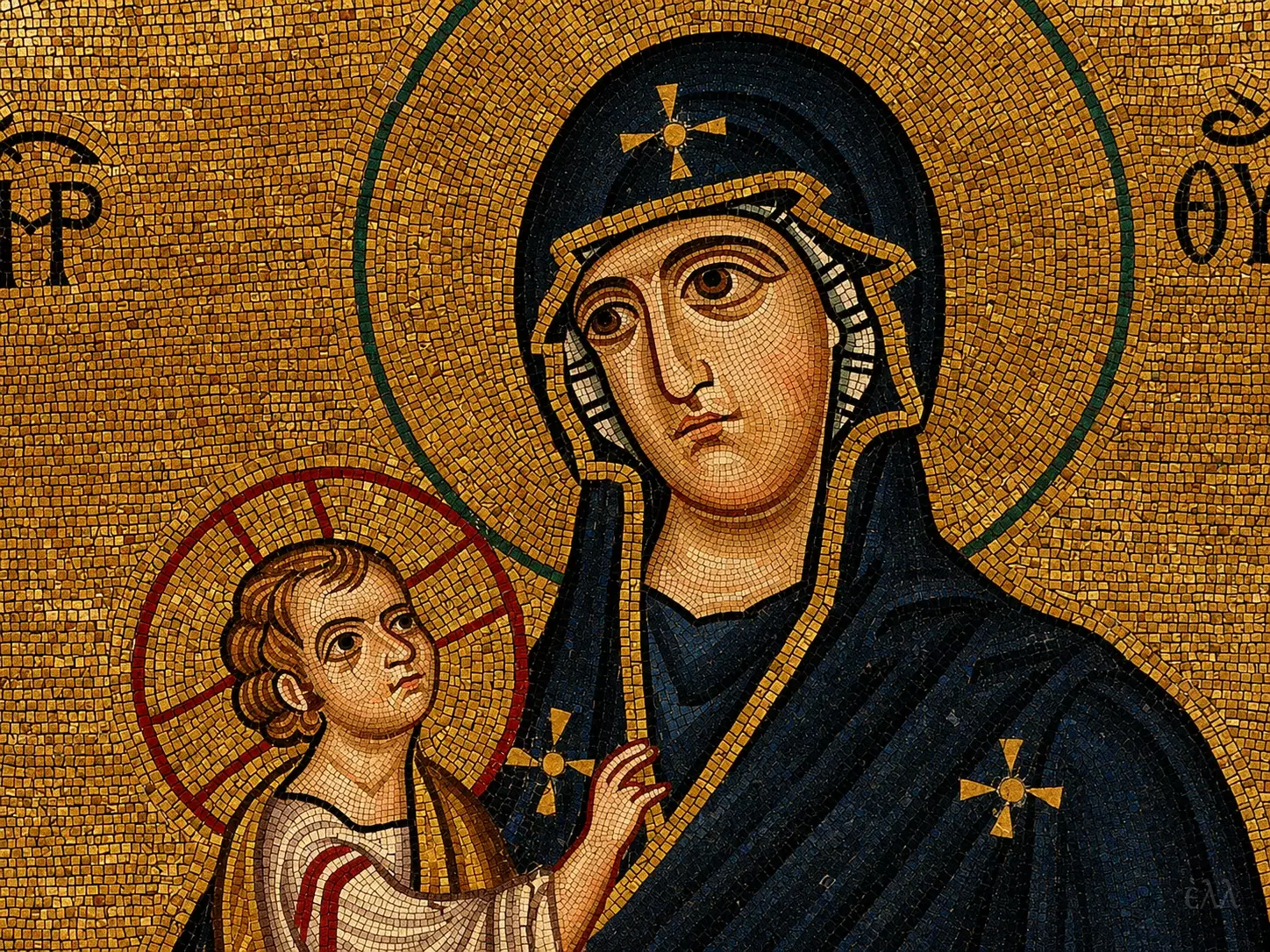
At close range, the mosaicist’s control of facial modelling becomes clearer. The Virgin’s long nose is established by narrow brown contours, with lighter tesserae building the bridge and cheekbones; the mouth is small, edged in red-brown, and the chin softly rounded. Her large eyes dominate the physiognomy. Their slight asymmetry—different in angle and spacing—belongs to the hand-set logic of the mosaic surface and gives the gaze an unusual tension. White and pale-grey tesserae appear between the maphorion and the face, forming the inner veil in crisp, alternating blocks.
Christ’s head is handled with greater compression. Brown curls are arranged in repeated hooks and bands, while the face is constructed from close-set cream, ochre and reddish tesserae. The eyes turn sharply upward. Because the Child is shown in three-quarter movement, the contour of the cheek and nose becomes especially important; a dark line gathers the profile before dissolving into the gold surrounding the halo.
The inscriptions ΜΡ and ΘΥ occupy the field on either side of the Virgin’s nimbus, the conventional Greek abbreviation for Mētēr Theou, “Mother of God.” Their dark lettering is integrated directly into the gold, visually sparse beside the dense modelling of the faces. The designation fixes the identity of the central figure while the iconographic type is carried by gesture: the supporting right arm, the presenting left hand, the Child turned toward his mother, his raised fingers meeting the fold of her maphorion.