
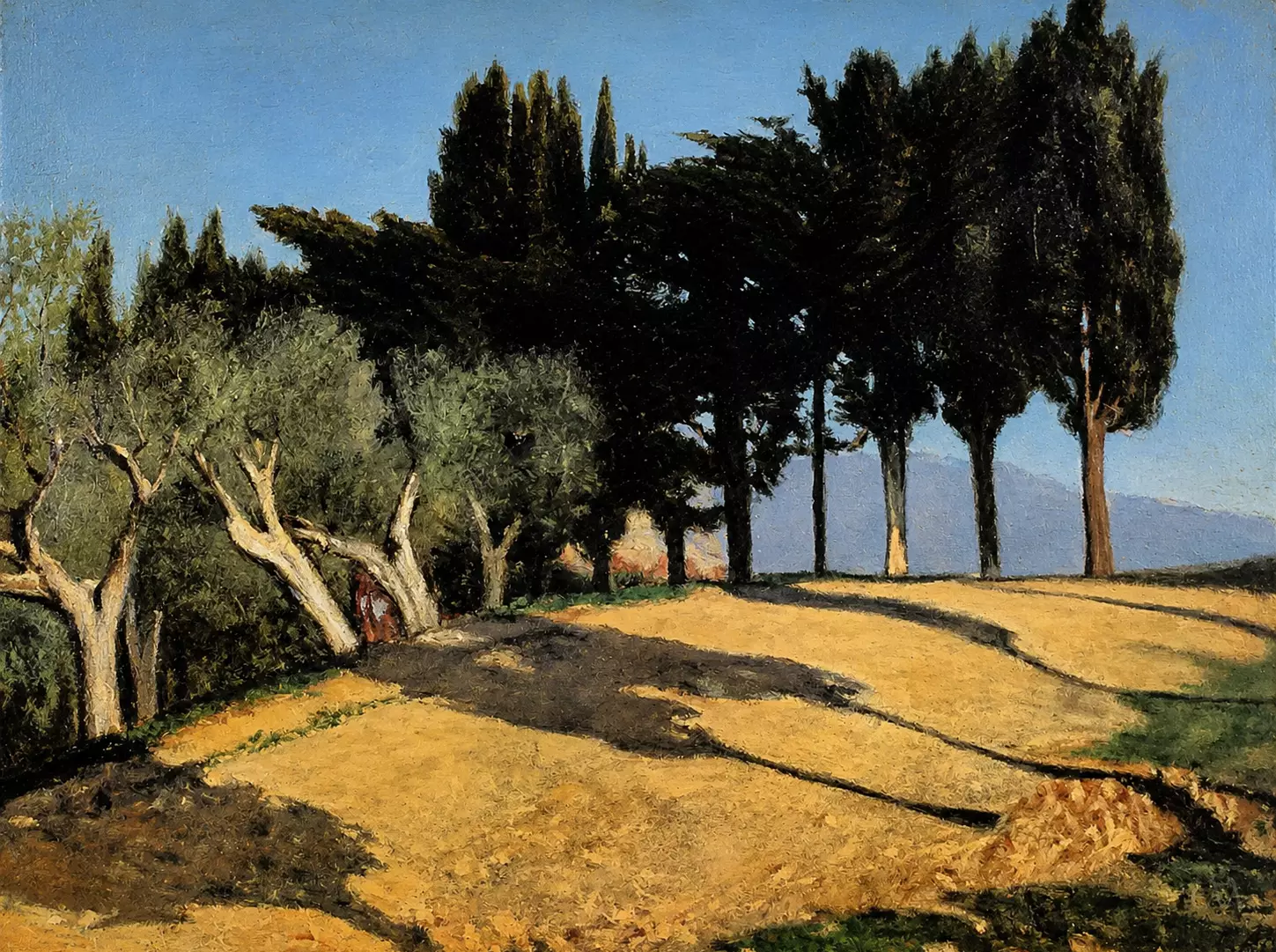
A broad band of sunlit earth rises through Country Road with Cypresses, while above it a dense stand of trees cuts across the blue sky in an almost continuous dark mass. Giuseppe Abbati painted this small landscape around 1860 in oil on canvas; measuring only 28 × 37 cm, it is preserved in the Gallery of Modern Art at Palazzo Pitti in Florence. Within that compact surface, the painter makes light, shadow and the solid shapes of vegetation carry nearly the entire structure of the scene.
The foreground is unusually forceful. Pale, twisted trunks emerge from the darker vegetation on the left, their angular forms set against patches of brown earth, grey-green foliage and the intense yellow of the road. Beyond them, the terrain rises gently toward a row of cypresses whose vertical silhouettes dominate the upper half of the composition. Nothing requires narrative explanation: no figures interrupt the landscape, no distant architecture establishes a picturesque destination. The eye moves through intervals of colour and tone—yellow ground, black-green foliage, blue sky—before following the road into the shaded centre.
Such concentration belongs naturally within the artistic environment of the Macchiaioli, the group with which Abbati became closely associated after settling in Florence. Their experiments centred on direct observation, strong tonal relationships and the construction of forms through areas of light and colour. The Uffizi Galleries describe this approach as a rejection of academic convention in favour of contemporary experience and a simplified pictorial language, with particular emphasis on the effects of sunlight upon volume.
Across the painting, Abbati organises space through large chromatic masses. The brightest passage occupies the lower and central ground: an expanse of ochre-yellow earth whose irregular edges follow the contours of the road and field. Against it fall elongated shadows, deep brown and nearly black in places, spreading laterally across the surface. Their shapes have considerable visual independence. They describe the direction of the sunlight, establish the undulations of the terrain and, simultaneously, divide the foreground into a sequence of interlocking areas.
This method lies close to the principle of the macchia, the “stain” or patch of colour from which the Macchiaioli derived their name. The term entered critical discussion in the early 1860s and referred to a manner of reducing visible reality to relationships of light, shadow and simplified colour, often with detail subordinated to larger tonal structures. In Abbati’s Cloister of Santa Croce, painted in 1861–62, the same investigation became particularly clear: blocks of marble supplied the artist with sharply differentiated volumes upon which sunlight could act. Contemporary critic Diego Martelli specifically associated Abbati’s work at Santa Croce with the study of elementary contrasts of colour and chiaroscuro.
Into vegetation and open terrain, in Country Road with Cypresses, those principles are transferred. The cypresses, massed together and heavily shadowed, form an irregular dark screen. Individual trunks become visible toward the right, slender verticals supporting foliage that merges above into a broader silhouette. Between them appear narrow glimpses of the pale horizon. One reddish-brown trunk at the far right stands apart with particular clarity, while the upper contours of the trees break unevenly against the sky.
Below this canopy, the smaller olive trees introduce another kind of rhythm. Their trunks bend, divide and twist; their foliage, rendered in subdued grey-green and olive tones, has a broken, granular appearance. Most prominent is the pale trunk near the left-centre foreground, which forks sharply upward before disappearing among darker leaves. Its exposed wood catches the light with an intensity close to that of the road. Large forms answer one another across the canvas: pale trunk and yellow earth, dark foliage and cast shadow, vertical cypresses and the more oblique movement of the rising ground.
Light, Colour and Pictorial Space
Abbati gives the landscape depth without filling it with descriptive detail. From the lower edge, the terrain advances through overlapping colour zones before narrowing toward the centre beneath the trees. A curved dark boundary running across the sunlit ground strengthens this recession, while the distant horizon is reduced to a thin, subdued strip beneath the sky. Perspective is present, quietly controlled, yet much of the visual strength comes from the surface arrangement of shapes.
The sky itself is strikingly simple. Pale blue occupies the spaces surrounding the cypress crowns, its relatively uniform luminosity making their silhouettes appear denser. Along the horizon the blue softens, producing a slight atmospheric recession without dissolving the strongly defined foreground masses. Against this cool field, the heated ochres below acquire still greater intensity.
Abbati’s brushwork reinforces that economy. Edges vary from sharply stated boundaries to passages in which neighbouring hues appear to merge through short, visible touches. The vegetation receives a rougher treatment; the open ground, broader areas of pigment interrupted by scattered darker marks. Comparable concerns with light, volume and geometric balance recur in Abbati’s documented landscapes and architectural studies. The Uffizi identifies direct observation of nature, spatial construction and the study of light upon solid form as central to his mature Macchiaioli practice.
Born in Naples in 1836, Abbati received part of his artistic training in Venice before becoming involved with the Florentine circle around the Caffè Michelangelo. During the following decade he worked alongside painters including Silvestro Lega, Odoardo Borrani and Raffaello Sernesi; in 1863 the four were associated with the so-called School of Piagentina, whose painters sought subjects in the countryside outside Florence. Abbati’s career was exceptionally brief: he died in Florence in 1868, aged thirty-two.
Seen within that compressed career, Country Road with Cypresses already contains concerns that would remain fundamental to his painting. Landscape is reduced to a few assertive relationships, yet observation remains acute: the irregular growth of the trees, the changing density of foliage, the angle of sunlight, the weight of shadow across uneven ground. At the centre, partly enclosed by the dark trees, a small opening of warm colour leads the eye deeper into the scene before the road returns to full illumination.