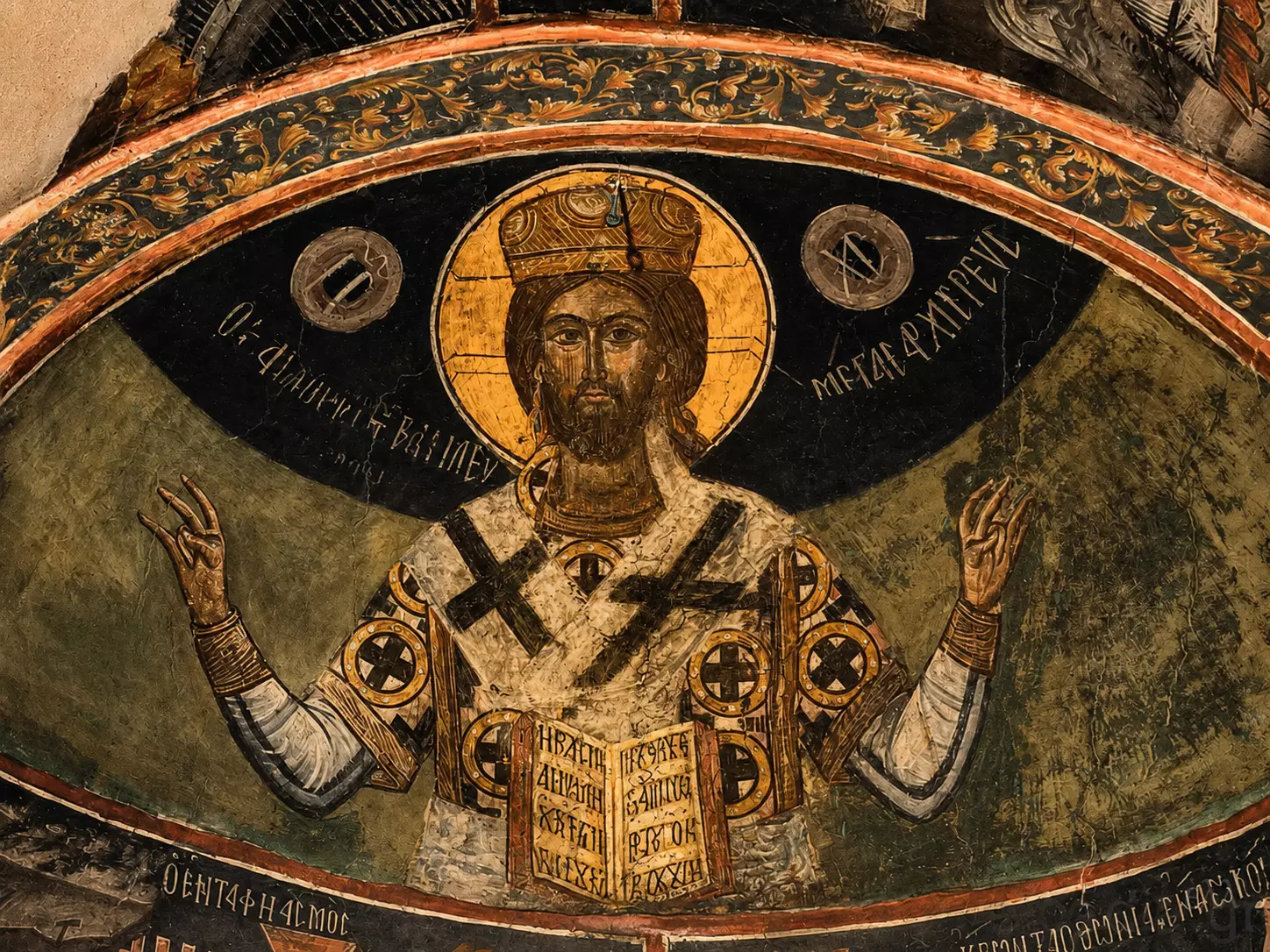
In 1620, the painter Georgios Moschos created one of the rarest compositions in Post-Byzantine painting within the katholikon of Chrysafa Monastery in Laconia: Christ depicted as King of Kings and Great High Priest. This semi-spherical fresco is situated inside the niche of the prothesis, where the half-length figure occupies the center, facing forward and blessing with both raised hands. He wears vestments including a patriarchal sakkos embroidered with pearl-adorned circles and crosses, alongside an omophorion featuring large cross patterns, while a mitre rests upon His head along with earrings. The monument, known today as the Monastery of the Forty Saints, is located in the Chrysafa region, eight kilometers from Sparta, amid dense vegetation of kermes oaks and cypresses, ranking among the most significant ensembles of Post-Byzantine painting in Laconia.
Moschos originated from Nauplio, a city experiencing economic and intellectual prosperity during the early 17th century. Alongside his brother Demetrios, he is counted among the most notable wall-painters of the period. The founder’s inscription preserves his name with characteristic humility as “least painter,” a common convention in the art of the era. The composition in the prothesis combines Christ’s royal and priestly offices into a single iconographic scheme, a rare feature in 17th-century monumental painting.
Iconography and Post-Byzantine Art in the Prothesis
The figure occupies nearly the entire semi-dome. Set against a stark black background devoid of landscape elements, only the circular golden halo appears, emphasizing the supernatural dimension of the depiction through color contrast. The stern face, featuring deeply lined eyebrows and set eyes, follows the established Byzantine Pantokrator type, minus the softness frequently seen in other contemporary representations. To the right and left of the halo, monograms of His name appear in circles, while higher up in the dark background, an inscription identifies the subject: “KING OF KINGS, GREAT HIGH PRIEST.”
Vestments and Symbolism
The attire renders the high-priestly rank of the figure in detail. The heavy sakkos features rows of pearl-adorned circles enclosing small crosses, with the intervening spaces filled with cross motifs to create a dense decorative surface. Over the sakkos, the omophorion with large dark crosses running diagonally across the chest completes the image of priestly authority. The decorated mitre and the earrings add an impression of imperial majesty, fitting for an era when the painter sought to express both the royal and sacerdotal dimensions of Christ.
An open codex floats before the figure, bearing a passage from the Gospel of John: “MY KINGDOM IS NOT OF THIS WORLD.” This text selection directly mirrors the meaning of the composition: the kingdom attributed here to Christ does not belong to earthly powers, despite the borrowed iconographic elements. The book, rendered with painted letters and leafing, serves as a written proclamation parallel to the painted inscription above. Beside it, in the dark background panels, two additional small inscriptions remain illegible, worn away by time and moisture.
The execution of this composition fits into the broader output of a workshop active for approximately forty years. Working alone in 1620 following the death of his brother Demetrios, Georgios Moschos had already decorated the katholikon of Voulkano Monastery in Messenia, as well as churches in Amyales and Koumbari. In 1620, he also painted the nearby church of Saint Nicholas in Chrysafa. Research into the brothers’ workshop reveals influences from Northern Greek painting, icon-painting techniques from the Cretan School, and Western iconographic borrowings, all maintained within a strict Palaiologan framework.