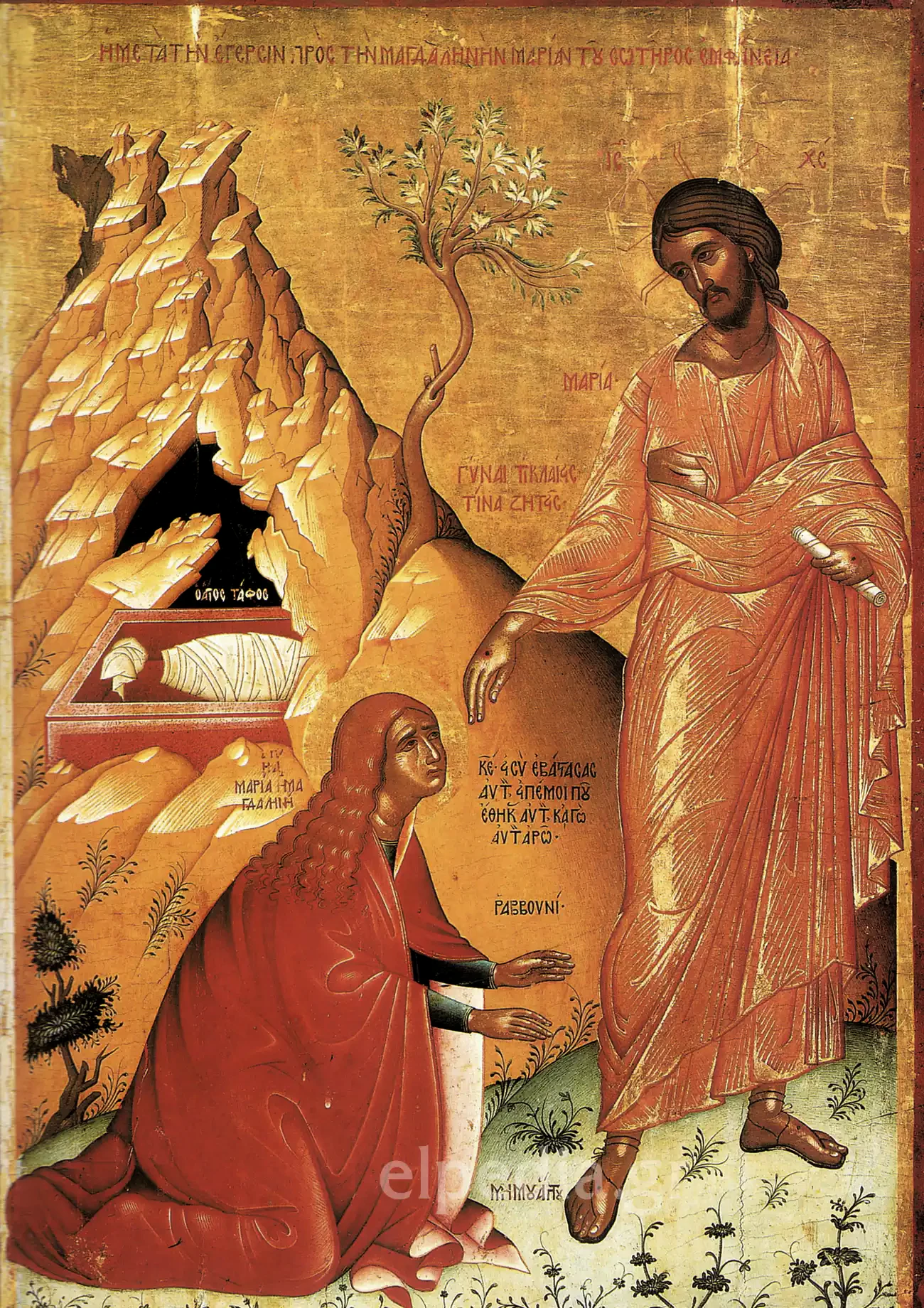
Signed by Emmanuel Lambardos and dated 1603, the Noli me Tangere now preserved in the Museum of Icons of the Serbian Orthodox Church Community in Dubrovnik belongs to the mature phase of Cretan painting at the turn of the seventeenth century. Scholarly literature specifically records the Dubrovnik icon under Lambardos’s name and with the date 1603. The subject comes from John 20:15–17: Mary Magdalene, standing outside the empty tomb, initially takes the risen Christ for the gardener; recognition follows when he calls her by name, and the encounter is marked by the words Μή μου ἅπτου, conventionally rendered in Latin as Noli me tangere. The icon condenses this exchange into two principal figures, a tomb, a sparse landscape and a field of inscriptions.
Within that economy, movement is carefully measured. Christ stands at the right, tall and slightly inclined toward Mary, while she kneels at the left and reaches forward with both hands. Between them lies a narrow interval that carries much of the narrative force. The relationship between gesture and distance is unusually exact: Mary advances, Christ acknowledges her, yet his lowered right hand defines the space that remains between their bodies. Around this encounter Lambardos retains the gold ground and strongly linear organization associated with the Byzantine tradition, while the freer treatment of posture, landscape detail and human response belongs to the broader visual culture of Venetian Crete. Comparable Cretan treatments of the subject likewise combine Byzantine conventions with Western elements.
Composition and the Empty Tomb
The composition rises along a diagonal from the kneeling Magdalene to the standing Christ. Mary occupies the lower left foreground, her broad red mantle spreading across the ground and giving her figure considerable visual weight. Christ, placed higher and farther to the right, is elongated by the nearly vertical fall of his garments. Their differing levels produce a restrained instability: the scene is balanced, although its balance depends on opposing directions, the upward movement of Mary’s gaze and hands against Christ’s downward glance and extended arm.
At the upper left, jagged ochre rocks open around the dark cavity of the tomb. A rectangular sarcophagus projects forward from the cave, and within it the white burial cloths remain visible. The contrast is abrupt — black recess, white linen, red-brown edge of the tomb — so the absence of Christ’s body becomes legible before any inscription is read. Between tomb and figures grows a thin tree with irregular branches and small leaves. Its trunk bends as it rises, interrupting the gold field with an organic line quite different from the angular mountain forms nearby.
Spare but observant, the ground itself scatters small plants, tufts and dark flowers across pale green earth, especially around Christ’s feet and along the lower edge. Such details introduce a modest sense of cultivated nature into a pictorial space still governed by the gold ground. No continuous atmospheric distance is attempted. Rock, tree, tomb, grass and figures hold successive zones with compressed depth, their relative scale and overlap sufficient to establish the setting.
Across the upper margin, a red titular inscription identifies the appearance of the Saviour to Mary Magdalene after the Resurrection. Additional Greek inscriptions are woven into the encounter. Christ’s question, “Woman, why are you weeping? Whom do you seek?”, Mary’s response, the name “Mary”, and “Rabboni” turn the gold field into an active textual surface. Such Gospel dialogue is characteristic of Cretan versions of the Noli me Tangere, in which inscriptions may reproduce substantial portions of the exchange between Christ and Mary. Word and gesture develop together, the painted dialogue occupying the same space through which the figures look and reach.
The Risen Christ: Gesture, Drapery and Pictorial Authority
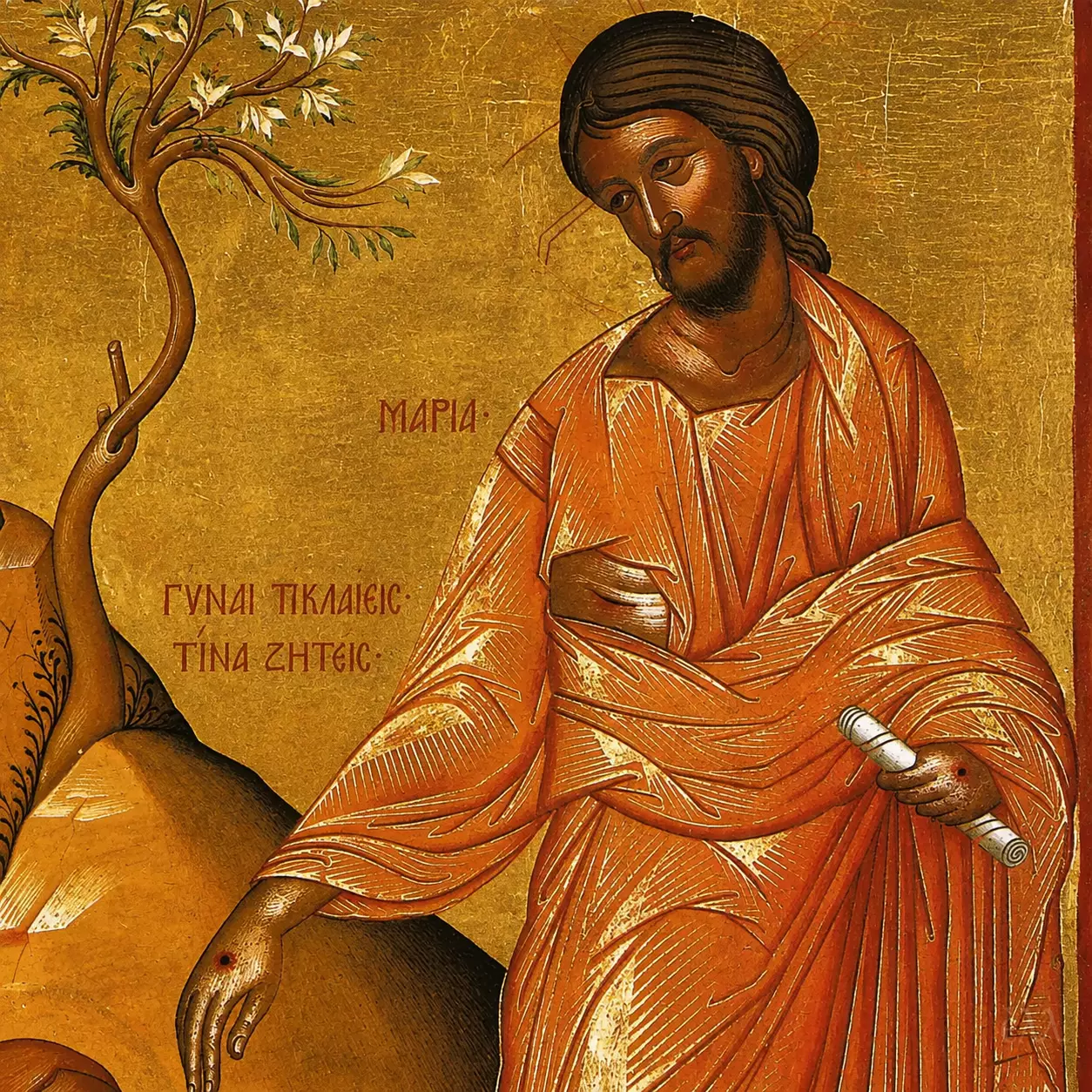
Seen at closer range, Christ’s figure depends on controlled linear energy. His head inclines toward Mary, framed by a cruciform halo whose fine outlines stay clear against the gold ground. The dark hair is arranged in smooth, repeated bands, while the face is built through warm brown flesh tones, narrow highlights and sharply described features. The gaze is lowered. It meets the narrative below him without disturbing the solemnity of the three-quarter presentation.
His garments are especially dense. An orange-red tunic and mantle fall in long folds articulated by pale, almost metallic highlights, some running parallel, others breaking into angular clusters around the torso, elbow and knees. These linear accents flatten and animate the drapery at once. In his left hand Christ holds a rolled scroll; his right arm descends toward Mary, the hand open and relaxed, its placement defining the prohibition embodied in the title.
The figure also shows the kind of stylistic coexistence characteristic of Cretan painting under Venetian rule. Byzantine conventions remain structurally decisive — the gold ground, halo, inscriptions, linear drapery and hieratic clarity — while the turning body and more responsive relationship between the two protagonists admit a heightened interest in physical action and psychological exchange. Cretan representations of Noli me Tangere remained popular into the seventeenth century, and surviving examples demonstrate sustained contact between established Byzantine pictorial forms and Renaissance-derived motifs.
Mary Magdalene: Supplication, Recognition and Colour
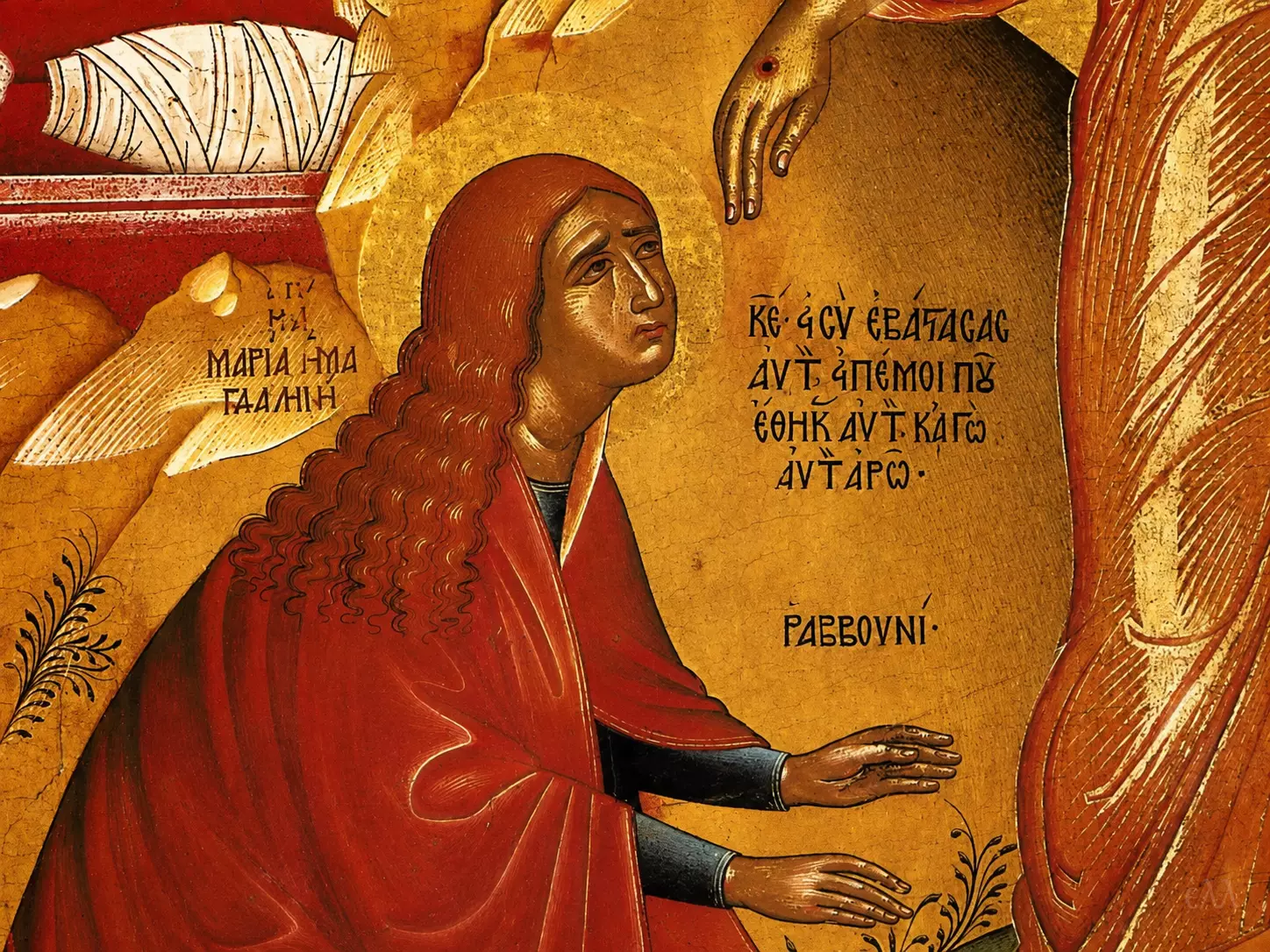
More expansive in contour and more emotionally exposed, Mary Magdalene forms the counterweight to Christ. She kneels deeply, the body almost entirely enclosed by a saturated red mantle whose broad surface is interrupted by only a few long, curling lines. Beneath it appear dark sleeves and a narrow strip of pale fabric. Her two hands extend in parallel toward Christ, palms turned slightly upward, creating a repeated horizontal movement across the lower centre of the icon.
Her uncovered hair is equally important. Long reddish-brown locks descend in dense waves over the shoulders and chest, softening a composition otherwise dominated by angular rock, hard-edged folds and straight inscriptions. The face turns sharply upward, with elongated nose, arched brows and eyes fixed on Christ. The uncovered, flowing hair of Mary Magdalene also appears in other Cretan versions of the theme and has been connected in scholarship with Western Renaissance prototypes circulating in Venetian Crete. In the detail, the emotional exchange is concentrated into a small cluster of forms: lifted gaze, parted lips, reaching hands, the name “Rabboni” nearby.
Even at this point of greatest intensity, the spatial separation between the figures remains intact. Mary fills the lower field with red; Christ occupies the higher zone in orange and gold; between them the open gold ground and the downward gesture preserve a slender visual pause. Behind Mary, the empty tomb still intrudes into the scene, its white cloths visible above her shoulder, so recognition of the living Christ remains visually connected with the evidence of the vacated grave.
For Lambardos, working within the Cretan School around 1600, the subject offered an unusually direct encounter between sacred narrative and human response. His documented activity belongs to a period in which Cretan icon painters sustained established Orthodox iconographic traditions while working amid intense artistic exchange with the Venetian world. The icon keeps the event within the formal discipline of post-Byzantine painting, yet small deviations carry remarkable weight: a tree bending between the figures, flowers dispersed across the ground, Mary’s hands advancing by a few inches, Christ’s fingers lowered above them.