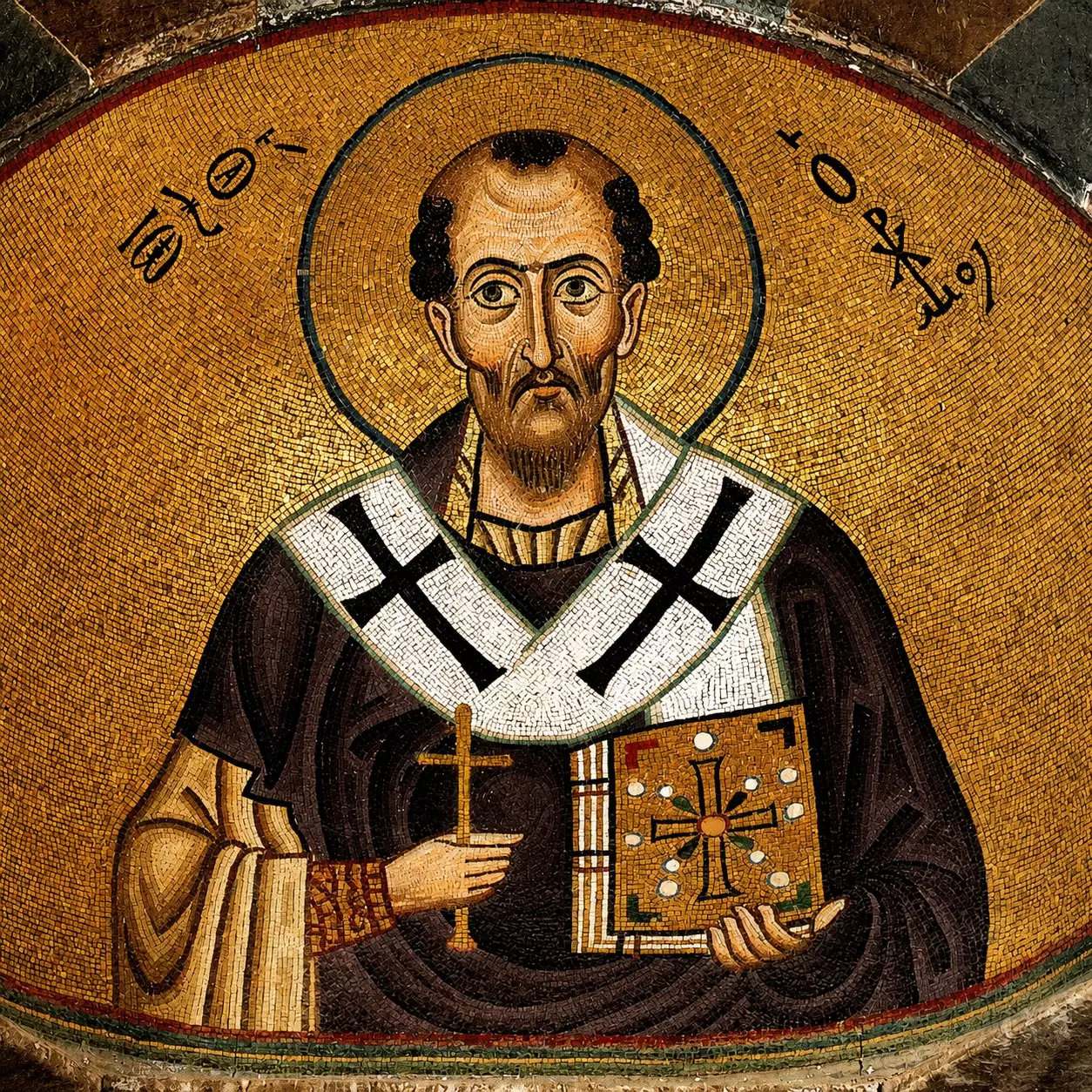
Against an unbroken field of gold, Saint John Chrysostom appears with the concentrated severity characteristic of the eleventh-century mosaic decoration of the katholikon at Hosios Loukas in Boeotia. The anonymous mosaicist presents the Church Father frontally, enclosed within a shallow niche and identified by a Greek majuscule inscription divided on either side of his halo. The monastery’s digital collection dates the work to the eleventh century and locates the saint among the mosaic busts placed in the small niches beneath the galleries of the main church.
Almost the whole composition depends upon the encounter between the figure and the gold ground. Spatial depth has been compressed until the saint seems to occupy a pictorial field detached from ordinary physical surroundings. Yet his face possesses remarkable plasticity. Across the forehead, cheeks and narrow nose, minute tesserae in ochre, brown, cream and subdued green establish successive tonal transitions. The effect is controlled, dense, occasionally severe. Hosios Loukas belongs to the group of major Middle Byzantine monasteries whose gold-ground mosaics UNESCO identifies among the outstanding achievements of eleventh- and twelfth-century Byzantine art.
Form and Authority
Most striking is the physiognomy. A high, almost bare forehead rises above deep-set eyes; dark curls remain at the sides of the head, while the short, sparse beard narrows toward the chin. Fine lines extend around the eyes and across the cheeks. Through them, the mosaicist builds a face that seems worn and intensely alert, its austerity heightened by the thin lips and strongly articulated nose. The gaze shifts slightly toward the saint’s left, breaking the absolute rigidity that a fully axial stare would have imposed.
The tesseral construction deserves close attention. Dark units define the eyebrows and contours of the nose, then gather around the eyes and beard; lighter tesserae form narrow bands across the forehead and the illuminated side of the face. Individual pieces remain plainly visible. Their orientation follows the forms they describe, so that line and colour work together to create volume. Around the head, concentric courses of gold tesserae reinforce the circular halo, while the surrounding field expands outward in gently changing alignments. The monastery itself emphasizes the unifying role played by gold tesserae throughout the katholikon, whose mosaic programme contains over 140 saintly portraits together with nine scenes from the life of Christ.
Episcopal Vestments and the Gospel Book
Across the shoulders lies the white omophorion, marked by large black crosses and edged with a narrow green border. Its pale surface cuts sharply across the dark episcopal vestment beneath, creating one of the strongest geometric structures in the image. Heavy areas of deep brown and purple gather around the torso; within them, the folds are restrained, broad, almost architectural. The body consequently acquires considerable mass despite the shallow pictorial space.
In his left hand Saint John supports a closed Gospel book with a richly ornamented cover. A central cross dominates its surface, surrounded by coloured elements and pale circular ornaments resembling pearls or inset stones. The rigid rectangle of the codex introduces another compact geometric form beside the sweeping curves of the omophorion. His long fingers curl beneath its lower edge, carefully articulated against the gold and dark fabric.
The saint’s right hand emerges from the heavy folds on the opposite side and holds a small cross. Because much of the arm is concealed beneath the dark vestment, hand and object initially appear unusually isolated. Anatomical placement clarifies the arrangement: the wrist continues naturally from beneath the cloth, the fingers turn inward around the slender shaft, and their distance from the shoulder accords with the hidden forearm. Within such compressed imagery, a small gesture carries considerable visual weight.
Saint John Chrysostom, bishop of Constantinople and one of the principal Church Fathers represented repeatedly in Byzantine ecclesiastical programmes, is therefore defined through a carefully limited group of signs—episcopal vestments, Gospel book, cross, inscription, distinctive physiognomy. At Hosios Loukas these elements enter the austere artistic language of the wider mosaic ensemble, a programme in which frontal saints, narrative scenes, marble revetment and gold surfaces were conceived as parts of the same monumental interior. The monastery’s documentation associates the exceptional quality of its mosaics with artistic connections to Constantinopolitan workshop traditions.
Even within that formal discipline, small variations keep the figure visually active: the displaced gaze, alternating warm and cool flesh tones, uneven fall of the omophorion, slender fingers against the dark garment. In the face especially, closely set tesserae turn minute changes of colour into modelling, leaving the strongest shadows beside the nose, beneath the cheekbones and among the sparse strands of the beard.