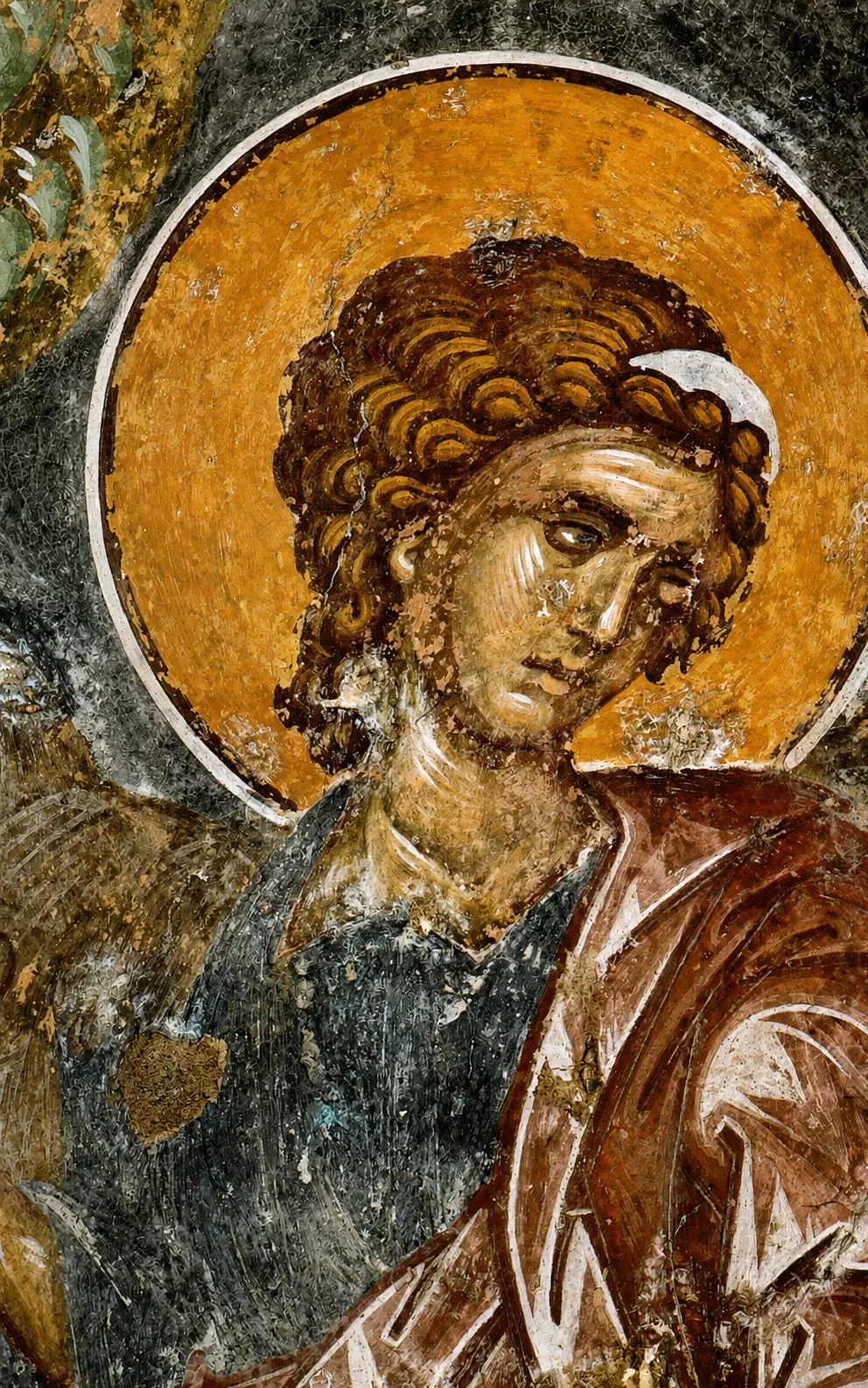
A youthful angel turns his head downward beneath a broad ochre halo, his dense curls held by a narrow white band. The surviving figure belongs to a Byzantine representation of the Ascension of Christ and was originally placed in the southern group of the composition, among apostles witnessing the departure of Christ. Its painter is unknown. Only the upper portion survives clearly—the head, part of a wing, the shoulders and sections of the garments—yet the fragment retains enough of the original painted surface to reveal an artist attentive to facial modelling, rhythmic line and a restrained palette.
The Ascension was one of the Great Feasts represented repeatedly in Byzantine monumental programmes. According to the New Testament narrative, Christ ascended forty days after the Resurrection before his followers. In Byzantine imagery he is conventionally raised above the earthly group within a mandorla, while the Theotokos occupies the lower centre and apostles gather around her; two angels commonly stand among them, directing attention toward the heavenly event. This archangel belonged to that lower register, a participant within a larger dramatic arrangement. The absence of a legible identifying inscription prevents a secure identification as Michael or Gabriel, and the visual evidence gives no reason to choose between them.
Within the preserved fragment, the turn of the head establishes the strongest movement. The face is presented in a three-quarter orientation, inclined and slightly lowered, with the eyes directed obliquely downward. That shift of gaze helps reconnect the fragment to the lost action of the Ascension, in which angels and apostles are linked by gestures, glances and the upward pull of the composition. Even without the surrounding figures, the pose retains something of that interrupted exchange.
Around the head, the halo forms a large ochre disc edged by a pale band and a darker inner contour. Its warm field intensifies the dark mass of the hair, organized into repeated curls of brown, deep red-brown and yellow-ochre highlight. The locks are compact, almost sculptural in rhythm, though individual curls expand and contract across the crown and temples. A white ribbon crosses the hair above the forehead and reappears near the temple. Such bindings belong to a long classical inheritance in representations of youthful winged figures and were absorbed into the visual vocabulary of Byzantine angels.
Below the halo, the clothing introduces a more angular rhythm. A dark grey-green tunic forms the central field of the torso, while a rose-red mantle crosses the shoulder in broad folds sharpened by pale linear accents. The remaining wing is constructed with narrow overlapping strokes in muted grey-green and brown. Its feathering is described through repeated lines, close enough to observed plumage to give the wing material presence. Broad chromatic areas govern the figure at a distance; closer inspection reveals small, rapid linear incidents.
Facial Modelling, Proplasmos and the Painted Surface
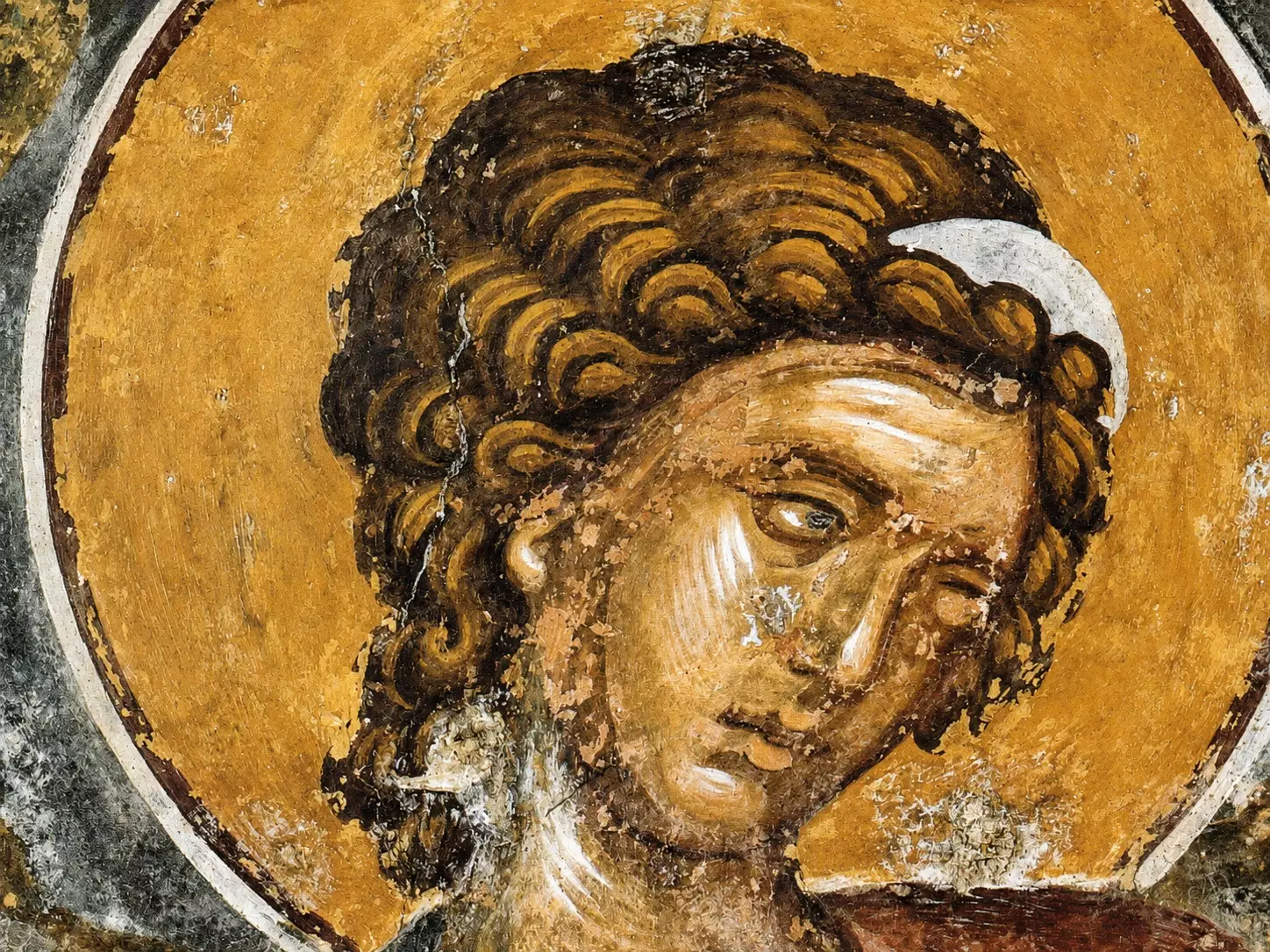
At close range, the face reveals the painter’s method more clearly. A brownish underlayer remains visible around the eyes, cheeks and sides of the nose, while warmer flesh tones and progressively lighter strokes build the projecting forms. The forehead and bridge of the nose receive the sharpest accents. Fine pale lines run beside the nose and beneath the eyes; elsewhere they broaden into small patches of light across the cheekbones and chin. This layered progression corresponds to the Byzantine practice commonly described through proplasmos and successive highlighting, although abrasion and pigment loss interrupt the extant surface.
The eyes are almond-shaped and heavily outlined, with dark upper lids giving weight to the lowered gaze. Curving brows approach one another above the long, narrow nose. The mouth is compact, formed with a dark dividing line and restrained highlights along the lips. What emerges is a contemplative physiognomy, youthful yet grave, its expression carried by the slight asymmetry between the tilted head, lowered eyes and firmly drawn features.
Damage has altered this modelling substantially. Cracks pass through the halo and hair, while numerous losses break the paint film across the cheeks, ear, neck and garments. Small abrasions expose lighter underlying material, producing a granular surface over passages that were once more continuous. The losses are especially dense around the lower face and neckline, where preserved highlights now alternate with bare interruptions. Painted plaster, fissured and worn, still holds the principal contours of the head.
Executed with water-borne pigments on fresh lime plaster, the painting belongs to the fresco tradition; Byzantine mural practice could also involve details added after drying. Technical precision remains important because the present appearance records both original execution and subsequent deterioration. The remaining paint nevertheless shows a disciplined sequence of dark base tones, middle values and bright accents, especially in the face and curls, where each addition remains legible as a separate stroke.
Seen in detail, the strongest impression comes from the balance between controlled line and soft modelling. Hair, wing and drapery depend on repeated linear marks; the face is built through broader tonal transitions, then tightened with highlights around the eyes, nose and mouth. Against the expansive ochre halo these passages remain concentrated around the inclined head. Near the forehead, the white ribbon passes beneath the curls and disappears into the dark mass of hair.