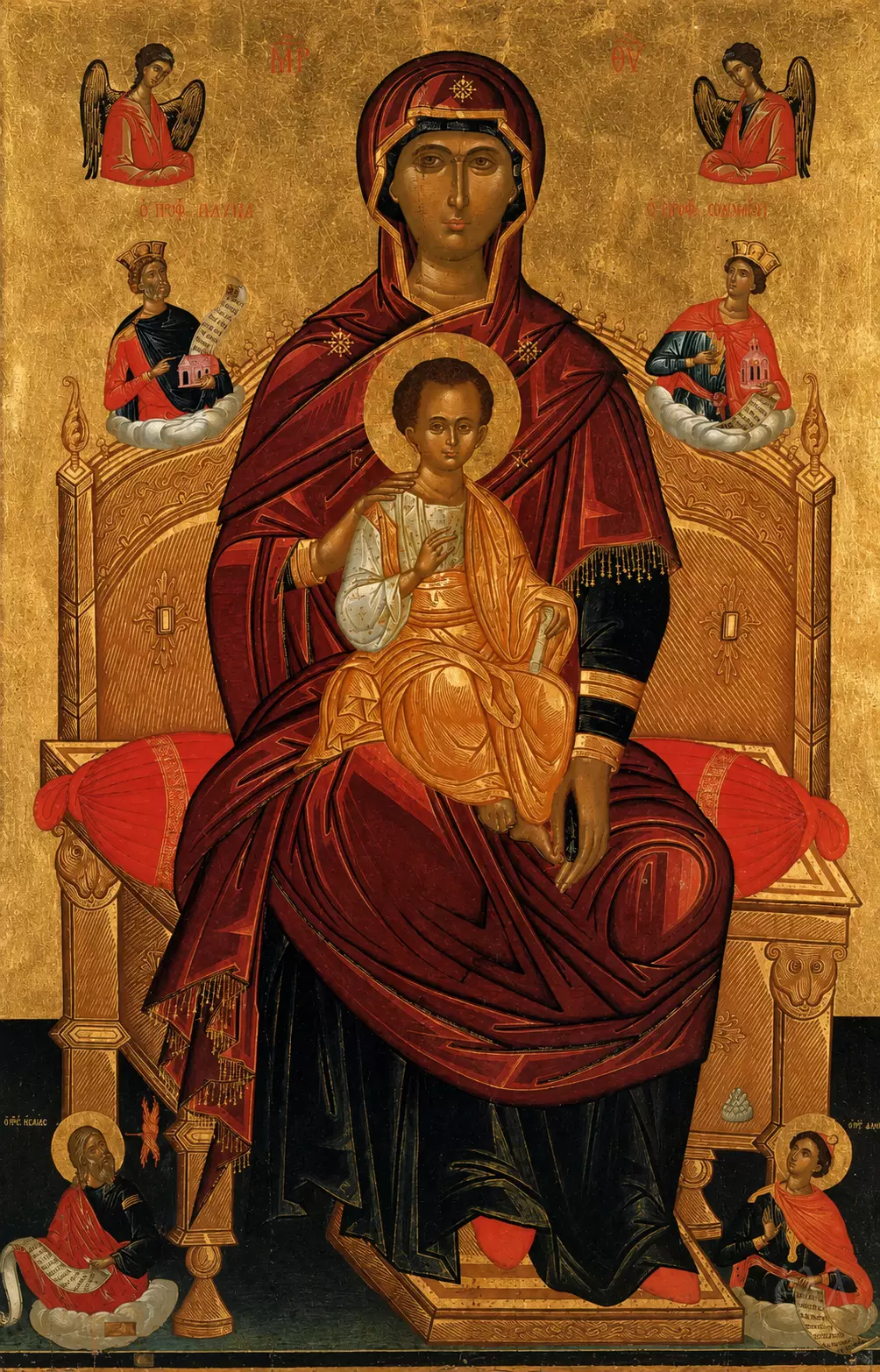
A wooden panel of modest yet substantial scale, some one hundred and twenty by seventy-seven centimetres, covered in burnished gold leaf and worked throughout in egg tempera, preserves within the Church of Saint Anthony in Corfu an icon long known as the Kyria ton Angelon, the Lady of the Angels. Its execution is generally placed around the year 1500, precisely the moment at which the Cretan School reached its fullest maturity, and connoisseurship assigns the panel not to Andreas Ritzos himself but to an anonymous painter active within his circle in Candia — the master usually credited with having fixed this particular iconographic formula, an enthroned Theotokos holding the Christ Child before a court of archangels and prophets, into something approaching a workshop standard. Compositions of this kind, produced in quantity by Cretan workshops through the fifteenth and sixteenth centuries, carried far beyond the island the visual vocabulary that Byzantine painting had spent centuries refining; Corfu, tied to Crete by trade, emigration, and shared Orthodox patronage, received such works readily, and the present icon belongs squarely to that current of transmission. What survives on the panel is a dense, hierarchically structured composition: the Virgin dominates the centre, seated upon an elaborately carved throne, the Child held at her side, while smaller figures occupy the upper corners and the lower register, each contributing its own layer of theological commentary to the central image.
Composition of the Kyria ton Angelon Icon
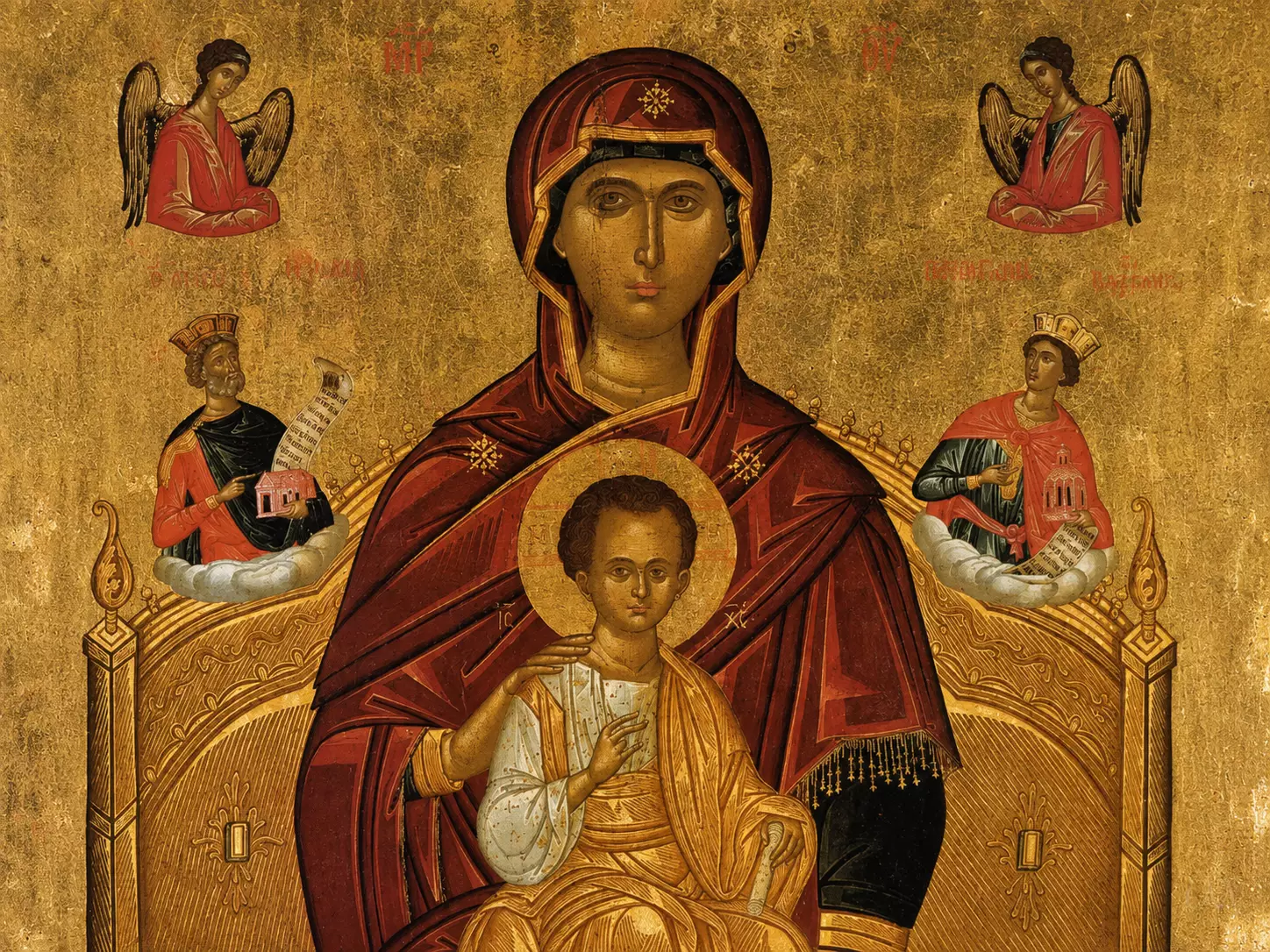
The Virgin fills the greater part of the panel, frontal and hieratic, her face rendered with the elongated, deep-set eyes and narrow, slightly aquiline nose characteristic of Cretan facial types of this period. A dark wine-red maphorion, patterned throughout with fine gold striations, wraps her head and shoulders and falls in broad, angular folds toward the base of the throne; beneath it, at the hem, a darker under-garment is just visible. The Child sits upon her left arm, turned three-quarter toward the viewer rather than fully frontal, his halo inscribed with the cruciform bars conventional to representations of Christ, the abbreviated Christogram set beside his head. A further inscription identifying the Theotokos occupies the gold field above. Her right hand rests at his shoulder, a gesture more supportive than demonstrative, and in this respect the group departs somewhat from the pointing hand of the strict Hodegetria formula, leaning instead toward the gentler, more enclosed relationship favoured in several Cretan variants of the enthroned type. Both figures are set against a throne of considerable architectural ambition — a high, straight back terminating in flame-like finials, a seat cushioned in red and edged with gold striping, and, carved into the arm, a small grotesque mask whose lion-like features recall the decorative repertoire of contemporary woodwork rather than any specifically theological programme.
Archangels and Prophets: The Celestial Court
Two winged archangels occupy the uppermost corners of the panel, each dressed in red, each inclined slightly toward the central group in a gesture of veneration rather than active address. Below them, flanking the throne’s high back, stand two crowned figures, robed in red over dark green, each holding an open scroll in one hand and a small architectural model — reduced to the scale of a toy, pink-walled and gabled — in the other. Figures of this kind, paired kings bearing scrolls and building-forms, are conventionally identified in Cretan compositions of the enthroned Theotokos as David and Solomon, whose psalms and temple were read by Byzantine exegesis as prefigurations of the Virgin herself; the present icon offers no obvious reason to depart from that reading, though the accompanying texts are not resolvable with certainty. Lower still, at the very base of the throne, two further prophetic figures kneel upon stylised clouds, their scrolls unfurled before them. One, on the Virgin’s right, is identified by an accompanying inscription as the prophet Isaiah; his companion, seated opposite, is rendered as a notably younger, beardless figure, similarly absorbed in the unrolling of his own text. Together the six subsidiary figures construct a kind of visual chorus, each contributing a fragment of prophecy to the central image of the Incarnation, their symmetrical disposition around the throne reinforcing the strict axial balance of the whole.
Materials, Palette, and the Cretan Workshop Tradition
Technically the icon belongs to the working methods standard in Cretan ateliers of the period: a wooden support prepared with a gesso ground, gilded before the figures were laid in, and painted in egg tempera built up through successive layers of modelling, from a dark underpaint toward the lighter flesh tones of the final highlights. The gold ground, left exposed around the figures, does more than supply a luminous field; it collapses spatial depth altogether, refusing any illusion of an architectural interior beyond the throne itself. Colour is handled with some restraint — the dominant wine-red of the maphorion, articulated by gold striations rather than by shading, is set against the cooler dark green of the angels’ and prophets’ undergarments and the black of the Virgin’s inner robe, with red recurring in the throne’s cushions and drapery to unify the lower register with the figures above. Workshops of this kind, clustered in Candia under masters such as Ritzos, worked to a considerable degree from repeatable patterns, a fact that accounts for the close family resemblance between panels of this type now scattered across churches and collections from Crete to the Ionian Islands and beyond. The Corfiot panel, whatever the precise identity of its painter, stands as a competent and faithful witness to that production: less an isolated invention than a carefully executed instance of a formula perfected elsewhere and carried, along with the painters themselves, wherever Orthodox communities required its particular theological argument restated in paint and gold.