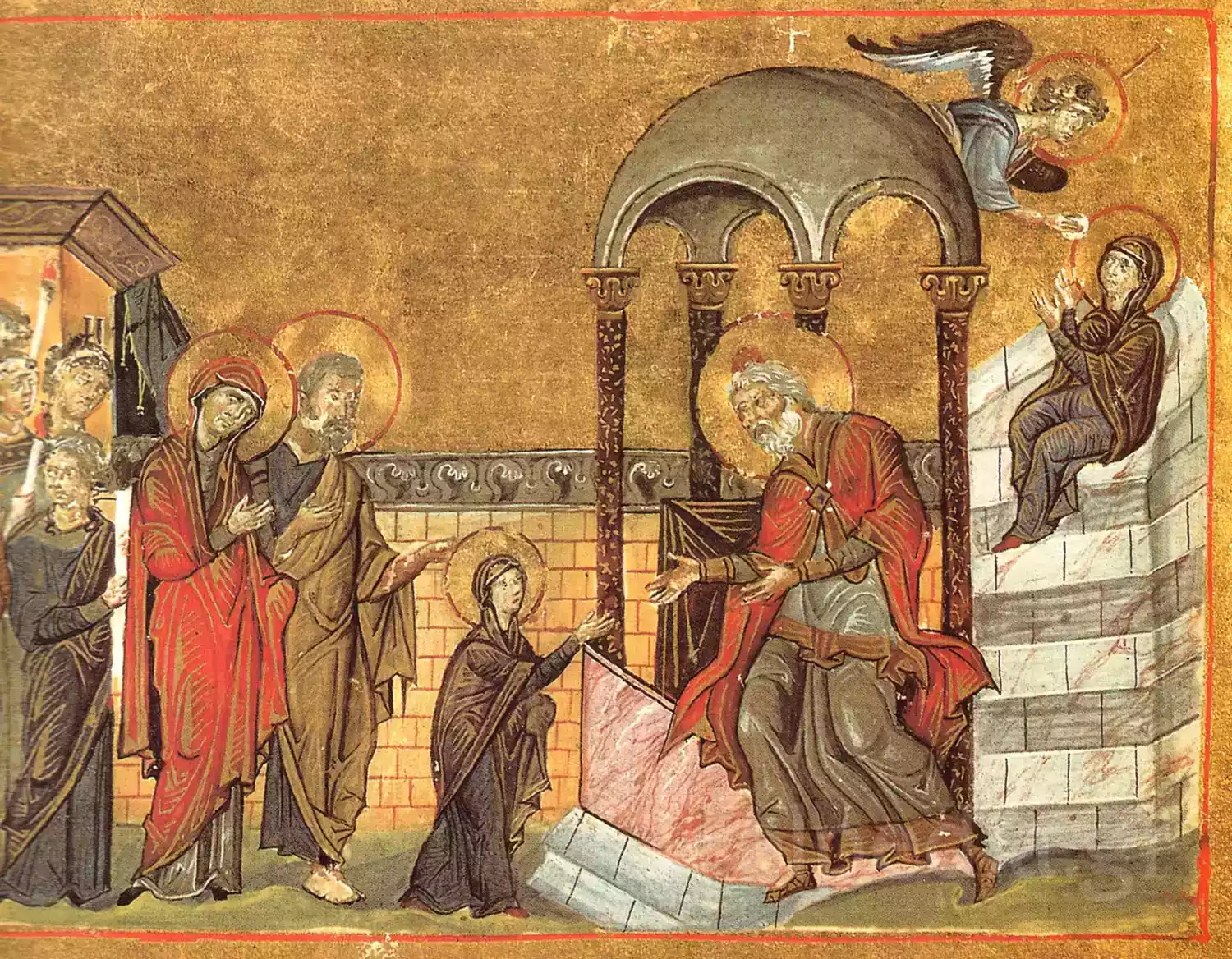
Few Byzantine manuscripts preserve, with such density of images, the theological imagination of an entire empire as the Menologion of Basil II. It is a codex of synaxarion content, crafted around 985-986 in Constantinople for the eponymous emperor, which is kept today in the Vatican Apostolic Library. Among its approximately 430 miniatures, the work of eight painters whose names were recorded, unusually for the time, beside each representation, stands out the scene of the Entry of the Theotokos into the Temple, one of the oldest known depictions of the feast in Eastern art. In the same iconographic whole, where female figures of martyrs predominantly prevail, the three-year-old Theotokos stands as a different, serene version of female presence. She is neither a martyr nor an ascetic. She is a child being handed over, with a gesture simple and at the same time momentous, to the space of the sanctuary. The composition draws from the apocryphal Protoevangelium of James, that text which describes the childless for twenty years Joachim and Anna dedicating their daughter in the Temple of Jerusalem. The painter, whoever he was among the eight, had no models to copy; he had to invent, almost out of nothing, an iconography that later would be stabilised at Daphni and would be transformed, centuries later, at the Monastery of Chora.
The Iconographic Programme and the Composition of the Representation
The Gold Ground and the Abolition of Space
That which first arrests the gaze is not a face. It is gold. A depth solid, impenetrable, without a trace of sky or wall in the sense that a painter of the West would understand it, seeking horizon and depth of field. Gold here is not colour in the conventional sense; it is a negation of colour, or rather a transcendence of it, since it transposes the scene into a regime of time that is not measured by hours and seasons. Linear perspective, an achievement of classical antiquity that the painting of the Macedonian Renaissance partly recalls in other places of the manuscript, is here almost abandoned. The figures do not stand within space; they stand upon time. One might say that this is the greatest paradox of Byzantine painting, that it succeeds in being simultaneously so material, with the gold leaf affixed to the parchment, and so immaterial in its intention.
The Architectural Staging of the Temple
Behind the figures, an edifice of layers of ochre and terracotta rises in severe construction, with the joints of the bricks drawn one by one, almost with accounting precision. A decorative zone with scrolls in a dark blue-green tone, accentuated with white brushstrokes, demarcates the middle of the composition like a cornice or like an epistyle capital. Two vertical piers, deep red, vertically intersect the gold depth and give the image a rhythmic division that recalls, however faintly, the structure of a ciborium. Behind the elderly priest is outlined a dark rectangular element with a chequered pattern of black and gold, perhaps a fabric, perhaps a curtain of the holy bema; it is not easy to say with certainty what exactly it represents, and perhaps this ambiguity was not at all accidental for the painter of the time. The Temple, in any case, is not rendered as a building for habitation but as a symbol of an institution, heavy, immovable, closed to the changes of the world.
The Reception: Zacharias and the Little Theotokos
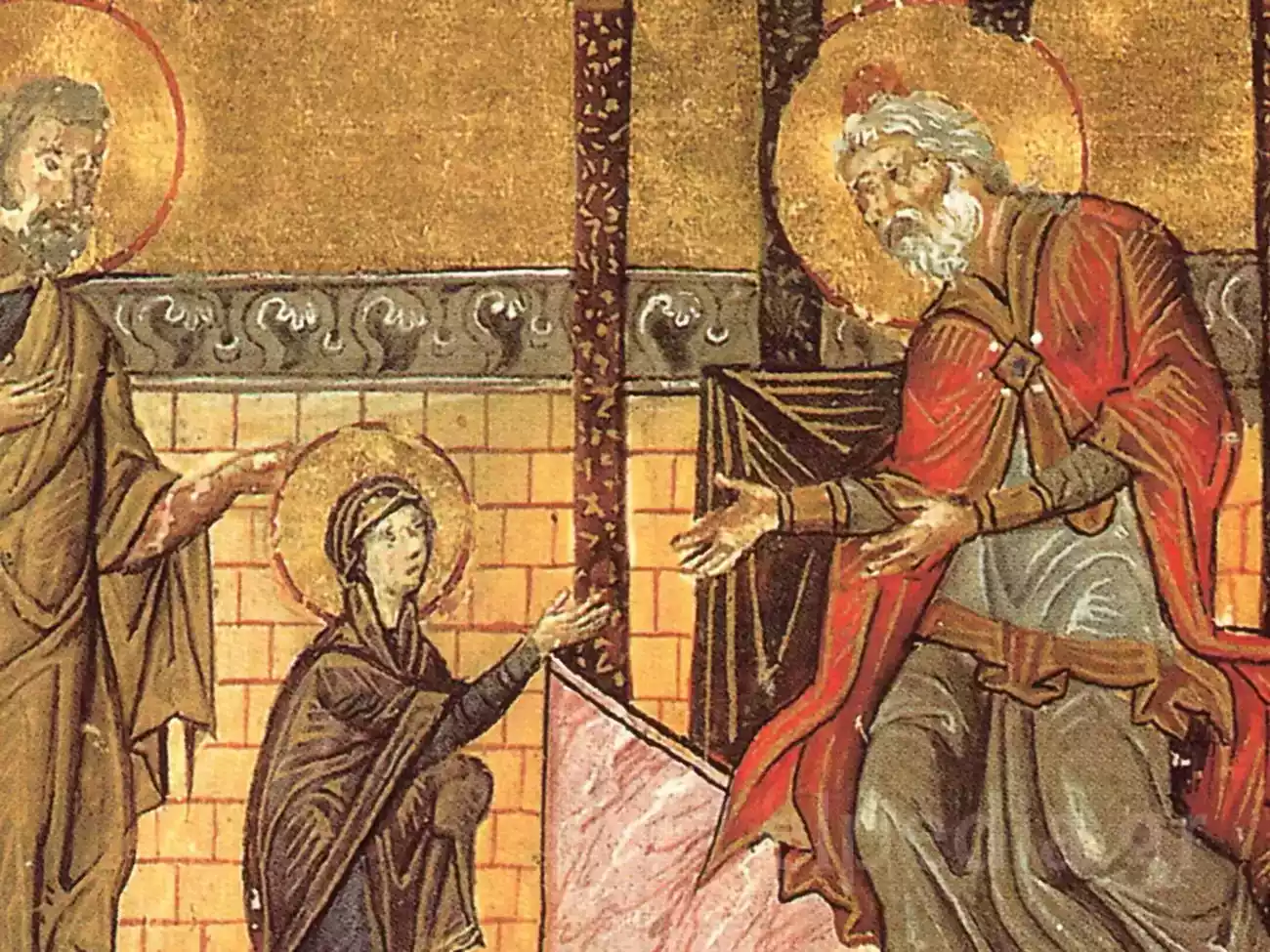
In the centre of the scene, a small-bodied figure wrapped in a deep maroon mantle, with a pale blue chiton showing from underneath, extends her two hands towards an elderly man. Her face, small and serious, turns upwards, with an expression that one could hardly call fear, yet neither certainty in the full sense of the term. According to the established interpretation which the later iconographic tradition followed, this man is identified with the priest Zacharias, the later father of the Forerunner, who brings the three-year-old Theotokos into the Holy of Holies, a privilege that normally belonged exclusively to the high priest and only once a year. Zacharias wears a deep red mantle with gold bands on the sleeve, over a bluish under-chiton, and is girded at the waist with a belt that ties in a knot; his hair and beard, white, are rendered with dense linear brushstrokes that declare the volume without describing it analytically. He bends towards the child, his hands stretched out in a gesture of reception, almost as if weighing the burden of the responsibility he assumes. On the left, a second male figure with a halo, perhaps Joachim himself, also extends his hand, in a parallel gesture that visually binds the two edges of the composition. Between them, a rosy stepped volume, perhaps the steps of the Temple, perhaps part of an altar, coloured with soft shades of pink that one rarely encounters in other places of the manuscript.
The Workshop of the Eight and the Macedonian Renaissance
This manuscript is not merely rich in images; it is a document of a specific political and artistic moment. It dates around 985-986, a period during which Basil II was severely tested by the Bulgarians, culminating in his defeat at the Gates of Trajan in August 986. Eight painters, Pantaleon, Georgios, Michael of the Blachernae, Michael the Younger, Symeon, Symeon of the Blachernae, Menas and Nestor, shared the work, with Pantaleon appearing as head of the group. Unusually for medieval art, where the name of the creator was usually lost behind the meaning of the image, here some scribe took care to note the name of each painter beside his work, without us knowing with certainty why. The style more generally is integrated into what art history calls the Macedonian Renaissance, a turn towards classical models that revitalised the naturalistic rendering of hands, faces, draperies, after centuries of schematisation. For anyone interested in placing this scene into a broader set of Byzantine miniatures, comparison with other pages of the same codex reveals how unified, and simultaneously how varied, was the language of this workshop.
The Entry of the Theotokos, exactly as it was rendered here, did not constitute the final word of the iconography. In the 11th century the type would be stabilised, with certain variations, in monuments such as the katholikon of Daphni, while in the 14th century, at the Monastery of Chora, the narrative would be expanded, scenes would be added from the house of the parents up to the entry into the Temple itself, in a visual sequence much more analytical. The miniature of the Menologion, however, remains a point of reference precisely because it precedes all these, because it tried first, in a manner almost experimental, how such a fundamental theological event can fit into half a page of parchment.
There remains, at the end, a sense of incomplete fullness, if such a contradiction is permitted. The gaze of the spectator completes mentally that which the painter only left to be implied, the procession of the virgins with the lamps which, according to the tradition of the feast, followed the little Theotokos, the silence of Holy Scripture upon this episode, the very tension between the human size of the child and the theological weight she will be called to bear. It is no accident that the hymnography of the feast speaks of a “heavenly tabernacle” and of a “much-prized bridal chamber”. This miniature, with its austere means, the gold, the red, the minimal pink, succeeds in conveying something of this transition, from the Old Testament to the New Testament, without needing even one superfluous element. Perhaps this, ultimately, is its most Byzantine characteristic.
(This is a translation from the Greek text.)

