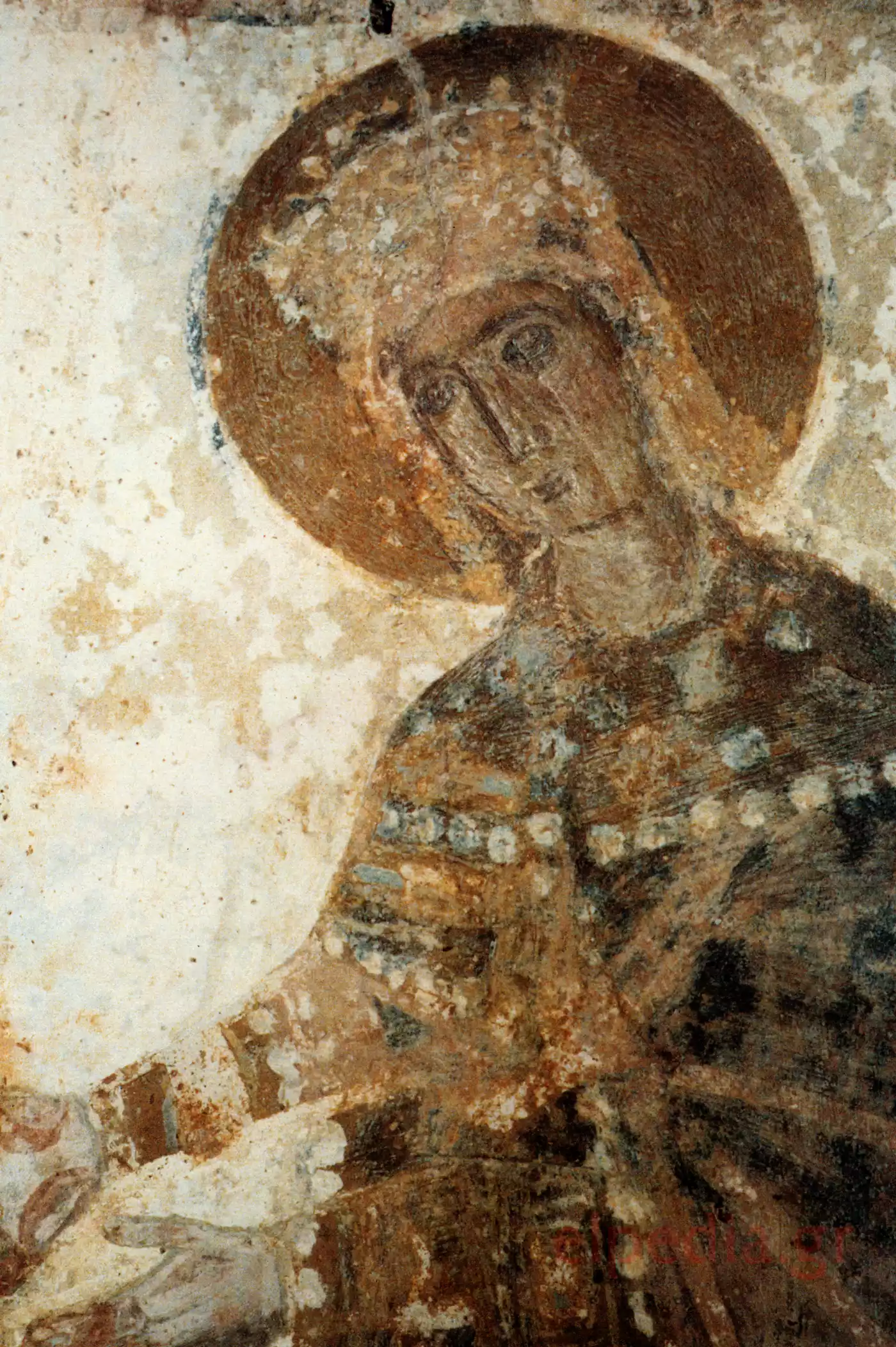
At the northern end of the Drymalia valley, south of the village of Moni on Naxos, the church of the Panagia Drosiani preserves one of the rarest surviving ensembles of Byzantine painting, coloured in the first half of the seventh century, before the period of Iconoclasm, by craftsmen whose names no inscription has recorded. In the northern apse of the original church Christ is depicted enthroned between the Virgin, the Forerunner and — a thing exceedingly unusual for a Deesis — King Solomon of the Old Testament. This is not, then, a typical deesis scene with the two customary figures on either side of Christ, but a more complex visual conception, in which the royal and prophetic dimension of Solomon is bound in meaning to the Divine Wisdom which Christ the Logos himself embodies.
The worth of this fresco programme is not confined to its theological originality. It is bound up also with the island’s wider cultural character, a fact brought out too by studies devoted to the monuments of Naxos as pillars of cultural tourism. The figure of Solomon, in his royal vestment and with the cross upon his breast, does not function merely as a complement to the scene. It brings to the fore an Old Testament prophecy which few monuments of the period dared depict with such clarity, and which today allows us to read the Deesis of Drosiani not as a simple deesis composition but as a theological commentary upon wisdom, kingship, and the Passion.
The Deesis of Drosiani and Its Two Figures
What survives today comes from a painstaking uncovering, layer upon layer, beneath later frescoes reaching down to the fourteenth century. The result is fragmentary, worn away in many places, with the plaster having lost portions of itself and the colour having faded into shades of ochre and brown recalling old leather rather more than fresco. It is precisely this decay that reveals something of the painters’ technique: the quick, almost nervous brushstrokes about the eyes; the sparseness in the moulding of the faces, which seeks not realism but immediacy of gaze.
Christ Pantocrator: The Face of Authority
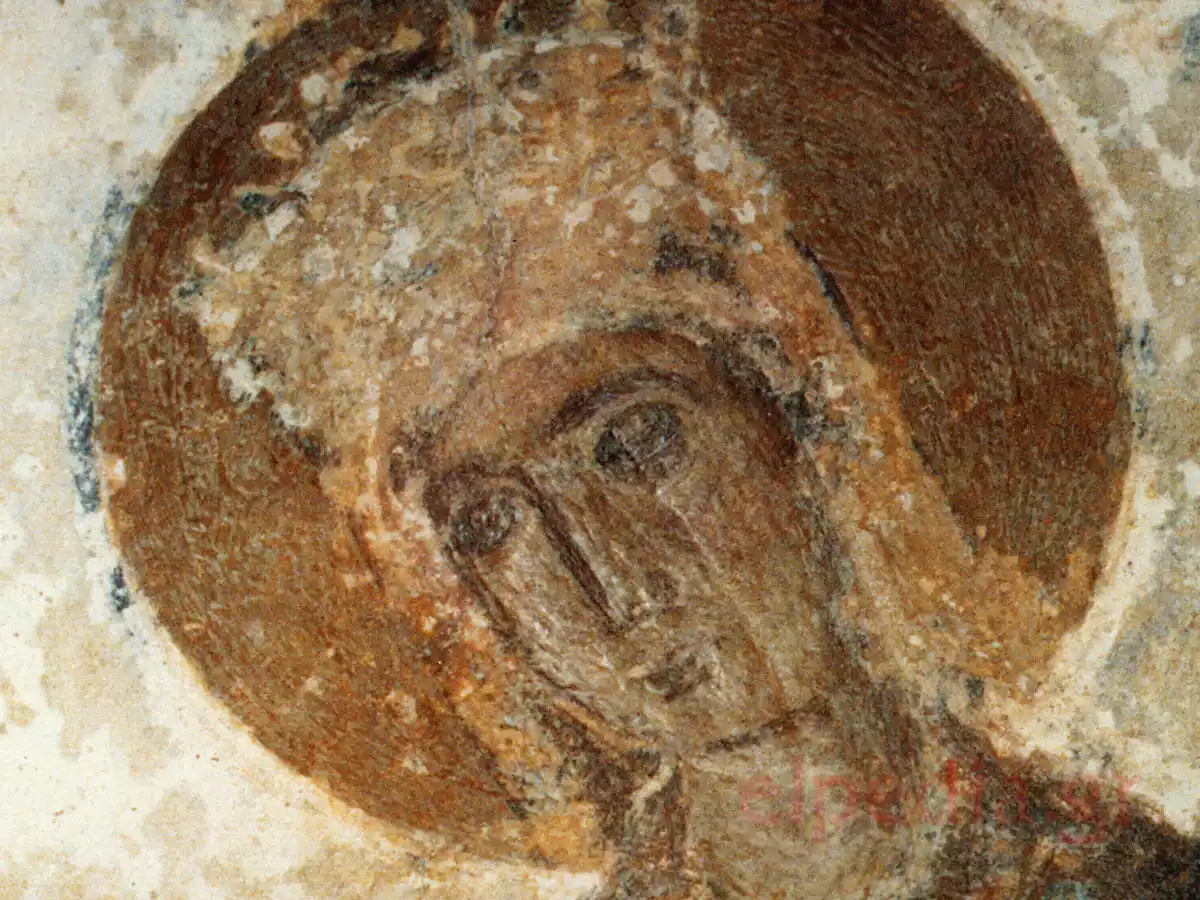
In close view the face of Christ is preserved, enclosed within a halo of deep chestnut colour with a white outline. The eyes, large and almond-shaped, look slightly aslant, with an intensity that has nothing of the saccharine about it. The nose long and slender, the face elongated, the hair parted in the middle and falling into two masses which decay has rendered almost unrecognisable in several places. Above the brow a crack in the plaster runs vertically across the forehead — a trace of centuries of damp within the stone, not a working of the painter’s hand.
This gaze, intense and inward-turning at once, belongs to a type of Pantocrator which scholarship has connected with the age’s endeavour to give visual expression to the twofold nature of Christ. And it is precisely in this church that the idea acquires particular weight, since in the dome of the Drosiani Christ is depicted twice — now as a young man with a sparse beard, now as a mature man with a full beard — together with six archangels instead of the customary four. An iconographic daring which, as scholars note, has not been recorded in any other surviving monument of the period.
Saint Solomon: The Wisdom of the Old Testament
Beside the Virgin, in a formal, almost frontal stance, Solomon wears a garment dotted with small white circles, an arrangement recalling the pearl-embroidered fabrics of imperial iconography. His halo, in the same deep chestnut tone as that of Christ, has suffered greater damage, with portions of the plaster having come away entirely at the upper part. The face nonetheless retains a concentrated, almost pensive expression, befitting the king of wisdom rather more than a mere witness or saint.
He holds, so far as the composition allows one to discern, a cross upon his breast with a small wreath at its centre, a symbol pointing directly to the Passion and to the messianic prophecy. The choice to include the wise king of the Old Testament in a Deesis scene is no mere decoration, since the wisdom of Solomon here functions as a prefiguration of the Divine Wisdom that was to be embodied in the person of Christ the Logos. In the same composition, a third figure, crowned and female, is interpreted by recent research as a personification of the Church, the Bride of Christ, founded precisely upon this same Divine Wisdom which Solomon prefigures. An ecclesiological commentary, that is to say, concealed within a scene which the casual visitor would read in haste as an ordinary Deesis.
The proximity of the two figures, Christ and Solomon, creates a dialogue visual before it becomes theological. The king’s gaze turns toward the centre of the composition, there where the enthroned Christ presides, in a relation of dependence which the painting renders without any superfluous element. Neither theatrical gestures, nor ostentatious symbolisms. Only two faces, worn by time, which continue to converse through the plaster.
Few monuments of the early Byzantine period preserve so clearly this conjunction between the Old and the New Testament. The Drosiani, dedicated to the Nativity of the Virgin, does not function merely as a place of worship. It has been recorded, through decades of research, as one of the most significant workshops of iconographic thought of its age, where solutions were attempted that elsewhere were not ventured. The visitor who today stands before the northern apse does not see merely two worn faces. He sees the trace of a theological discussion of centuries, set down in colour and stone, with an economy of means that no later school ever again recovered with the same intensity.
(This is a translation from the Greek text; the translation was made by K. Pappas.)

