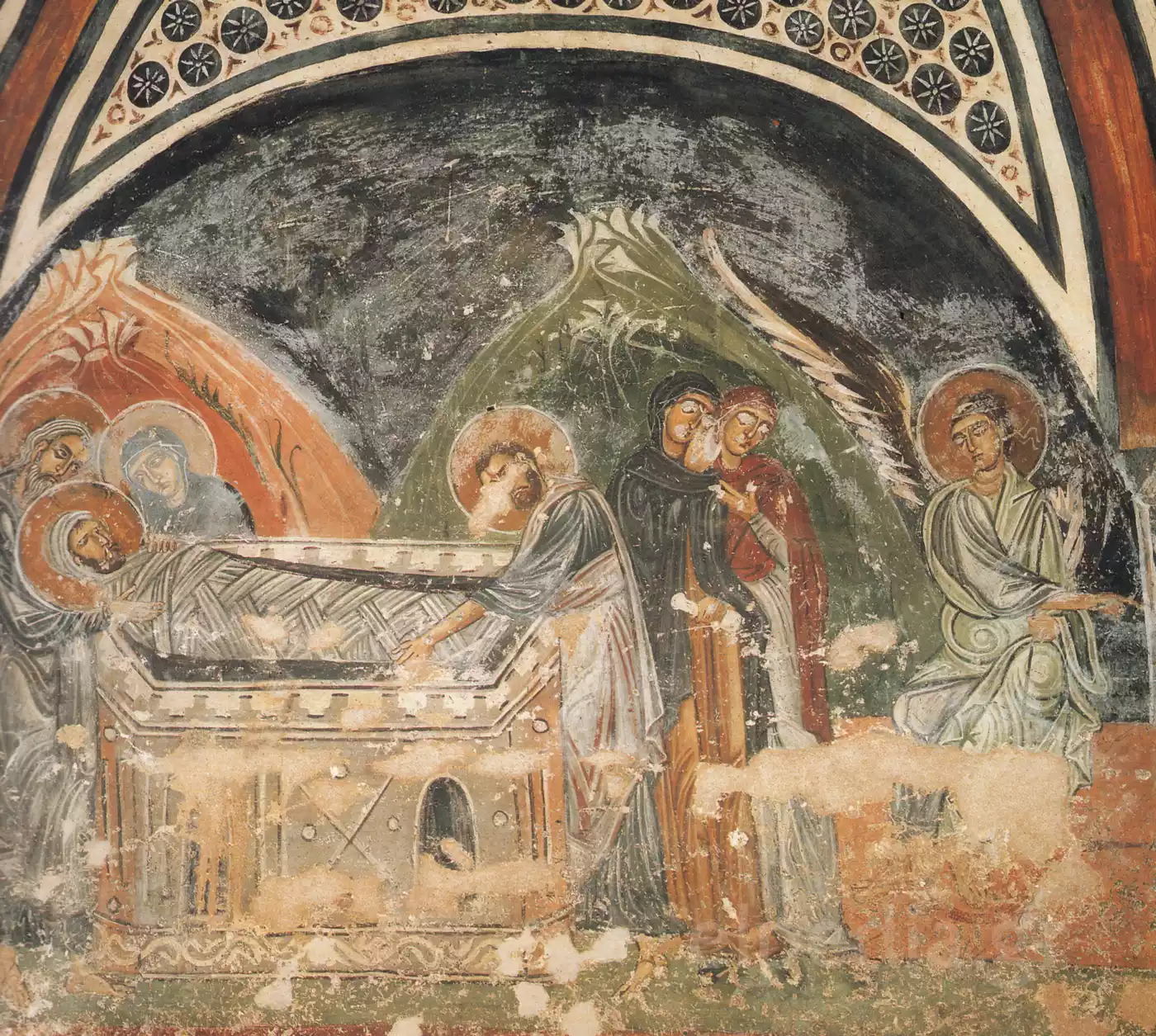
On the southern side of the crypt, beneath the Katholikon of the Monastery of Hosios Loukas in Boeotia, near the foothills of Mount Helicon, a painter whose name has not survived composed, around the third quarter of the eleventh century, two scenes within a single wall painting, the Entombment of Christ and the approach of the Myrrh-bearing Women to the tomb now empty. Made using the technique of fresco upon wet lime plaster, the composition covers a wall within a space that was not built to be admired by crowds but to receive the remains of the monks, functioning at once as an ossuary and as a chapel of the monastery. The result is a visual narrative in which burial does not constitute the end, since the angel who waits on the right side of the composition already announces the next chapter of the story. Recent microanalyses of Byzantine wall paintings in corresponding monuments of the same period have documented that the craftsmen relied upon natural earthen ochres mixed with lime, an observation that explains the warm, almost burnt, chromatic base which distinguishes our composition also. The crypt of Hosios Loukas is considered among the most complete surviving ensembles of Middle Byzantine wall painting, with eight scenes around the walls dedicated to the Passion and a multitude of medallions with figures of saints in the vaults, a programme which the Katholikon of the monastery, known also for its mosaics, does not repeat in the same manner anywhere else in the upper church. The Entombment and the Myrrh-bearers, placed side by side, do not function as two separate episodes but as a single theological proposition, written upon the plaster instead of paper, concerning the relation between death and that which follows.
The Diptych of the Burial and the Annunciation on the Wall of the Crypt
The composition is read as two acts of the same drama, joined the one to the other without a gap between them. A single landscape of rocks, warm on the left side and colder, greenish, towards the right, binds the two scenes visually beneath a dark, almost inky vault of a cave. Above all this runs a decorative band with rosettes within circles, the only purely geometric element amid so many human figures, a habit of frame decoration which we shall encounter later, in variations, in other monuments of the same period in northern Greece and in Macedonia.
The Burial of the Body: Joseph, Nicodemus and the Silence of the Theotokos
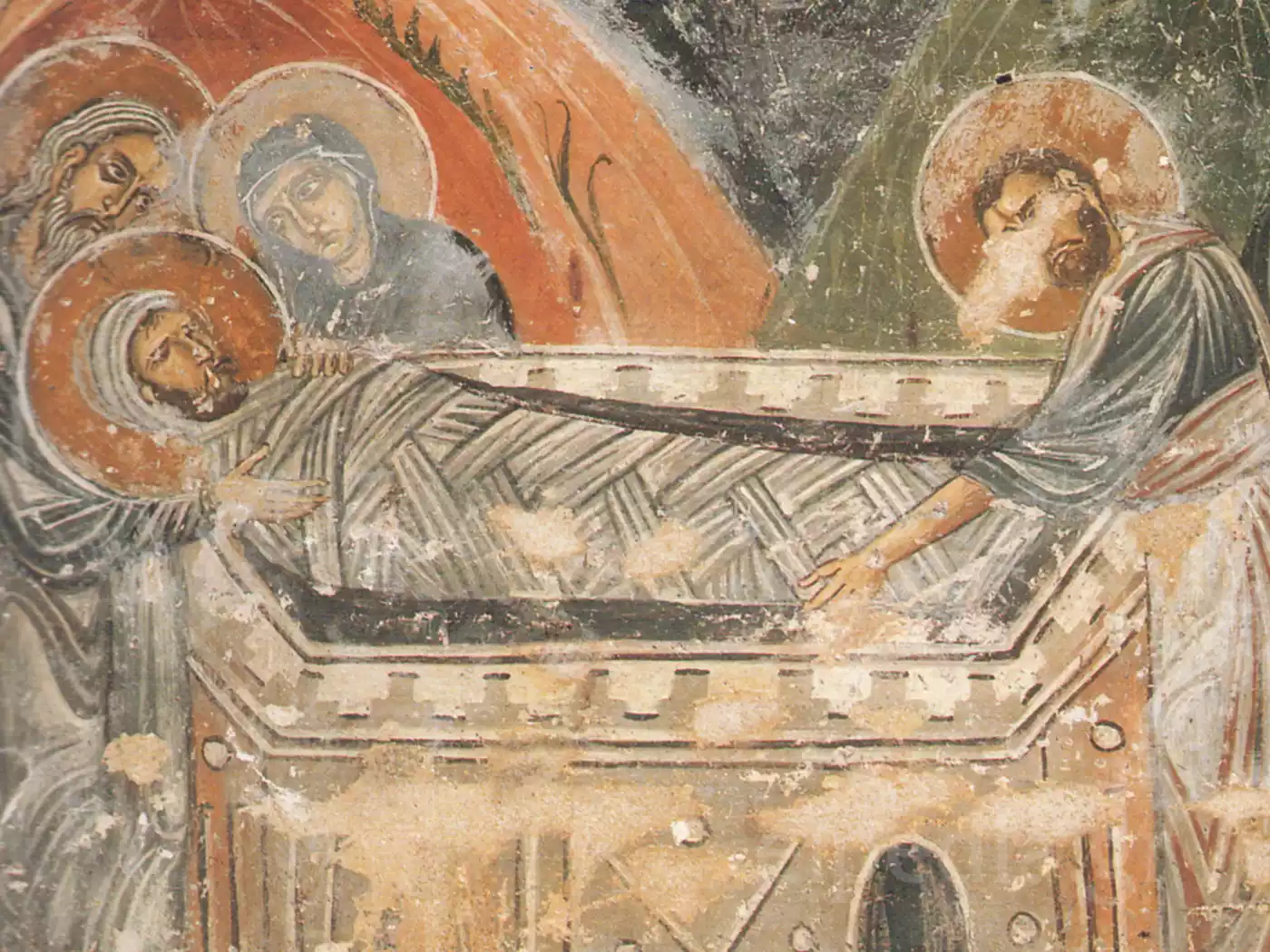
In the left-hand portion of the composition, two bearded men with haloes raise the body of Christ from its two ends, wrapped in a shroud upon which the painter has rendered, with fine crossing lines, the weave of the cloth as if it were matting. These are, according to the established iconography of the scene, Joseph of Arimathea and Nicodemus, the two men who, according to the narrative of the Gospels, asked Pilate for the body and laid it in a hewn tomb. Between them, a little further back, may be discerned the face of the Panagia, her head covered by a pale blue maphorion, inclining slightly towards the body of her son, without theatrical gestures, without tears painted upon her face. At the right-hand edge of the same group, a man with a short beard, wrapped in a grey-green himation with warm reflections, bends and rests his hand upon the shroud, perhaps John, the disciple who remained beside the cross until the end. The stone larnax in which they lay the body is no simple casket. The artist has given it a decorative rim with small rounded projections, like the battlements of a small fortress, a detail which refers to real marble tombs of the period and not to some conventional, abstract sarcophagus. On the front face of the larnax there may still be discerned traces of crossed geometric patterns and small circular ornaments, elements which the craftsmen often borrowed from real furniture or reliquaries of the period, transferring them into the painting with almost architectural precision. The background behind the scene is a warm ochre inclining towards terracotta, a colour of earth rather than sky, and upon it two slender branches stand out faintly, remnants perhaps of a tree that once framed the scene. The decay is not concealed. Plaster is missing in places, the colour has become salted and whitened, yet the weight of the gesture of the two men, the stooping of their bodies over the dead, remains entirely clear.
This iconography, known in the Byzantine tradition also as the scene of the Threnos when the emotional tension becomes more intense, will reach its most fully developed dramatic form a century later, in the wall paintings of Nerezi near Skopje, where the Panagia stoops and touches the face of her son with a despair that touches the limits of the human. At Hosios Loukas restraint is still the rule. There is no embrace, there is no bodily contact between mother and child, only the proximity of the bodies and the inclination of the heads, a language closer to the austerity of the earlier Middle Byzantine ensembles than to the emotional realism that will follow.
The Myrrh-bearing Women before the Angel at the Empty Tomb
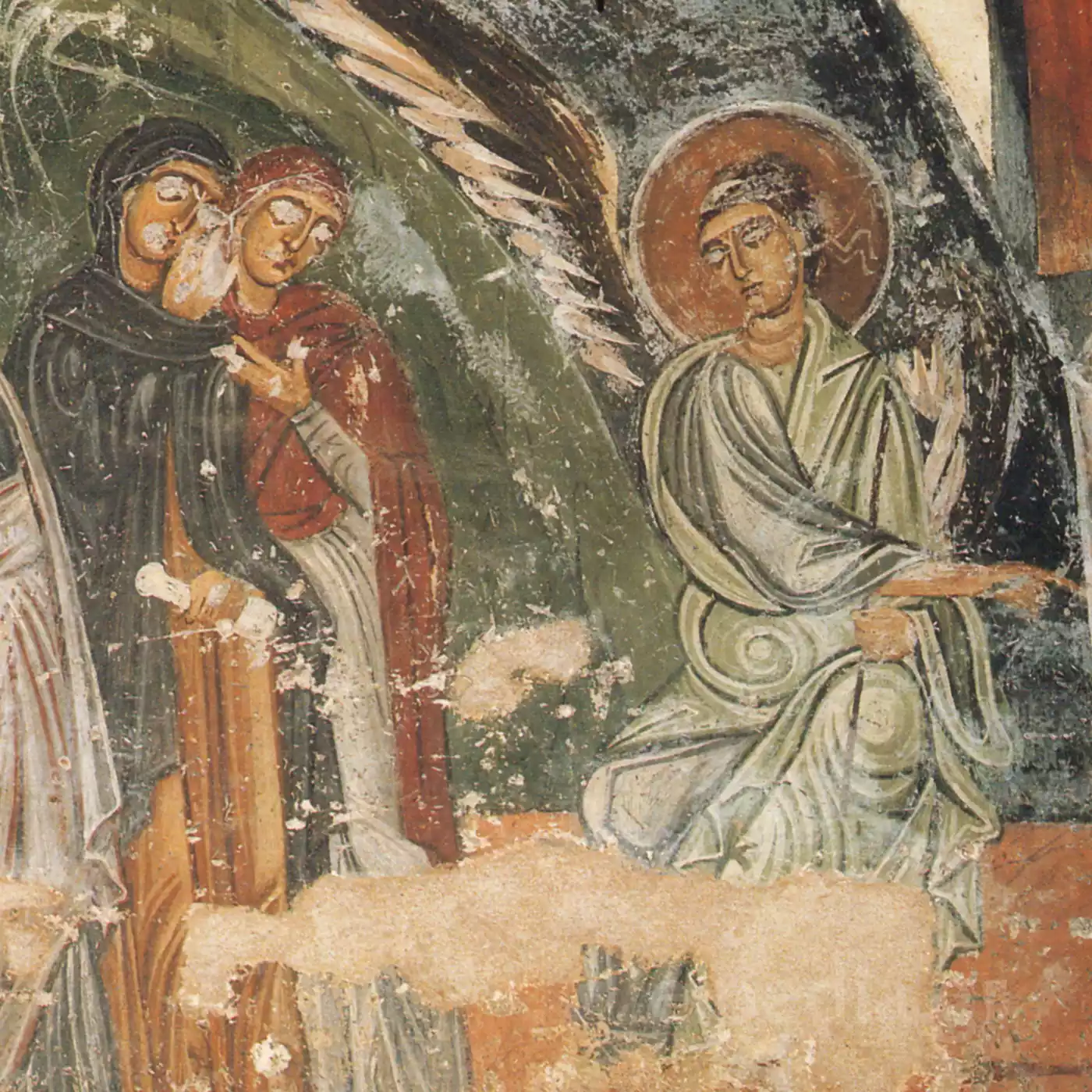
Immediately beside, three women approach in tight formation, their forms almost merging into a single dense mass of dark, black and deep red fabrics. Their heads are covered by maphoria that leave free only the face, and one of them brings her hand near her mouth, a gesture which Byzantine painting employs systematically to signify surprise mixed with pain. The Myrrh-bearers, according to the narrative of the Gospels, were those who arrived first at the tomb with myrrh to tend the body, only to find it empty, and it is this moment, of bewilderment before understanding, that the painter chooses to render. Opposite them, seated upon what remains of the tombstone, an angel with large light-coloured wings and a himation in shades of sea green extends his hand towards the right, towards the empty space of the tomb which we no longer see within the composition but which is indicated by the direction of his gesture. The drapery of his garment forms, at the height of the knee, a spiralling eddy of lines, a technique favoured in Middle Byzantine painting to give volume without resorting to realistic shading, with white lines of highlighting running over the green like little streams. The green background behind the angel is neither landscape nor sky, rather an abstract substance of rock, close to what we would today call colour symbolism rather than a realistic depiction of nature. The angel does not look the women full in the face. His gaze falls low, almost contemplative, in contrast to the dynamic extension of the wing behind him, a contrast which was in all likelihood a deliberate choice of the painter. White patches of saline efflorescence cover portions of the background, traces of damp which the crypt, semi-subterranean as it is, could scarcely have avoided in its long history, yet the faces, where they survive, still retain an expression that is vivid, almost confessional.
The Material Trace: Fresco Technique and Earth Pigments
The very technique by which the wall was worked deserves a pause. The colour was spread upon the fresh, still wet lime plaster, so that the pigment might bind chemically with the plaster as it dried, a process which left minimal margin for correction and required of the painter that he draw with confidence, without second thoughts. The earthen ochres, the greens from oxides of iron or copper, the black from charcoal, compose a palette poor in raw materials but rich in result, precisely because the artist knew how to draw intensity from the contrast of a few, well-chosen tones rather than from their variety. Comparable analyses of pigments in other Byzantine ensembles of the period have confirmed this very austerity of materials, a feature which betrays not poverty but a conscious choice of language.
What remains today of this wall painting is not a square metre of painted plaster but a document upon how they thought, how they organised space and how the craftsmen of the Middle Byzantine period painted, without signature, without biographical note, with only their own work as testimony. The crypt, dug beneath the main church and dedicated to Saint Barbara, housed three tombs, among them that of Hosios Loukas himself, and functioned as a burial place for the monks long after the relics of the founder had already been transferred to the upper church. Its iconographic programme insists upon scenes of death and resurrection, a choice functional rather more than decorative, made for the eyes of those who would pass through that space bearing a body for burial, monks who knew well what it meant to bury someone and to wait.
To view today such a composition as historical testimony, and not only as an object of veneration, means to examine it as a stratum of information upon workshop techniques, upon networks of apprenticeship among craftsmen, upon the preferences of patrons who do not always leave their name behind. Byzantine wall painting, like the mosaic or the portable icon, operates simultaneously on two levels, as an object of veneration for whoever prayed before it and as a dense testimony of material and artistic history for whoever studies it today with the tools of science. Both levels hold simultaneously, without the one nullifying the other.
The study of such ensembles, by art historians but also by materials scientists, continues to reveal details which the ordinary viewer finds it difficult to grasp, from the composition of the mortar to the small deviations of a hand from the manual of the period. Every such analysis adds a grain of knowledge upon workshops and craftsmen who left behind no names, only walls. What endures, however, beyond every technical analysis, is the precision with which an unknown painter managed to place side by side the weight of a body that is being lost and the lightness of an angel who already knows the end of the story. Within the same frame, without transition, without explanation.
(This is a translation from the original Greek text, translated by K. Pappas.)

