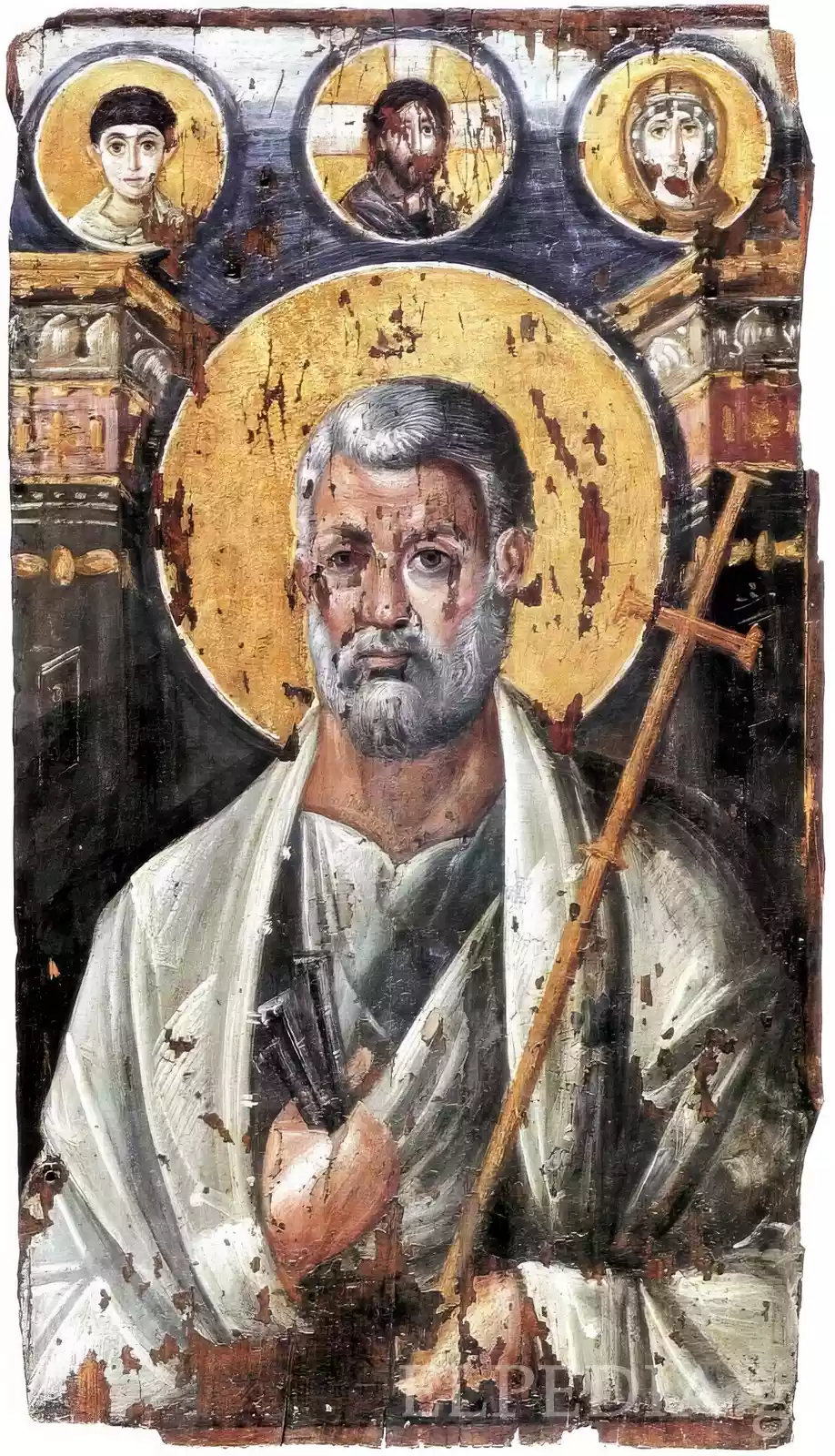
In the Monastery of Saint Catherine, on Mount Sinai, is preserved one of the very few surviving testimonies of painting before the Iconoclasm. It is the encaustic icon of Saint Peter, the work of an unknown artist dated to the late sixth or early seventh century AD, executed on wood with dimensions of 92.8 by 53 centimetres. The technique of encaustic painting, whereby the pigment is mixed with molten wax and applied while it is still warm, gave the work a material density rarely encountered in later Byzantine iconography. Many researchers connect this method, together with the almost immediate, lifelike rendering of the face, with the funerary portraits of Fayum, a tradition of Graeco-Roman Egypt which appears to have significantly influenced the early painters of icons. The study of this particular work cannot, of course, ignore the wider context within which it was born, that period of flourishing Byzantine monasticism which led to the founding of the monastery itself under Justinian. In the pages that follow, the composition, the face, and the particular visual language of a work standing at the border of two worlds are examined — that of the Roman portrait and that of the Byzantine icon as it would be shaped in the centuries to come.
The Apostle’s Face: Between the Roman Portrait and the Byzantine Icon
Peter is depicted frontally, to the waist, with a white mantle falling heavily upon his shoulders, resembling almost the toga of a philosopher rather than the vestment of a religious figure. In his right hand he holds a long cross-bearing rod, whilst in his left may be discerned two small keys, those which refer directly to the words of the Gospel concerning the “kingdom of heaven.” The golden halo behind the head, worn away in several places and with the gold leaf having flaked off here and there to reveal the brown ground beneath, does not function merely as a symbol of sanctity. It functions also as a luminous surface which, by its contrast, throws into relief the dark, earthy texture of the skin.
It is the gaze that one retains most. The eyes, hollowed, sharply outlined, asymmetrical in expression, do not look upon the viewer with the fixed, almost transcendent severity that would later prevail in Byzantine art. They look with something more human, almost hesitant. Researchers have observed that the face is not entirely frontal, since the body turns slightly — a detail which may seem insignificant but betrays a painter still familiar with the conventions of Graeco-Roman portraiture. This is no schematised icon. It is something closer to the depiction of a specific, mortal man, with the grey hair, the short beard, and the low forehead which would henceforth become the established type of the apostle throughout the whole of the Byzantine tradition.
Above the figure, against a blue background darkening as it descends towards the head, three golden medallions open out. In the centre, Christ; on the right, the Theotokos; on the left, a third figure whom many identify as John the Theologian. This arrangement is no arbitrary composition. It repeats, in miniature, the hierarchical logic that would come to dominate the Byzantine iconographic programme of the following centuries, with Christ at the centre of every composition and the remaining figures organised around him in descending order of significance.
The Detail of the Face: Decay and Plasticity
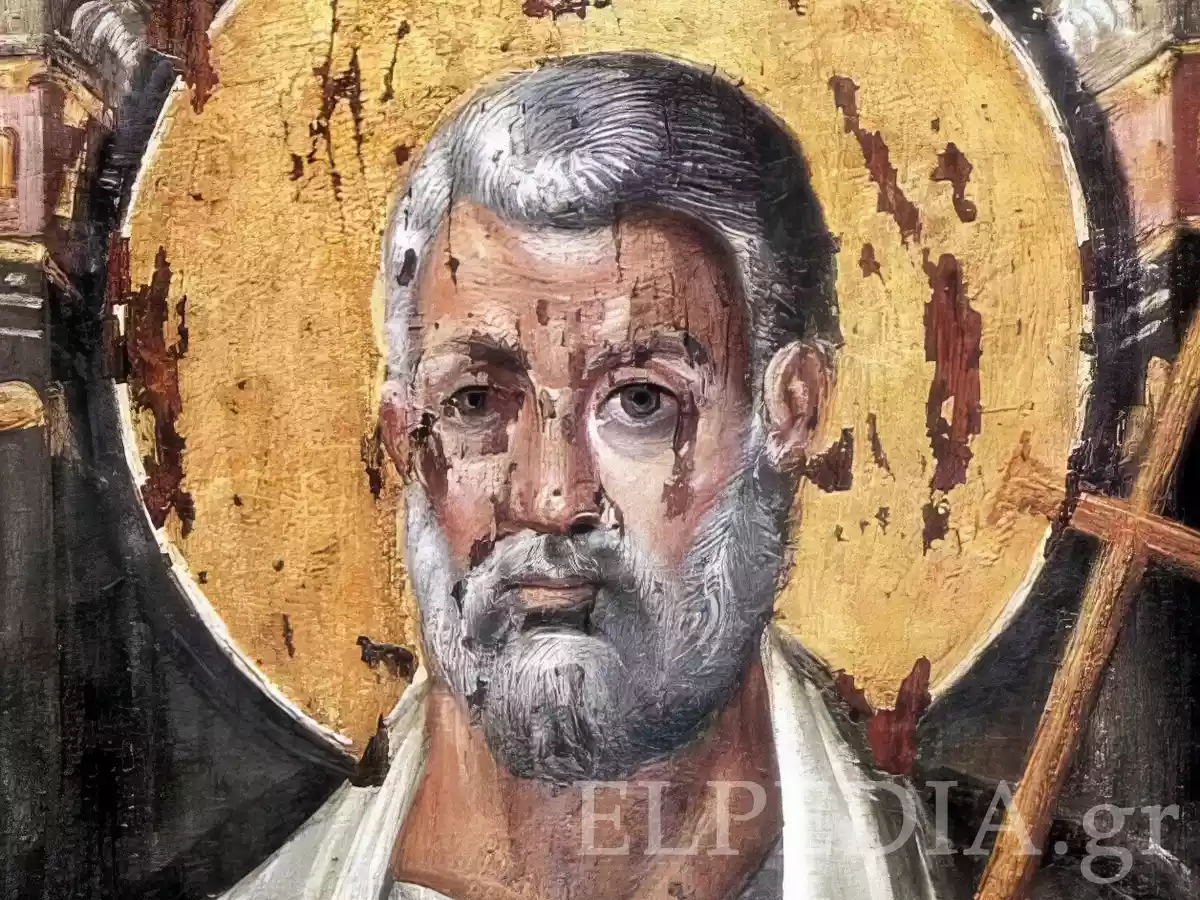
Magnified, Peter’s face reveals something that escapes easy notice in general view. The surface is not smooth. It bears deep cracks, flaking of the pigment, marks of fifteen centuries of exposure to conditions which few works from other regions would have withstood. The dry climate of the Sinai peninsula, together with the isolation of the monastery, explains to a great degree why this work survived where corresponding pieces in Constantinople or in Rome were destroyed, whether by the Iconoclasm itself or simply by time.
The plasticity of the face, however, remains the most striking element. The painter is not content with a linear outline. He builds volume through gradations of light and shadow, shading one cheek more than the other, giving the face a three-dimensional quality reminiscent more of Hellenistic sculpture than of later Byzantine iconography with its characteristic flatness. The white of the beard is rendered with quick, almost free brushstrokes, whilst the gaze retains, even amid its decay, an intensity difficult to describe merely as technical achievement.
The icon of Saint Peter from Sinai is not simply one of the oldest surviving specimens of Christian painting. It is a moment of transition, recorded upon wood, between two worlds which for some decades coexisted without having yet been definitively separated. The Graeco-Roman technique of encaustic, the physiognomic precision reminiscent of Fayum portraits, the slight turn of the body — all these coexist with elements that would henceforth become an inseparable part of Byzantine iconography, such as the keys, the cross-bearing rod, the medallions in the upper part of the composition.
The monastery that housed it through all these centuries was no mere accidental repository. It was founded at a time when monasticism was undergoing a broader monastic reorganisation throughout the empire, and its isolation in the desert of Sinai proved, in retrospect, the very reason so many fragile works escaped destruction. Today, the icon stands as one of the few windows onto an age which, without it, we would know almost exclusively through texts, and not through faces.
(This is an English translation of the original Greek text; the translation was made by K. Pappas.)

