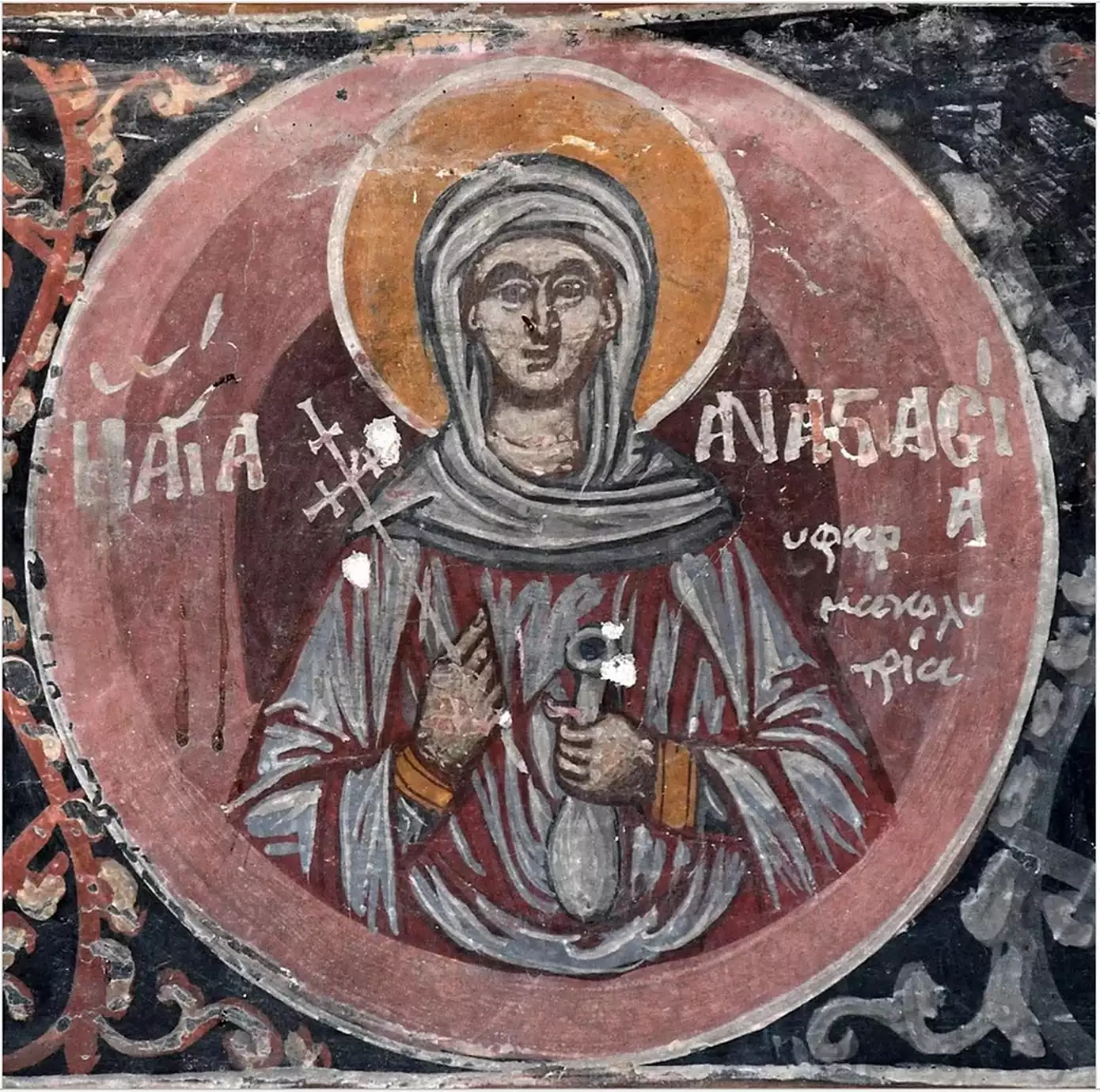
In the church of Saint Paraskevi, in the mountain settlement of Anavra — known also by its older name, Goura — in the district of Almyros, there survives a fresco dedicated to Saint Anastasia the Pharmakolytria, a martyr of the early fourth century. The figure is set within a circular medallion, a solution commonly employed in church decoration, where the saints are ranged in sequence along a frieze or an arch, each enclosed within his own geometric outline. The painter remains anonymous, as is the case with the greater part of provincial ecclesiastical painting, where the signature never carried the weight we attach to it today. The execution betrays a folk hand, untrained in the great workshops — a fact that in no way diminishes the interest of the work as a document. Quite the contrary: such frescoes constitute a valuable source for understanding how official Byzantine iconography was translated, simplified, and adapted to the needs of small rural communities.
Anavra preserves to this day a whole web of such monuments, scattered across the churches and chapels of the area, forming a living archive of local religious art. The colour of the ground — a deep, reddish brown — together with the coarse, almost hasty line of the drawing, lends the work an immediacy often absent from the more refined examples of the greater tradition.
The Figure of Saint Anastasia in the Frescoed Medallion
The saint’s face dominates the centre of the composition, its features rendered in dark, greyish tones against a lighter background, a technique producing a sharp contrast of light and shadow without any particular gradation of tone. The eyes are large, almost disproportionate, the gaze directed slightly towards the viewer’s right. The nose is long and thin, the mouth small and closed, without a trace of expression that might disturb the gravity of the depiction. Around the head spreads a halo in a strong yellow, almost orange, a colour that draws the eye at once and functions as the single purely luminous point within the whole composition. The garment covering the head and shoulders is rendered in dense, parallel lines of grey and white — a form recalling, without copying it, the typical rendering of drapery in the monastic or martyrial dress of women’s figures within the Byzantine tradition.
The Hands and the Symbols of Martyrdom
In her right hand the saint holds a martyr’s cross, small in size, the fingers gripping it loosely, almost symbolically rather than functionally. In the left, which appears closer to the viewer, one discerns a small vessel — most probably a phial or flask for ointments — an element pointing directly to the epithet “Pharmakolytria,” that is, to her who delivers from drugs, or who heals through them. Tradition relates that the saint had been taught by her teacher Chrysogonus the preparation of healing distillations from herbs, which she used to tend imprisoned Christians. The object in her hand, however much the ravages of time make its precise reading difficult, functions as an iconographic key linking the depiction to this very dimension of her life: the medical and the therapeutic.
The Inscription and the Colour Setting
Above and to the right of the figure a portion of the nominal inscription is preserved, with the letters ΑΓΙΑ and ΑΝΑΣΤΑΣΙ clearly discernible, while lower down, in smaller size, the reference to the epithet appears to continue. The script is in capitals, with broad, square letters incised directly upon the plaster, without the care for calligraphic finish one would meet in urban workshops. The medallion is framed by a band in shades of pink, which is in turn surrounded by a dark, almost black ground decorated with foliate ornament in red and grey — vine-scroll motifs winding freely around the circle. Such decorative bands were customarily used to frame rows of saints at the lower height of the walls, there where the faithful could draw nearer to the figure, read the name, recognise the face.
The use of red, both in the ground of the medallion and in the garment beneath the veil, creates a chromatic unity that keeps the whole coherent despite the simplicity of the design. This is a palette typical of the provincial workshops of the late Byzantine and post-Byzantine periods, where costly pigments, such as lapis lazuli, were replaced by more accessible ochres and reddish earths. The result is not lacking in expressiveness. On the contrary, it acquires a hardness of line and an immediacy of gaze that is often absent from the more “perfect” examples of urban painting.
Anavra, moreover, is not merely the place where this work survives. The wider area, with its environmental park at the springs of the Enipeas, from which the river of the same name rises, and the network of paths around Goura, joins natural heritage to religious art in a whole that deserves to be studied as one, not in fragments.
The study of such frescoes, remote from the great centres and the renowned workshops, shows in the end just how alive the iconographic tradition of Saint Anastasia remained throughout the Greek provinces, from Thessaly to the islands. Her character as Pharmakolytria, her office as protectress of those who suffer from sickness and pain, explains why her figure was chosen so often to adorn the walls of small parish churches, there where the needs of daily life were, first of all, bodily needs. The medallion of Anavra, in its wear and in its simplicity, stands as a witness to this very bond between faith and care for the body.
(Translated from the Greek. Translation by K. Pappas.)

