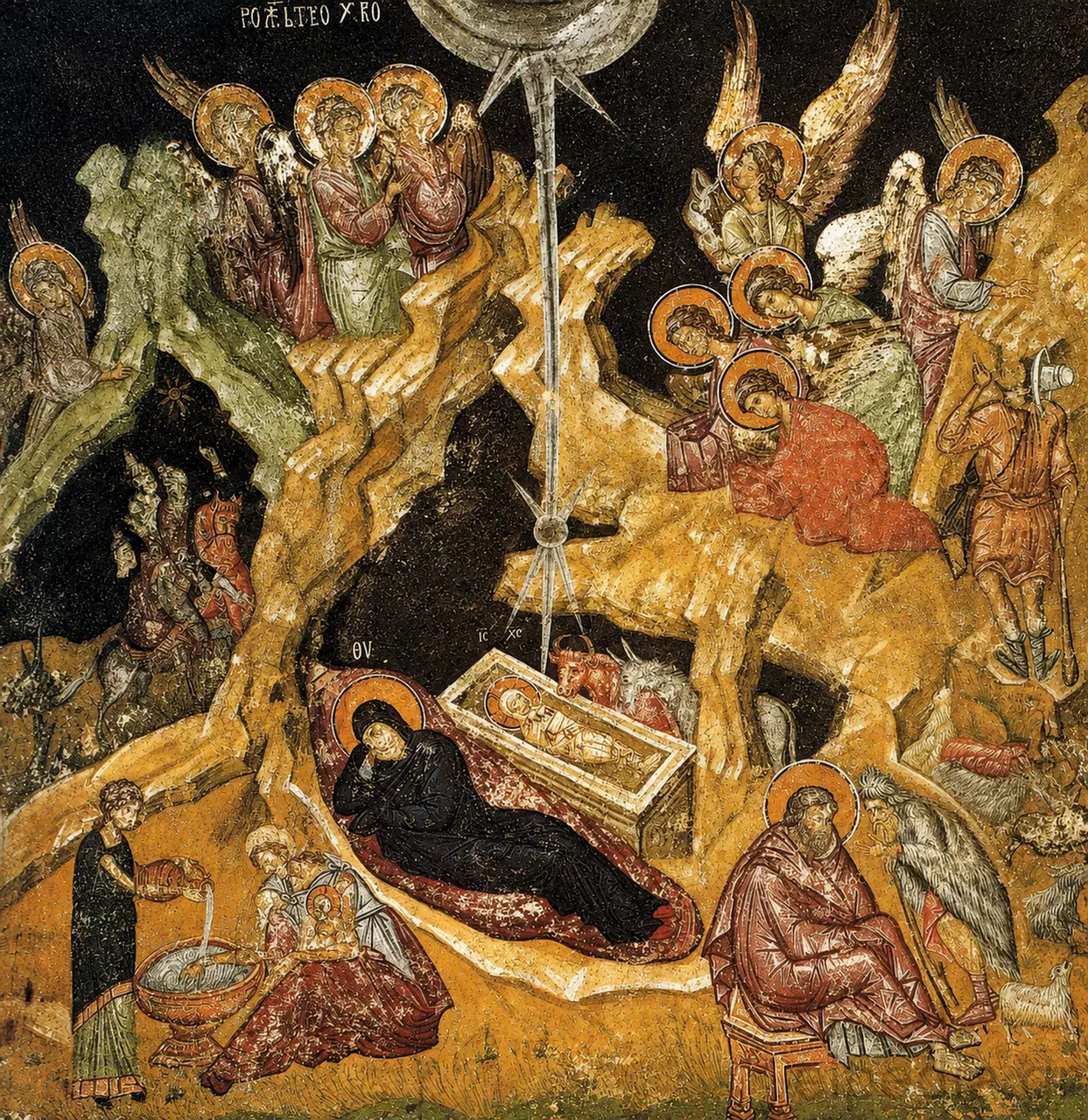
An anonymous painter set down, around 1250, the Nativity of Christ in the dome of the southern wing of the church of the Holy Apostles, within the monastic complex of the Patriarchate of Peć, in what is today Kosovo. The work belongs to the earliest painted stratum of the church, that which covers the space beneath the dome and is attributed to the years of Archbishop Arsenije, around 1250 or 1260, successor of Saint Sava on the throne of the autocephalous Serbian church. Scholars describe the fresco as a composition of singular, monumental character, executed in dark, heavy tones that set it noticeably apart from the brighter Palaiologan painting of the following centuries. It is a composition dense with meaning, in which the cave, the star, the ranks of angels and the human figures gathered about the manger exceed the plain visual narration of the gospel episode and constitute a narrative system with clear theological axes. The study of such ensembles as visual heritage permits us to read upon the surface of the wall not only religious content, but also historical evidence concerning technique, iconographic conventions, and the artistic exchanges that ran through the Balkans in the thirteenth century.
The Patriarchate of Peć, inscribed by UNESCO among the World Heritage monuments of the region, is not a single church but a complex of four churches united beneath a common narthex, in which the Church of the Holy Apostles stands as the oldest nucleus. In this nucleus, before the remaining chapels were even added, the scene here under examination was painted first.
The Iconographic Composition of the Byzantine Nativity Fresco
The composition is organised about a vertical axis, from the summit of the dome down to the manger. Three zones succeed one another, yet without breaking apart the visual unity of the subject. Above, the heavenly powers. In the middle, the mountain and the cave. Below, mankind.
The Star, the Light, and the Ranks of Angels
At the summit of the composition, a circle of concentric lines in silver and white renders the Star of Bethlehem, from which there extends downward a narrow, perfectly straight ray of light reaching as far as the cave and the manger. Two groups of angels frame the star, one to the left and the other to the right, their wings open and their hands raised in an attitude of doxology. The first group forms a dense cluster of faces, in which the haloes overlap one another and the figures are with difficulty distinguished one from the other.
The second, more sparsely arranged, leaves greater space between the bodies and the wings, lending a sense of downward movement, perhaps toward the shepherds who are to receive the tidings. Beneath this second group may be discerned a cluster of seated figures in red tunics, bowed toward the star in an attitude of adoration, most probably the Magi before they have even set out upon their journey toward the manger. Further to the right, amid steep rocky masses painted in ochre and gold, stands an upright figure with a long staff, probably a shepherd, while in the lower right corner of the composition may be discerned a portion of a flock, with sheep in white and greyish colouring. Above to the left, an inscription in capital letters, in an older form of Slavic script, identifies the scene as the Nativity of Christ. At several points of the upper zone the plaster has come away together with the pigment, leaving bare patches that interrupt the continuity of the wings and the faces, a deterioration common to frescoes of seven centuries’ standing.
The Theotokos, the First Bathing, and the Hesitation of Joseph
At the centre of the composition, within a dark opening of the cave, the manger with the swaddled infant is framed by the heads of the ox and the ass, turned toward it. The Theotokos, clothed in a deep crimson maphorion that covers almost her entire body, lies reclined before the manger, her head inclined and her gaze turned away from the child, in an attitude of inwardness and silent contemplation that Byzantine iconography reserves often for the mother of the God-man immediately after the birth.
Lower down and to the left, two female figures attend to the first bathing of the infant — an episode of apocryphal origin and unknown to the canonical Gospels, established early in the iconography in order to underline the real, bodily dimension of the birth. One leans over a round basin holding a vessel of water, the other supports the small body of Christ, while their garments, in green and deep red, break the monotony of the earthen tones that dominate the rest of the mountain. At the right edge of the scene, seated upon a low rock, Joseph wears a rose-coloured mantle and holds his hand close to his face, a gesture that Byzantine painting employs above all to signify doubt and inward struggle. The Theotokos, for her part, turns away from the infant; Joseph, for his part, sits apart from both, at the very margins of the composition, his gaze lost somewhere beyond it, as though he were still troubled by the incredulity which, according to the apocryphal tradition, the supernatural conception had caused him.
Style, Colour, and the Place of the Work in Byzantine Art
The colour scale of the fresco remains, throughout its extent, earthen and dark: brown, ochre, crimson and deep green compose a palette far removed from the luminosity that would later prevail in Palaiologan painting. The dark, imposing figures of the fresco appear to derive from models of late Roman painting, possibly of Palestinian origin, a connection supported also by the neighbouring compositions of the Ascension in the same dome and of the Deësis in the apse of the sanctuary, works of the same workshop and the same decade.
The figures, tall and solid, avoid the complexity of gesture that would return in the painting of the fourteenth century, preferring frontality and severity in the features of the faces. This severity, combined with the monumental scale of the bodies, has led scholars of Byzantine art to recognise in the Patriarchate of Peć one of the most significant stations of thirteenth-century Serbian fresco painting, long before the region passed into the orbit of the Palaiologan renewal that would mark, at the beginning of the fourteenth century, the neighbouring church of the Panagia Ljeviška. The deterioration of the plaster, visible at several points of the composition, undoes neither the strength of the drawing nor the unity of the narrative, although portions of the wings and faces in the upper zone have been lost beyond repair, together with the plaster that had held them.
(Translated from the Greek text; translation by K. Pappas.)


