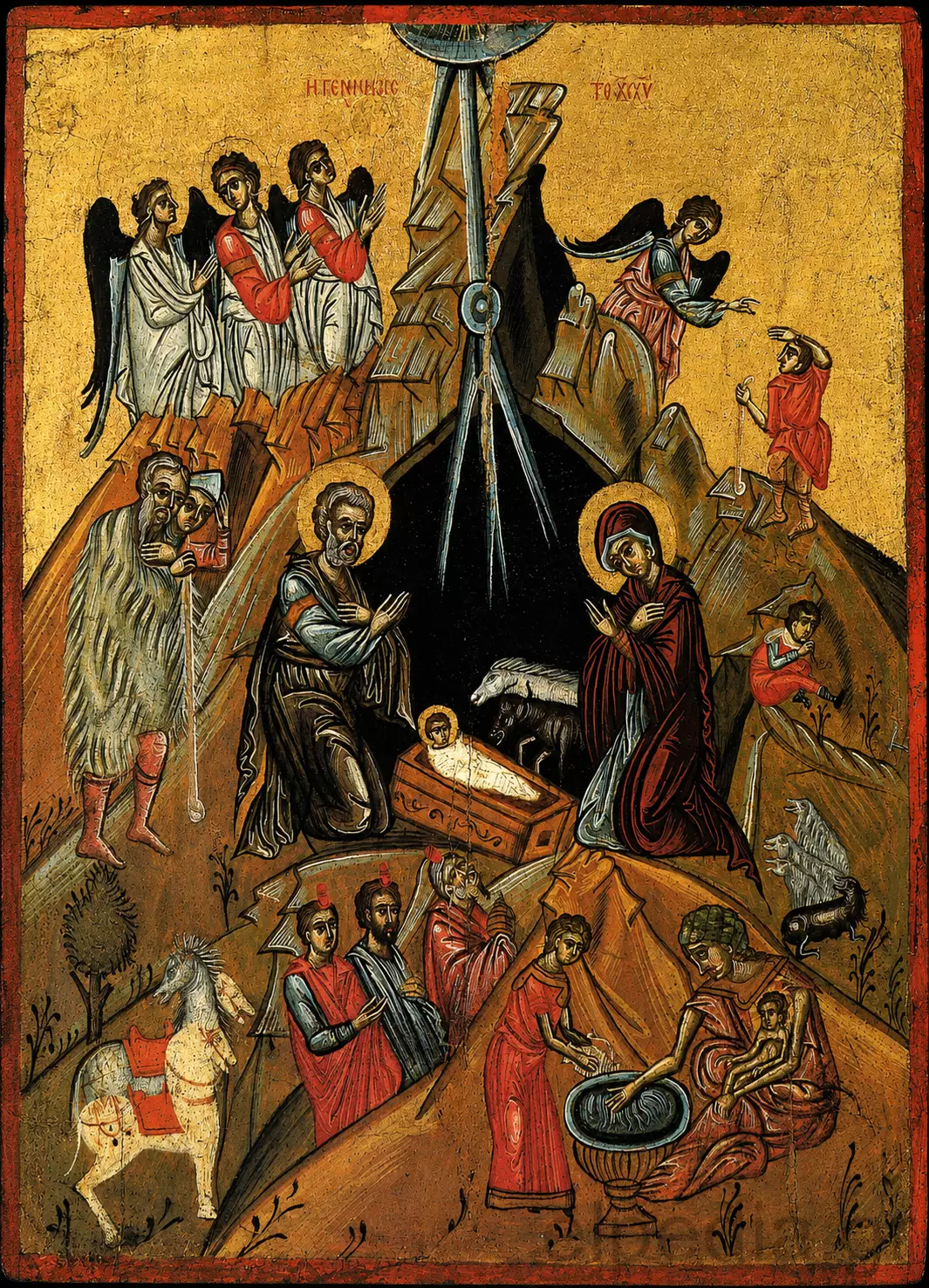
The eighteenth-century post-Byzantine icon of the Nativity constitutes a visual document, bearing witness to the aesthetic and social fermentations of its time. Originating from the Honoured Confraternity of the Purification in Livorno, Italy, this particular composition captures the evolution of iconographic types in a period when Eastern origins converse openly with Western borrowings. The work — examined within the context of art history — reveals the synthetic capacity of the anonymous artist to manage traditional form, integrating a modern narrative that distances itself from the austerity of earlier eras. The central cave defines the space, accommodating the figure of the Theotokos in a posture of genuflection and adoration before the divine infant. This dark depth of the cave stands in direct contrast to the bright colours of the garments and the rocky landscape. The painter chooses to render the event by abolishing the rigid linearity of Palaiologan prototypes, permitting a freer execution in the drapery and in the postures of the individual figures. Each scene framing the central episode is organised within a unified space, indicating the manner in which the religious image functioned as a multifaceted visual narrative for the congregation.
Warm ochre colours, dominating the background, substitute the traditional gold, imparting a terrestrial temperature to the whole. The light no longer emanates exclusively from the uncreated depth; it is organised, instead, through the gradations of colour upon the rocks and the faces. This iconographic choice reflects the broader tendency of the period, during which art seeks new paths of expression, adapting Byzantine schemas to the aesthetic demands of diaspora communities.
The Architecture of the Composition and the Framing of the Figures
Analysis of the central axis brings to light the asymmetrical balance of the composition. The Theotokos does not recline upon the familiar red pallet; she is depicted, conversely, kneeling, with hands crossed upon her chest. The deep crimson maphorion covers her figure, underlining a human modesty before the newborn, which rests swaddled in the manger.
Three luminous rays of light descend from the semicircle of heaven, traversing the space to terminate upon the infant. This movement of light — piercing the shadow of the cave — orchestrates the visual trajectory of the beholder.
At the base of the depiction develop the secondary episodes, functioning as narrative parentheses. To the left, Joseph sits in contemplation, supporting his head upon his hand. Opposite him, an elderly figure of a shepherd in a fleece addresses him. The presence of this elder introduces a psychological tension into the otherwise serene landscape. A white horse with a red saddle, turned outwards, stands at a short distance, adding a realistic detail to the traditional hagiography. To the right, the scene of the bath projects the human dimension of the infant. Two women — the one holding Christ, the other pouring water into the font — are rendered with natural movements. Their garments, with rich folds and vivid red colours, create a sense of vitality. This specific iconographic approach is closely connected to the social structures of the time, wherein organisations, akin to a Confraternity of Purification, undertook an active role in the commissioning of such artworks, functioning as nuclei of social and spiritual cohesion.
The Role of the Landscape and the Secondary Figures
In the icon under study, the rocky landscape develops in gradations, with peaks ascending like natural steps. This geometric schematisation of nature does not seek the faithful representation of space; it operates, rather, as a theatrical backdrop. In the upper left section, four angels in a posture of prayer gaze upon the star. The uniformity in their faces and garments — with white tunics and red bands — creates a rhythmic dance. Opposite them, yet another angel announces the event to a young shepherd, who sits upon the rock playing a flute. The contrast between the celestial figure and the simple herdsman, together with the sheep drinking water in the corner, reinforces the dual nature of the subject. In the scene of the annunciation, the gesture of the angel, with the right hand raised in a posture of speech, cleaves the air, addressing the shepherd. The youth, wearing a red tunic and azure leggings, turns his head upwards, abandoning for a moment his instrument. The shepherd’s dog, a dark silhouette absent from more archaic specimens, accentuates the presence of pastoral life, amplifying the pragmatic character of the rendering.
The painter’s palette focuses upon earthen hues, rejecting the use of a uniform gold ground. This decision grounds the depiction. Floral motifs, scattered small trees, and shrubs sprout among the arid rocks, signifying the renewal of creation.
The artist applies the colour with certainty, employing intense chiaroscuro upon the faces, bringing forth their features with clarity, yet avoiding the harshness of preceding centuries.
The Spiritual Function of the Visual Space
The complexity of the folds in the garment of Christ and in the fabrics of the women at the bath reveals a tendency toward decorative richness. The brazen font with its peculiar base reflects the light diffusing into the lower right space. The midwife tests the temperature of the water — a gesture absolutely maternal, protective, unveiling the vulnerability of the flesh. The child stands within the water, accepting the ministration, thereby connecting the historical event to the universal human experience of birth. The halos, both of the Theotokos and of Joseph, are delineated by thin white and ochre lines, without excessive flourishes, maintaining a humble presence. The absence of halos from the angels of the doxology constitutes a conscious subtraction, focusing attention upon the faces themselves, upon their clean physiognomies with rosy cheeks and soft features. Colour functions organically, binding the individual subjects into a unified visual impression, without fragmenting the composition.
Observation of the whole reveals a deeper intention of the creator to surpass mere narration. The figures are not isolated; they communicate through the gaze, the posture of the body, the sweep of their garments. The darkness of the manger — intense, deep — dominates the centre, drawing the beholder into the mystery of the narrative. Rather than offering ready answers, the icon of the Nativity leaves room for the scholar to marvel at the nature of these contrasts, at the manner by which the light cleaves the darkness, creating fissures in the flat rock. A work that stands as a testament to an epoch which persistently sought the balance between the human and the divine, recording with colour its anxieties and its expectations.
(Translated from the Greek text by K. Pappas.)


