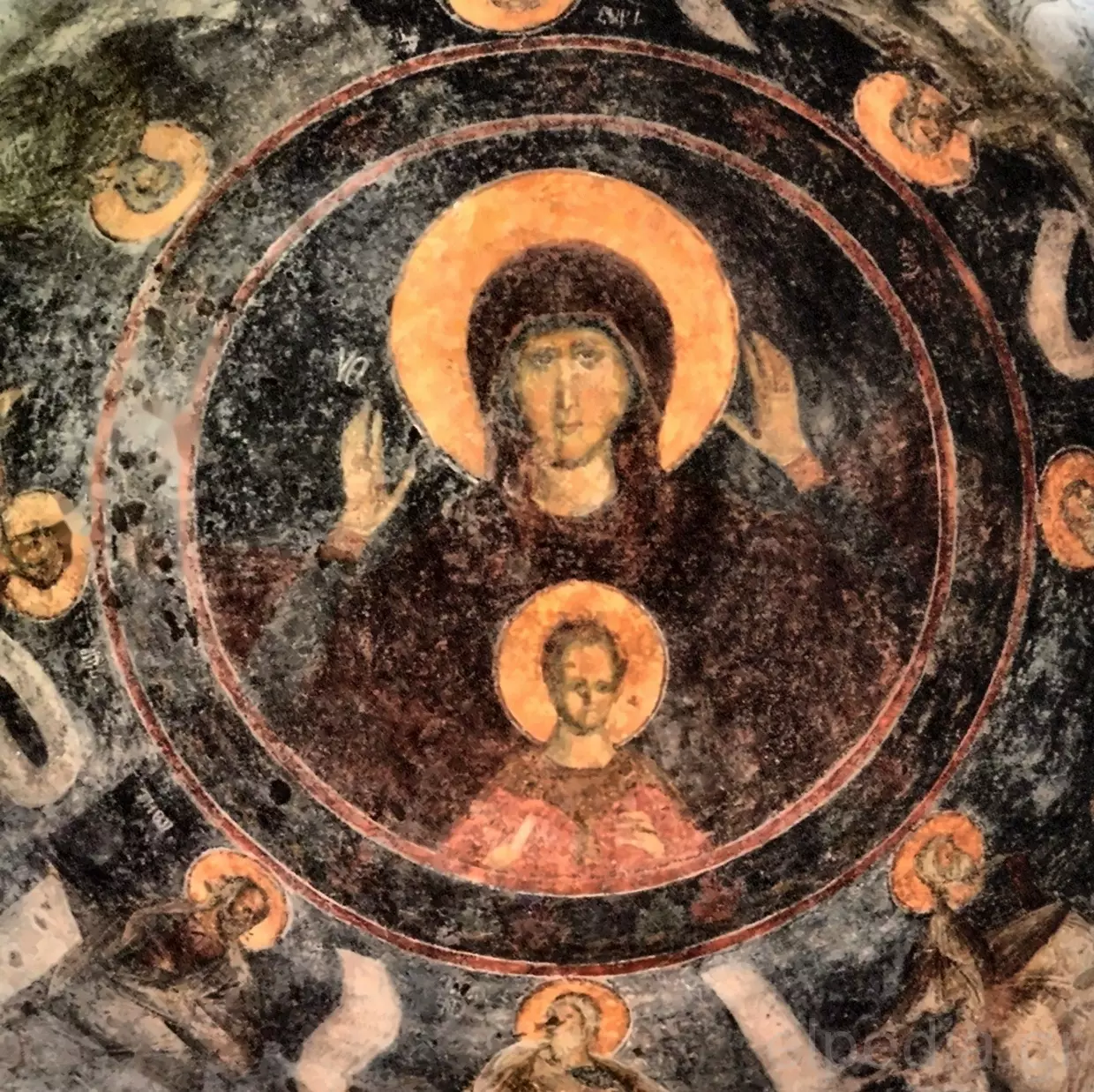
The figure of the Theotokos with Christ at her breast, dominating the small dome of the upper floor, belongs to the iconographic programme of the Panagia Hodegetria, the church that tradition named Aphentiko, the catholicon of the Brontochion monastery in Mystras. The building was founded around 1310 by the abbot Pachomios, archimandrite and grand protosyncellus of the Peloponnese, a cleric who took care to secure imperial privileges and extensive landholdings for his monastery. The composite architectural type of the church, known in the relevant research as the Mystras type, combines on the ground floor the layout of a longitudinal basilica with a five-domed cross-in-square church on the upper floor. The result recalls, on a smaller scale, edifices of Constantinople itself. At least two painters worked on the decoration of the internal surfaces, composing one of the richest ensembles of frescoes preserved in the archaeological site of Mystras, although the ravages of time have eradicated a large part of the original composition.
The Theotokos is depicted standing, with her hands raised on either side in a posture of supplication, within this small dome of the narthex, separate from the central dome of the nave, whilst Christ, enthroned at the height of her breast, blesses with one hand. Prophets of the Old Testament are inscribed in smaller circular frames around the double corona that encloses the two figures, witnesses to a prophecy that the Incarnation came to fulfil.
The Fresco of the Theotokos in the Dome of Mystras
The Figure of the Theotokos and the Infant Christ
Two concentric bands, deep red in hue, delineate in the centre of the dome a double ring and isolate within it the figure of the Theotokos from the darkened, worn background of the vault. Clothed in a deep red maphorion and bearing a golden halo, the Virgin raises both her hands on either side, in a gesture of supplication that the Byzantine visual code usually attributed to the figure of the Platytera. Beside her face are discerned traces of the abbreviated inscription which formerly identified her figure with her name, today scarcely legible. At the height of her breast is inscribed a second, smaller circular frame where Christ is depicted, clothed in a tunic in a shade of pink towards terracotta, one hand raised in blessing.
This composition, known in Byzantine iconography as the Platytera or the Theotokos of the Sign, usually appears in the conch of the sanctuary, but here it has been transferred to the secondary dome of the narthex, a solution that reveals how freely the artists of Mystras managed the traditional iconographic repository, adapting it to the particularities of an unusually composite building. The technique remains that of fresco, with the colour being deposited upon wet lime plaster so that it binds permanently to the surface of the wall, a method that demanded of the painter speed and certainty in the drawing, since correction after the drying of the plaster was practically impossible.
The Prophets Around the Dome of the Narthex
In the partitions between the windows of the drum are inscribed, each in its own circular frame, prophets of the Old Testament in bust, garments of ochre upon a dark ground that soot and time have almost swallowed. Few of the faces are preserved clearly distinguishable today. Lower down, in the zone where the dome rests upon the piers, two standing figures of larger scale, with broad, light-coloured garments, occupy the pendentives, framing the scene in a manner that gives the whole a sense of graded hierarchy, from the large figures of the foundation to the small, dense medallions of the apex. The choice to surround the Theotokos with prophets is not rare in Byzantine painting, since the prophetic testimony to the Incarnation constituted a standard theological argument that ecclesiastical art elaborated with a multitude of variations from the 11th century onwards.
At this point, however, the composition acquires particular weight, inasmuch as it is placed not in the main dome but in a second, smaller vault dedicated exclusively to the narthex, a space that in Byzantine architecture functioned traditionally as a transitional stage between the outside world and the nave. The light that enters from the windows of the base unevenly illuminates the figures, bringing forth some and leaving others almost indiscernible within the general shading of the vault. The restricted lighting, moreover, was not accidental, since the small secondary domes above narthexes deliberately avoid the full illumination of the central vault, keeping the space of the narthex in a more subdued, preparatory atmosphere in relation to the nave.
Byzantine Art in Mystras in the 14th Century
Byzantine art in Mystras in the 14th century is certainly not exhausted in this small vault, but the manner in which it is organised here shows clearly the ambitions of the workshop that undertook the decoration of the Hodegetria. The same architectural type that was first tested in this building was used a few years later in the erection of the Pantanassa and in the alteration of the Metropolis, a fact that shows how swiftly the innovation of one monastery became a model for the entire city.
The French Byzantinist Gabriel Millet studied the monuments of Mystras at the beginning of the 20th century, laying the foundations for the subsequent research around these ensembles, without his work many of the surviving traces would not have even been systematically recorded. The figures that were examined above, however much decay has wronged them, permit the recognition of an iconographic programme that is consistent, organised around the relationship of the Theotokos with the prophets who foretold her birth. The quality of the drawing, the colour that still resists decay in certain places, the diligence in the rendering of the faces, all these compose the testimony of a workshop that worked with knowledge of the models of Constantinople but also with its own, distinct identity.
(Translated from the Greek text by K. Pappas.)


