
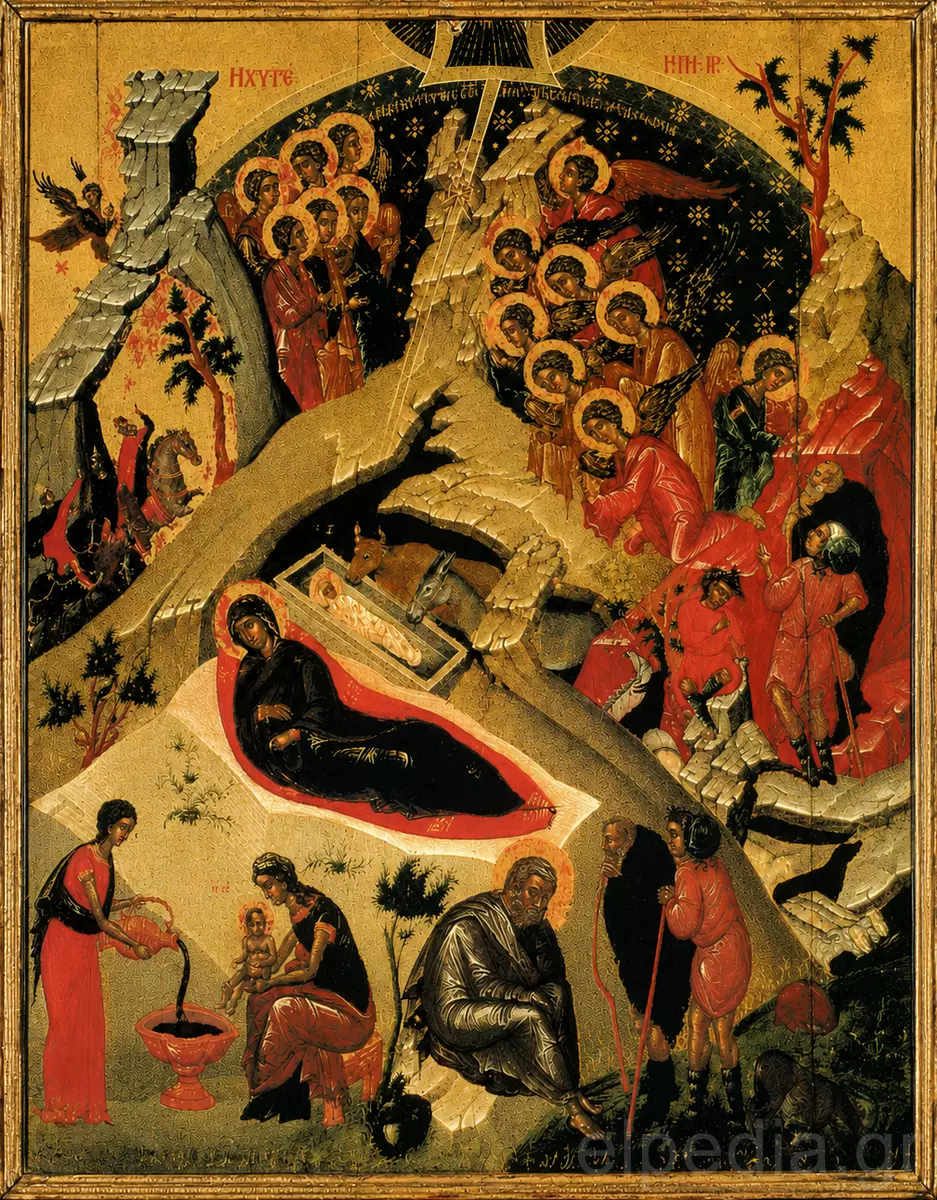
To the collection of portable icons associated with the Hellenism of Venice belongs a Nativity of the Lord, a work of the 16th century, painted most probably with egg tempera upon a wooden substrate, according to the technique that predominated in the workshops of the epoch. It is a dense composition, replete with persons and episodes, where the central event of the Nativity is accompanied by parallel scenes that enrich the narrative. The golden ground covers the background, while a complex of rocky masses organises the icon into levels, ascending from the cave unto the summit, there where the sky opens in a semicircle of dark deep-blue, strewn with stars. Few creators of the epoch dared such density of detail without losing the cohesion of the whole, and this exactly makes a Nativity icon such as this a representative specimen of the post-Byzantine production that flourished between Crete and Venice.
The preservation of such works is owed to a great degree to the Hellenic Institute, where rich material of portable icons is gathered, which documents the artistic production of the Greek communities of Venice from the 15th century onwards. In the specific composition are recognised elements that refer to the Cretan School, such as the posture of the Theotokos, the wealth of the secondary scenes around the cave, and the austere, almost architectural organisation of the mountainous landscape. No detail appears accidental, neither the position of the angels nor the silent sorrow in the gaze of the Virgin.
The Nativity icon and the narrative around the cave
In the centre of the composition, within a dark, almost triangular opening of the rock, the Divine Infant is discerned swaddled, lying in the manger, with the ox and the ass bowing from above Him. Above the cave, a column of light descends from the opening of heaven, visually uniting the divine space with the earthly. The Theotokos, wrapped in a deep red maphorion over a dark garment, is lying before the cave, her gaze turned not towards the Infant but towards the beholder, with a restrained expression that many scholars connect with a foreknowledge of the future Passion.
The angels, the shepherds and the scene of the bath
To the right, a multitude of angels in red and gold garments forms a choir around a cave opening of a secondary order, where shepherds are discerned, one of whom plays a wind instrument, while an angel bows downwards conveying the gladsome tidings. To the left, above a silver-coloured rocky elevation, a smaller group of figures with haloes observes the scene, while lower down a mounted figure with a red cloak appears to be directing himself towards the event, an element that many times in the iconography of the Nativity refers to the journey of the Magi.
In the lower section of the composition, two distinct groups organise the earthly, human dimension of the event. To the left, two female figures perform the bath of the newborn: the one holds the infant in her embrace, the other pours water from a pitcher into a red basin, a scene that is not mentioned in the canonical Gospels but originates from apocryphal tradition and has been permanently incorporated into the iconography of the Nativity already from the middle Byzantine period. Further to the right, seated with his head inclined upon his right hand, Joseph bears an expression of deep thought; opposite him stands an elder shepherd resting upon a staff, a figure that in the interpretative tradition is often connected with the temptation of doubt, without however the tranquil, almost pensive climate of the scene being altered.
The icon as a document of Byzantine and post-Byzantine art
The coexistence of so many episodes within a unified iconographic space is not a simple decorative choice; it imprints a mode of narrative where time is compressed, and the theological meaning prevails over the natural sequence of events. Works such as this, originating from the workshops of Cretan painters who were active in Venice, combined the Byzantine iconographic tradition with elements of western aesthetics, giving form to a post-Byzantine art particularly vibrant, which knew broad dissemination in the Greek colonies of Italy. The study of such icons as historical documents illuminates not only their religious function but also the commercial, social and artistic networks that united Crete with Venice in the 16th century.
(This is a translation from the Greek text, translated by K. Pappas.)


