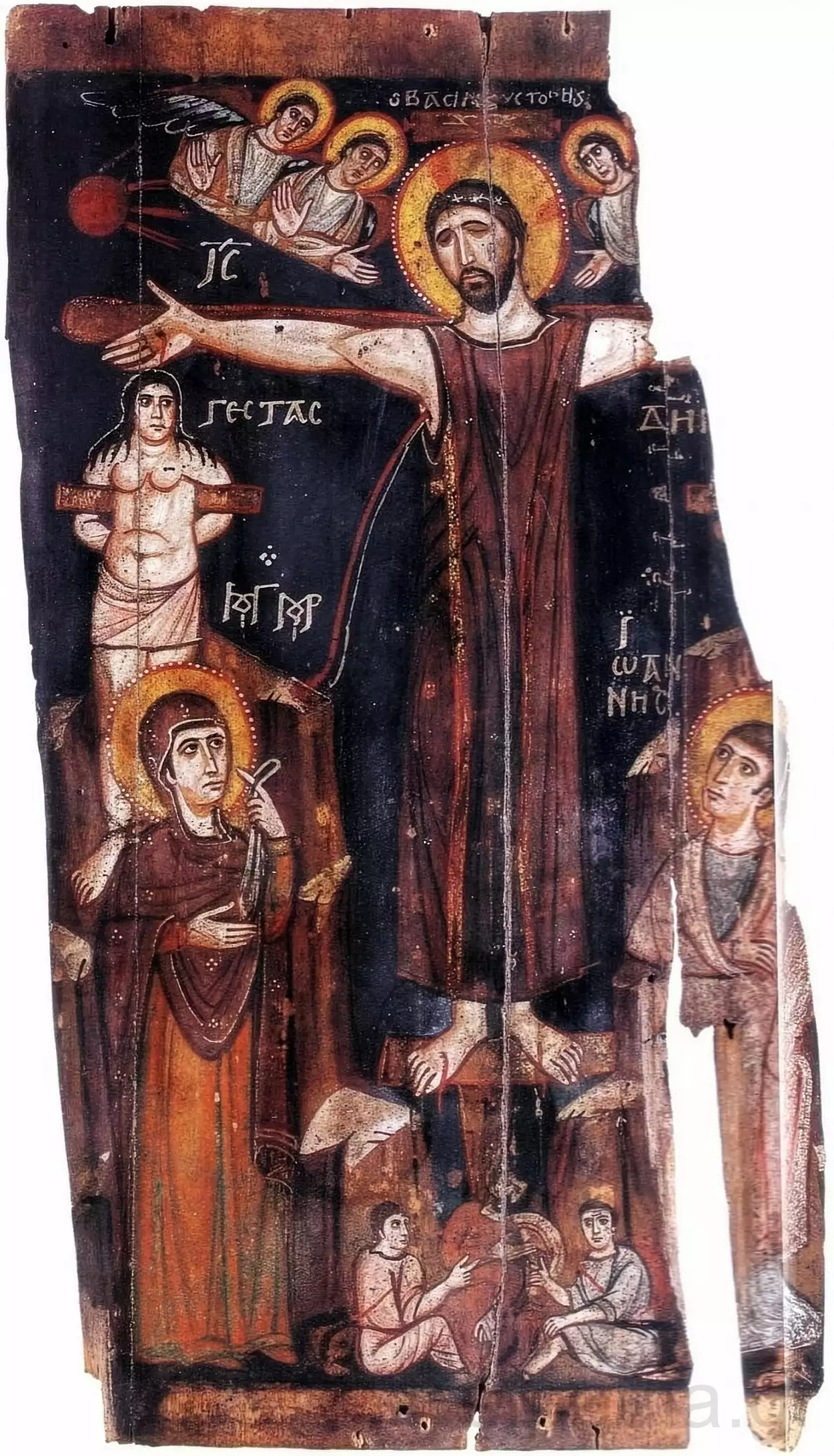
On a small wooden panel, measuring only 46.4 by 25.5 centimetres, Byzantine art condensed the entire drama of the Crucifixion nearly fourteen centuries before it reached us. Executed in the 8th century by a painter whose name history did not preserve, this icon belongs to the collection of the Monastery of St Catherine, at the foot of Mount Sinai. According to several scholars of Byzantine art, it is the oldest surviving depiction of the dead Christ upon the cross, and the first known icon in which the Crucified bears a crown of thorns upon his head. Its survival is owed in large part to the very isolation of the place, since the desert location of the Monastery kept it away from the two waves of iconoclasm, when thousands of sacred icons were systematically destroyed throughout the empire. The story of the mission to Sinai, as recorded by travellers and researchers of the past century, explains why the Monastery today safeguards more than half of the Byzantine icons that survive worldwide.
At the centre of the composition Christ stands dominant, upright upon the cross, clothed in a long, sleeveless tunic of rare iconographic origin. Around him, the two thieves upon their own crosses, the Virgin and John sunk in grief, four angels framing the scene, and the soldiers stooped at the foot of the cross compose a dense narrative whole, in which no figure stands by chance and no gesture remains unaccounted for.
The Composition of the Byzantine Icon of the Crucifixion
What first draws the eye is not only the figure of Christ, but the strict symmetry around him. Two thieves frame the central cross at almost equal distance, two pairs of angels balance the upper section, two figures, the Virgin and John, stand facing one another at the base of the scene. This scheme follows an iconographic type that had become established in Byzantine art long before the 8th century and would continue, with variations, down to the late Byzantine period, betraying no randomness in the painter’s arrangement.
Christ wears the kolobion, a long tunic without sleeves, which is rarely encountered outside eastern representations of the Crucifixion, since in the West, already from the 9th century, the naked body with the loincloth would prevail. From his side flow blood and water, alluding to the well-known passage of the evangelist John, and simultaneously to the eucharistic practice of mixing wine with water, as it had been established by the Quinisext Ecumenical Council of 692. In the upper left corner, a red disc represents the sun, while opposite it the moon ought normally to be found, but the decay of the wood on the right side of the panel has carried away this part of the icon together with part of the figure of John.
At the lower part of the composition, two soldiers sit stooped, absorbed in disputing over Christ’s seamless tunic, a detail that refers directly to the evangelist’s account of the division of garments by lot at the foot of the cross. Beside them, driven into the ground, their spears can be made out, a realistic touch of daily life within a scene that otherwise avoids every narrative detail unrelated to doctrine.
Historical Context: the Monastery of Sinai and Iconoclasm
Byzantine iconoclasm lasted, with an intervening respite, from 726 to 843, and during it the greater part of early Christian iconography that might today illuminate the origins of this art was destroyed. Sinai escaped because, from the 7th century onward, it lay outside Byzantine territory, under Arab rule that had no reason to become involved in a purely internal dispute of Constantinople concerning the veneration of icons. This is why the Monastery’s collection today includes more than half of the Byzantine icons that survive throughout the world, many of them gifts of pilgrims who arrived here and left them behind as an offering of thanks or a votive supplication.
The systematic recording of this collection is owed in large part to Kurt Weitzmann, whose research in the mid-20th century brought to the light of the international scholarly community the range and significance of the icons of Sinai, a collection that until then had remained almost unknown outside narrow circles of specialists. Thanks to this research, this Crucifixion was recognised as one of the rarest surviving records of early Christian painting to have reached our own day.
Technique, Materials, and Colour Palette
The colours of the icon are predominantly earthen, brown and red, with a sporadic presence of gold in the halos and the inscriptions. Red predominates around the figure of Christ, recalling the blood of the sacrifice, while the deep, almost black background gives the composition a sense of nocturnal, timeless depth, far from any naturalistic reference to landscape or architecture. The rendering of the faces follows the tradition known from the earlier icons of Sinai, with large, expressive eyes, an elongated nose and a small mouth, elements that recall directly the early Greco-Roman funerary portraits of Fayum, which had already influenced the painting of the region centuries earlier.
This is not, however, a mere continuation of an older technical tradition. The painter adapts the Greco-Roman repertoire of physiognomic rendering to a purely spiritual function, in which the gaze no longer conveys individual identity but an inner state — sorrow, devotion, silent submission.
The preparation of the wooden support followed the usual technique of the period, with a thin layer of gesso covering the surface before the drawing, while the pigments were usually bound with egg yolk, a technique that would dominate the panel icon for centuries, following the gradual retreat of the older encaustic method which the first painters of Sinai had inherited from the Greco-Roman tradition.
Christ’s Face among the Angels
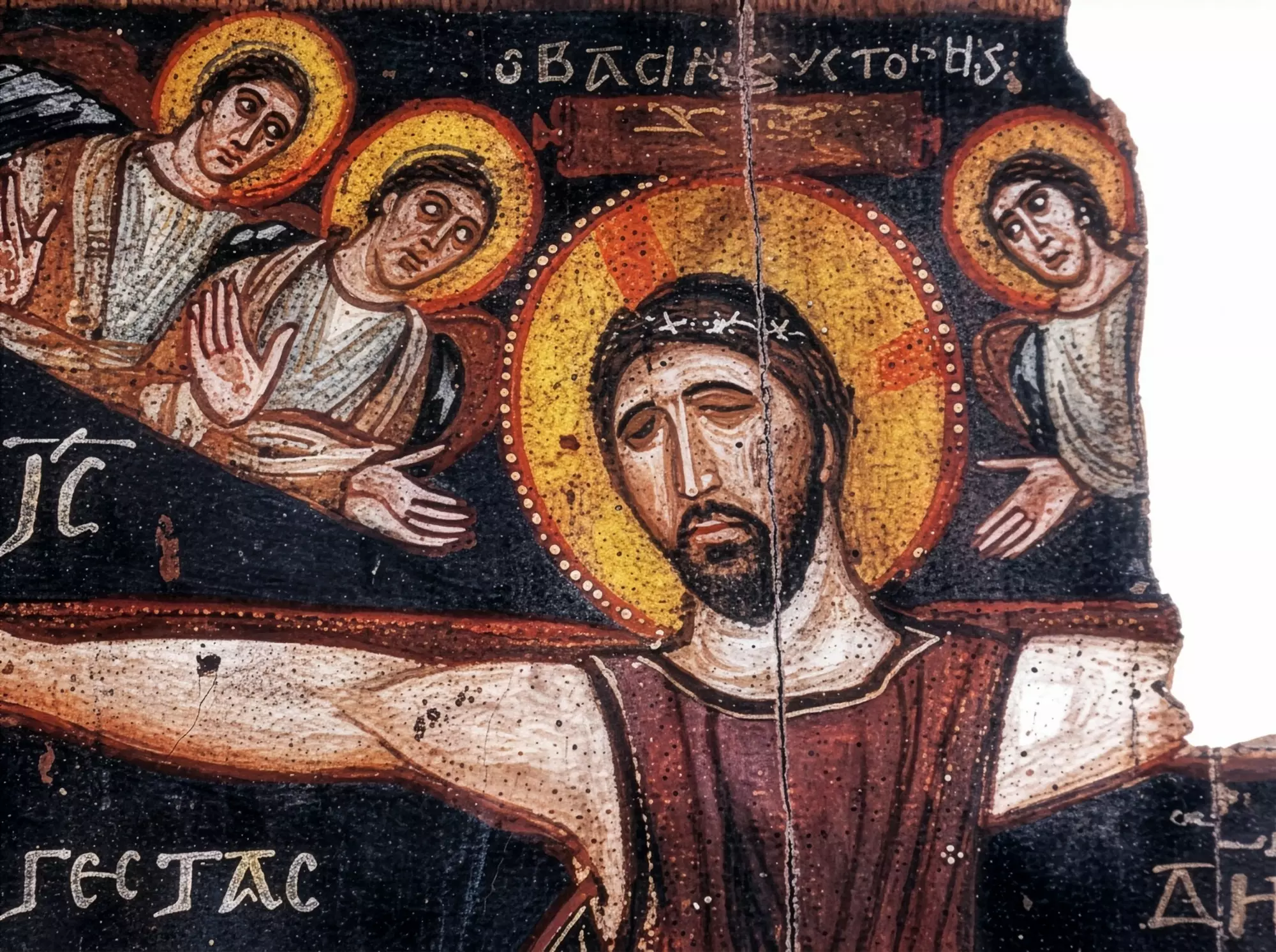
In this detail, the face of Christ occupies the centre, framed by four angels flying low, two on each side, their hands spread out in gestures of mourning and astonishment together. The halo bears, inscribed within it, a cross with arms in shades of red and orange, an element that sets it apart from the plain halo of the other figures in the icon and declares the divine nature of the one depicted. Directly above the horizontal arm of the cross can be read the inscription “THE KING OF GLORY” (Psalm 24), a title that refers to the 23rd Psalm of the Old Testament, known also as the 24th according to Western numbering, and which in the Byzantine tradition often accompanied representations of the crucified Christ, emphasising the victory over death already at the very moment of the sacrifice itself.
Christ’s eyes are closed, the head inclines slightly to the right, the hair and the locks are rendered with fine, almost calligraphic lines that follow the curve of the face. There is here no trace of pain in the dramatic, almost theatrical sense that Western art would later acquire. The expression remains restrained, almost distant, as would befit one who has already passed to the other side of death.
The four angels do not repeat the same posture. The two on the left raise their hands in an almost defensive movement, palm open outward, while the two on the right maintain a more restrained, almost observant posture. It is difficult not to see in this slight asymmetry an early attempt by the painter to convey movement and individuality within a strictly symmetrical scheme, something Byzantine art would develop far more in the centuries that followed.
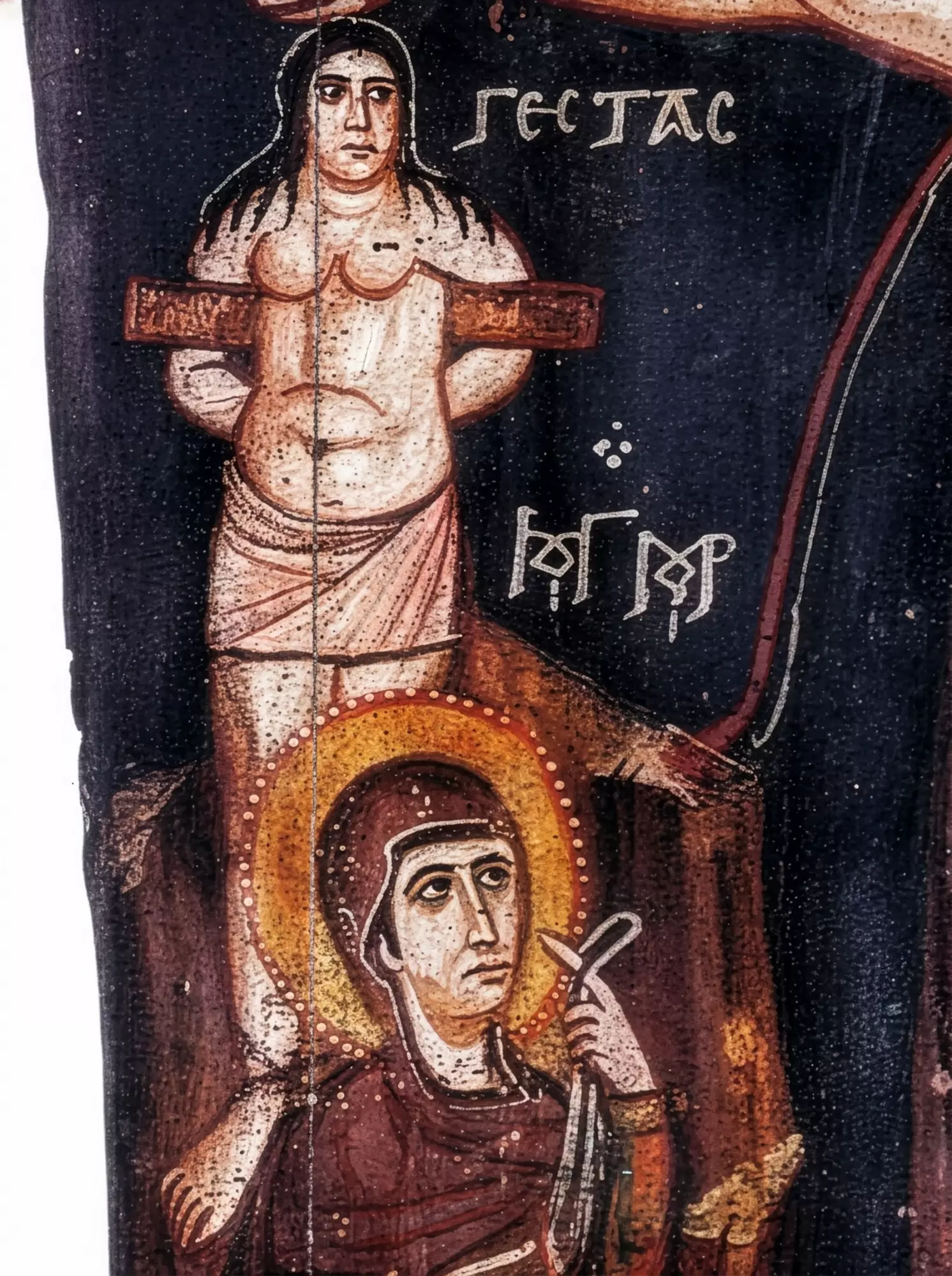
Gestas and the Lament of the Virgin
On the left of the composition, one of the two thieves, Gestas, hangs on his own cross with the upper part of his body bare and only a white cloth wound around his waist. His name is read clearly beside his head, written in the same capital letters used throughout the icon for the inscriptions, while the other thief, Dismas, according to the tradition also followed by the apocryphal texts, is positioned symmetrically on the right side of the scene. The posture of Gestas’s body, with his hands bound behind the arms of the cross and not nailed, deliberately differentiates him from Christ, whose hands are outstretched and pierced through the palms.
Lower down, at the base of Gestas’s cross, appears the face of the Virgin, her head slightly inclined and one hand raised to her cheek, in a gesture that Byzantine art would repeat countless times in the centuries that followed to signify mourning. Her halo is plain, without the cross borne by that of Christ, and beside her can be made out part of an inscription identifying her by name, a trace of a naming tradition that precedes the official establishment of the title Theotokos by the Third Ecumenical Council, in 431.
The Virgin’s gaze turns not toward the viewer but toward Christ, as does John’s gaze on the opposite side, in a composition where every figure looks toward the centre and none looks outward. This inward-turning, so different from later Western painting where a figure often addresses the viewer directly, shows how differently early Byzantine art conceived the relationship between the sacred spectacle and whoever stands before it.
This Crucifixion is not a unique record within the Monastery’s collection. In the same monastery survives also the icon of Christ Pantocrator, a work of the 6th century considered the oldest known depiction of Christ in this iconographic form. The two icons, although separated from one another by roughly two centuries, together bear witness to how rich and varied the iconographic repertoire was that developed at Sinai, long before Constantinople imposed its own standards upon the whole empire.
The painter who made it left behind no name, only the wood and the colours, which fourteen centuries later still endure.
(This is a translation from the original Greek text, translated by K. Pappas.)

