
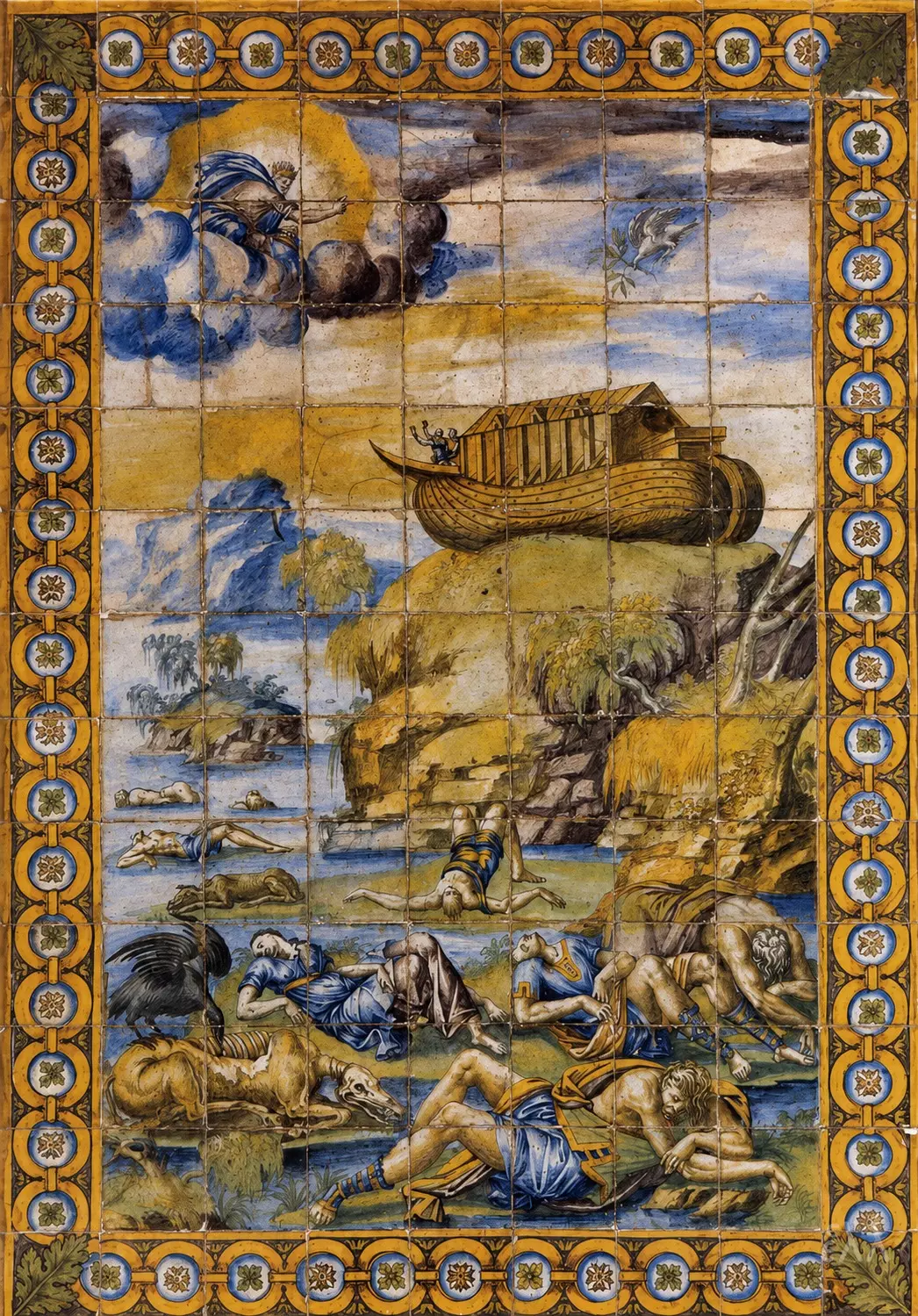
Dozens of baked clay tiles, fitted together into a single rectangular surface, constitute the representation of the Flood crafted by Masséot Abaquesne, the faience maker of Rouen, born around 1500 in Cherbourg and deceased in 1564 in Sotteville-lès-Rouen. The ensemble is kept in the National Museum of the Renaissance, in the château of Écouen, and is connected to the commissions given to the workshop by the constable Anne de Montmorency during the mid-16th century. It belongs to a triptych dedicated to the history of Noah, with the other two parts dealing with the construction of the vessel and the boarding. In the present composition the waters have already receded.
The technique explains much of what one sees. Low first firing, covering with a white tin glaze, painting upon the still unfired surface with pigments from metallic oxides, cobalt for the blues, iron for the browns, antimony for the yellows, and a second passage from the kiln. The jointing of the tiles remains visible over the whole extent, a grid of fine lines that passes indiscriminately over clouds, rocks, and bodies.
Abaquesne’s ceramic art and the economy of the landscape
High on the left, within dark clouds, a figure wrapped in a blue mantle extends its right hand to the right, while in the opposite corner of the sky a bird traces its flight. The ark, wooden, with the roofed dwelling on the deck and the high figurehead, has settled on an ochre slope, and on the prow very few, minuscule figures are discerned. The left hemisphere opens into bluish mountainous massifs and willows, all these of Northern European origin, while the yellowish rocks on the right rise solid. Below, on the shore, the victims of the flood are spread among animals that did not make it in time, a black vulture bends over, the water shines shallow. The postures of the bodies, with the bold foreshortenings and the twisted axes, betray engraved models of Italian provenance, filtered by the school of Fontainebleau.
(Translated from the Greek text by K. Pappas)


