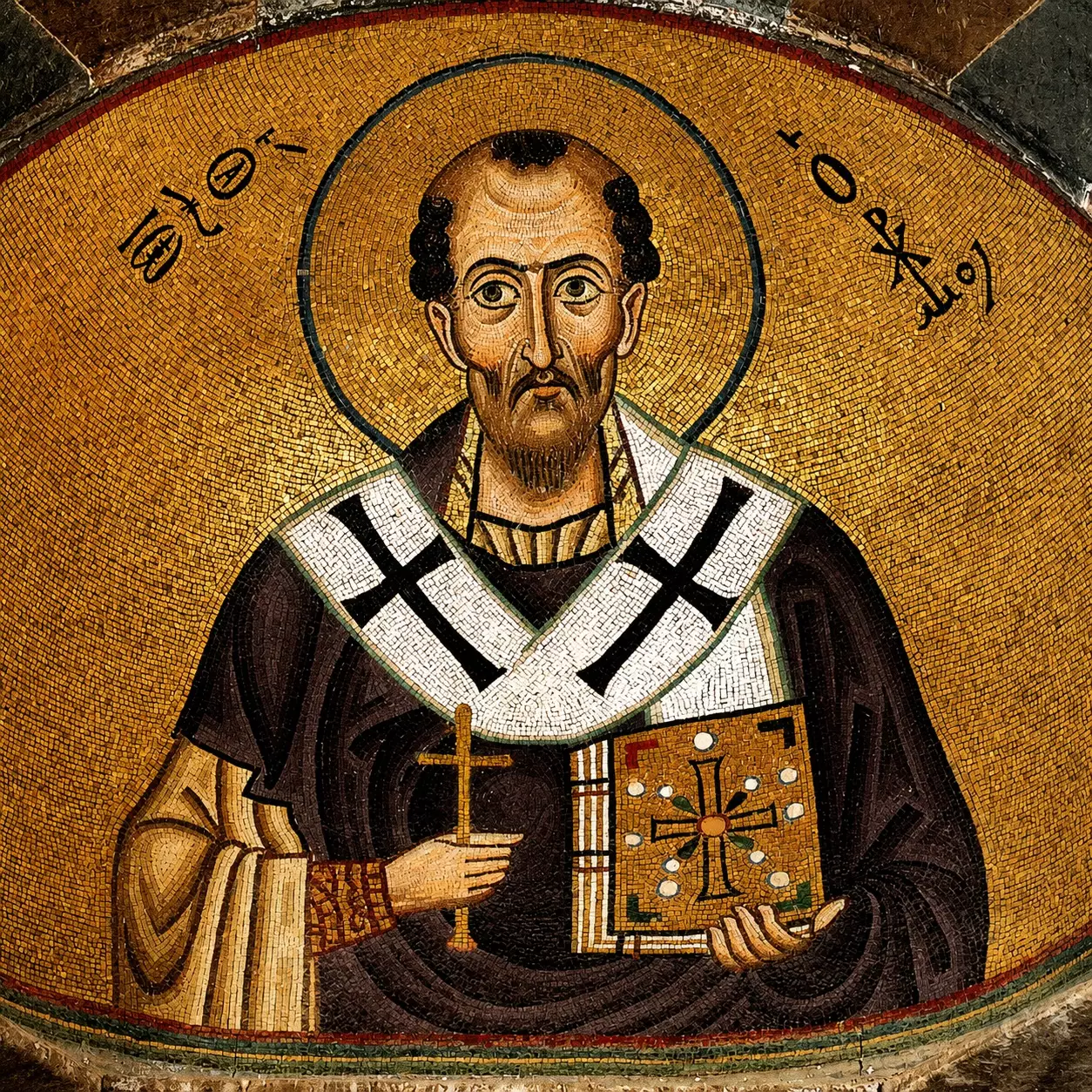
Within the niche of the Katholikon of the Hosios Loukas Monastery in Boeotia, the mosaic of Saint John Chrysostom, the creation of an anonymous artist of the eleventh century, commands attention with its austere solemnity. The face of the hierarch emerges from the gold ground, which abolishes every notion of natural space and time. Shadows and lights struggle across his features, composing a physiognomy carved by asceticism. His hollow cheeks, tightly pressed lips, and penetrating gaze, directed slightly to his left, betray his inner intensity. The inscription in capital letters, placed asymmetrically on the two sides outside the halo, confirms his identity.
The mosaicist handles the material with confidence. Earthy shades, ochres, browns and greens are worked in dense lines to render the volume of the face. Massive and heavy, the dark purple vestment covers the saint’s shoulders, lending monumentality. Over it, the white omophorion with its large black crosses encircles the neck and descends vertically, breaking the dark monotony of the phelonion. The cross in his right hand constitutes not simply a symbol, but an extension of his very being. An extension that organises the composition.
Byzantine Art and the Hieratic Stillness of Saint John Chrysostom
This composition is subordinated to the hieratic stillness traditionally prescribed by Byzantine art. In his left hand John holds a large closed Gospel book. The sacred codex, decorated with multicoloured stones and pearls forming a central cross, is set against the austerity of the rest of the figure. If we observe carefully the right side of the figure, the hand holding the small cross seems to emerge organically from the dark folds of the vestment. The low luminosity in this area and the absence of a detailed outline of the arm should not mislead us. The anatomical position of the wrist, the inclination of the fingers, the natural distance from the shoulder, clearly demonstrate the continuity of the right arm beneath the heavy fabric. The slender, long fingers clasp the golden handle of the cross with a determination that penetrates the calm surface. The right hand declares the steadfastness of faith. Faith guides his gaze, a gaze turned away from the viewer, turned perhaps towards some imagined divine source.
Rarely does one encounter so much concentrated energy within a few square centimetres of mosaic. The short, sparse beard and the few dark hairs receding high above the forehead reinforce the sense of a man who has consumed his physical strength. Perhaps this physiognomic precision preserves memories of an actual presence, perhaps again it constitutes a stylised record of his spiritual authority. Black tesserae strongly trace the curve of the eyebrows. They descend, form the shadow along the nose, define the pupil of the eye. Every tessera serves the structure. The right cheek receives the greater amount of light, while the left gradually sinks into warm brown shadows, creating a subtle sense of volume.
(Translated from the Greek text by K. Pappas.)


