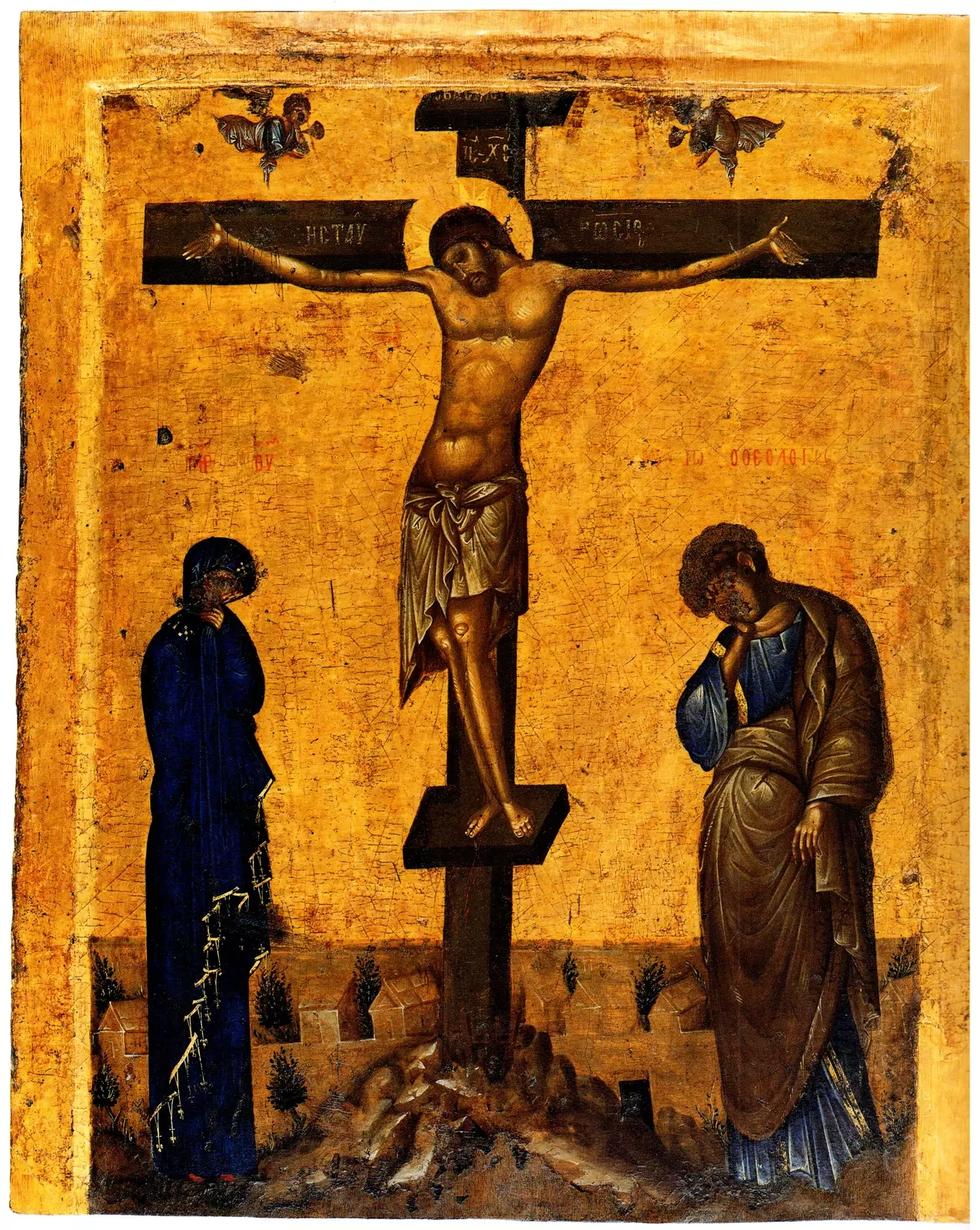
A wooden panel measuring 1.03 by 0.85 metres preserves, in the collections of the Byzantine Museum of Athens, a double-sided Byzantine icon of the Crucifixion dating from the 14th century, a period of intense artistic renewal for Palaiologan painting. The painter remains anonymous, as is moreover the case with the greater part of Byzantine artistic production, yet his hand reveals familiarity with models that extend beyond the narrow limits of a simple local tradition.
Against a deep gold ground, Christ hangs from a large cross, secured in the earth with stakes and stones, within a desolate landscape in which walls with battlements, a rectangular gateway, and small buildings with pitched roofs can be distinguished, among which rise low trees. Two figures accompany the scene, the Virgin Mary and John, each with his or her own manner of mourning. The technical execution of the icon belongs to a current of painting that has been associated, with regard to certain details of its iconography, with Western models of the period, a fact that makes the work a point of reference for the study of artistic exchanges between East and West during the late Middle Ages. In the lines that follow, the composition, the attitudes of the figures, and its relationship with other contemporary works are examined in detail.
The Byzantine Icon of the Crucifixion and Its Iconographic Distinctiveness
At the centre of the representation, Christ is nailed to the large horizontal arm of the cross with His hands extended, while His torso curves slightly, obeying an internal logic of weight that the painter knows well. His head has already inclined towards His right shoulder. The knees bend discreetly, the feet are nailed separately, and the folded loincloth ends in a pointed extremity falling towards the left, giving the lower zone of the body a movement that counterbalances the rigidity of the crucifixion.
Above the horizontal beam, two angels fly towards the cross, bringing a hand to the face, a gesture that transfers mourning to the level of the heavenly spectacle, while an inscription upon the vertical arm indicates the abbreviated name of Christ, and a second inscription, extending in two parts along the horizontal beam, gives the word of the Crucifixion, as was customary in works of this period.
To the left of the scene stands the Virgin Mary, wrapped tightly in a deep-blue maphorion that covers her as far as the chin. Only her left hand emerges, brought towards the face with the thumb touching the lips. Her body remains upright and slender, with the head slightly bowed, and it is precisely this restraint of movement that conveys the impression of a dignified lament, without outward display.
On the right, John yields more openly to his sorrow: his body bends, his head rests upon his right hand, while the left, falling freely, appears to hold the edge of his mantle. The contrast between the restrained attitude of the Mother of God and the more human, almost familiar, expression of the disciple is not a chance compositional device, but reflects two different traditions in the representation of mourning, which coexist in the Byzantine art of the period without coming into conflict.
The gesture of the Virgin Mary, with one hand emerging from within the closed maphorion and the thumb at the lips, as well as the corresponding movement of John’s right hand, has also been identified in other monuments of the same period, such as a liturgical scroll and an illustrated psalter, a fact that places the work within a wider network of iconographic exchanges. A similar composition occurs both in a 13th-century icon from Sinai, attributed to a workshop of Crusader Acre, and in an epistyle from the same monastery that has been associated with a Venetian workshop of the third quarter of that century.
This encounter does not weaken the Byzantine character of the icon; on the contrary, it shows how fluid the boundaries were between Eastern and Western visual languages in the border regions of the empire and in territories under Latin rule.
The Figure of Christ in the Byzantine Icon of the Crucifixion
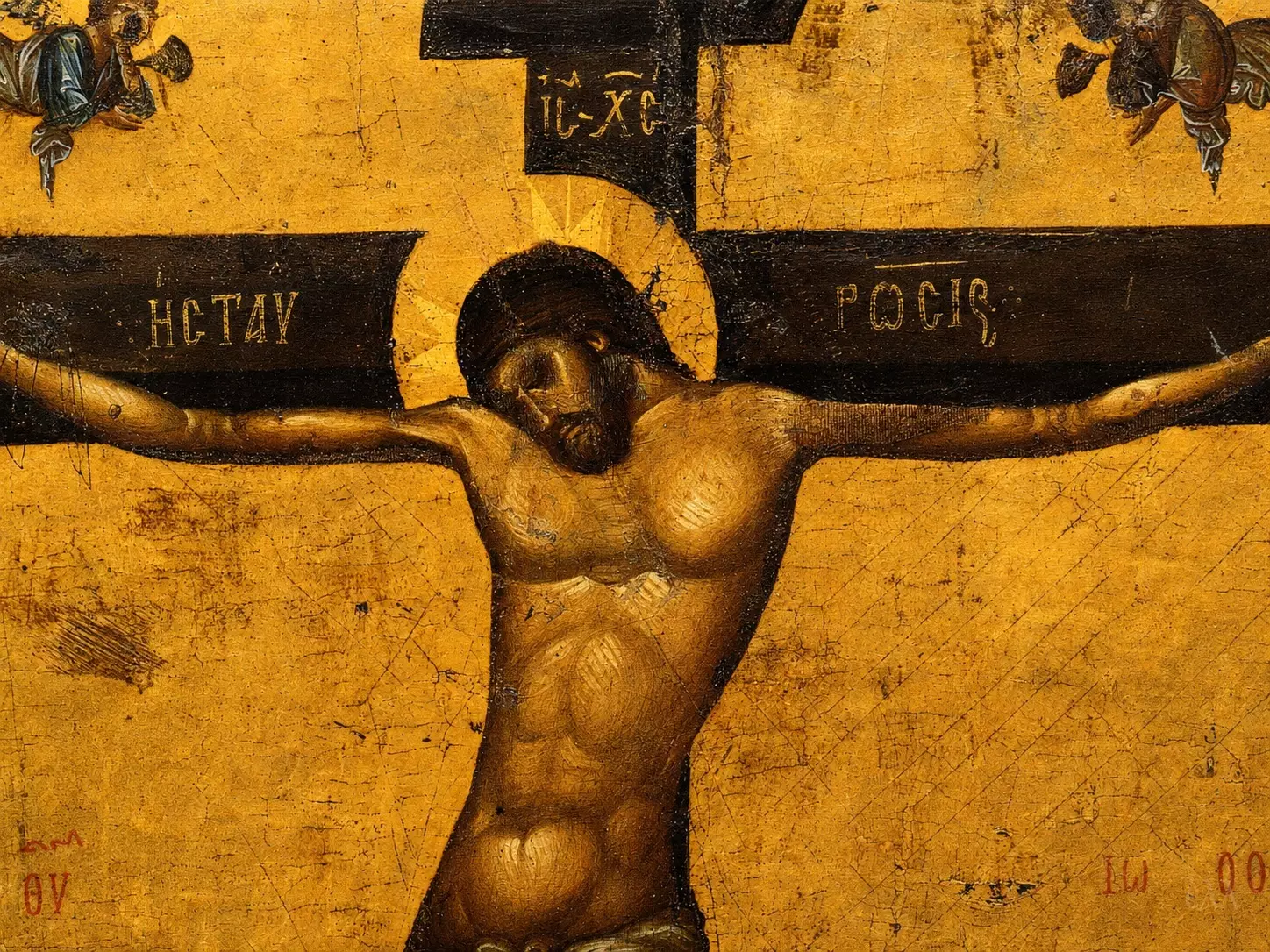
Approaching the face and torso of Christ, the eye encounters an anatomy rendered with restrained but decisive means, in which the light falls in narrow, elongated bands upon the chest and abdominal area, constructing volume without weighing it down. The halo, incised with rays around the head, organises the space behind the face into a geometry that balances the asymmetry of the pose, while the hair and beard, rendered with dark, abrupt brushstrokes, intensify the shadow that weighs upon the half-closed eyes.
The inscription on the horizontal beam, directly above the shoulders, completes the abbreviated designation of the scene, written in characters that follow the form of the beam without disturbing the visual balance of the composition.
The modelling of the body, with the alternations of light and shadow following the muscular structure of the chest and abdomen, reveals a painter well acquainted with the models of Palaiologan plasticity, that tendency to render the human body with a sense of volume, without, however, losing the spiritual character of the representation. The result is not an anatomical study. It is an image of the Passion, in which corporeality serves the theological meaning of the sacrifice and not the reverse, and precisely at this point technical mastery meets the purpose for which the image exists.
The icon, finally, does not stand in isolation within the history of 14th-century Byzantine painting. It belongs to a generation of works that experiment, without abandoning the theological rules of representation, with new ways of rendering human emotion, at times borrowing elements from neighbouring traditions and returning them, transformed, to their own visual system.
(Translated from the Greek text by K. Pappas.)


