
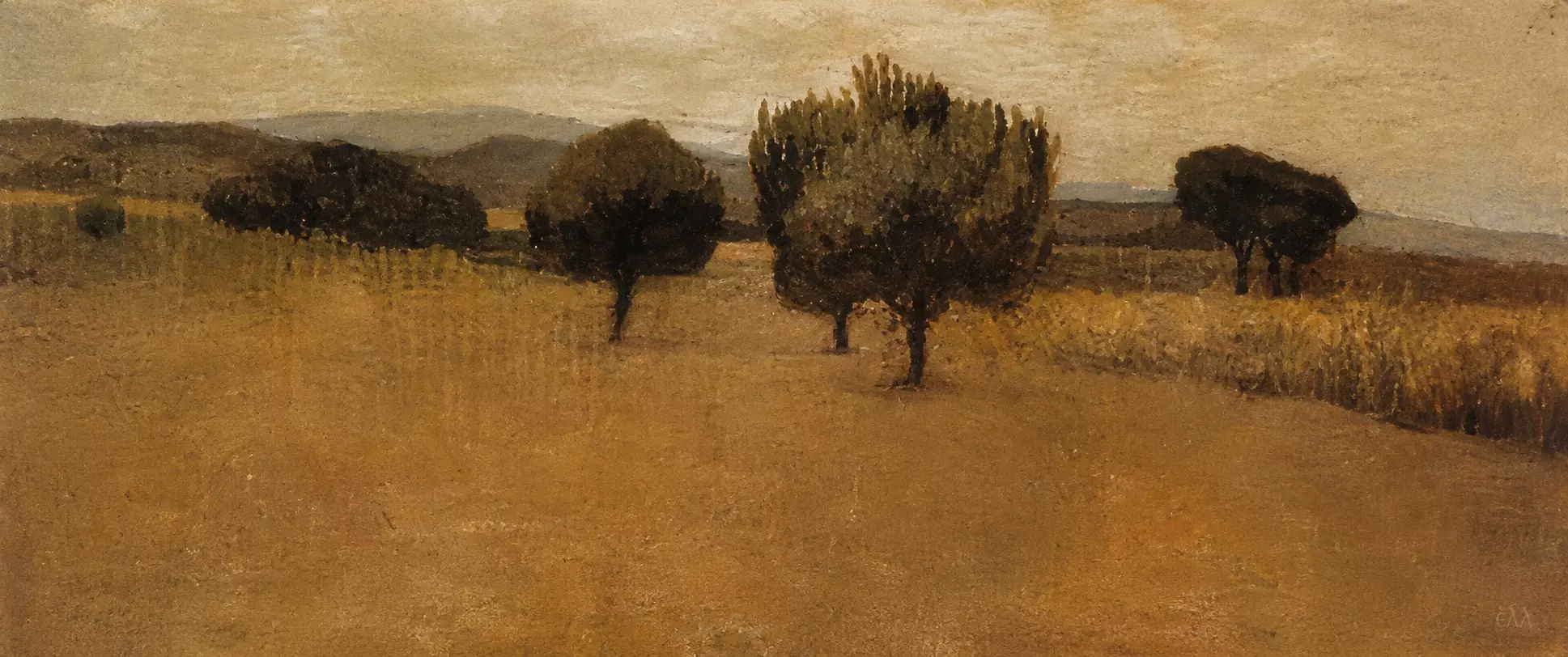
A few centimeters of wood are enough for Giuseppe Abbati to condense an entire Tuscan countryside. Painted in 1863 on a panel measuring just ten by thirty centimeters, the work now housed in the Gallery of Modern Art at Palazzo Pitti in Florence is one of the most characteristic examples of the aesthetics of the Macchiaioli, that movement of Italian painters who, in the mid-nineteenth century, turned to direct observation of natural light, abandoning academic discipline of drawing. The artist, born in Naples in 1836, had a short life, dying in Florence in 1868 after an accident involving a rabid dog. Even so, he managed to capture with particular sensitivity the natural sights of Tuscany, among them those of Castiglioncello, the coastal area where the artists of the circle around Diego Martelli often sought refuge. The elongated, almost panoramic format of the composition is no accidental choice, since it serves precisely the need to convey a horizontal, open view of the countryside, where the eye travels across the plain unimpeded to the distant hills.
The agricultural land stretches out in shades of ocher and brown, worked with small, dense brushstrokes that build the surface like tesserae of warm color. Five or six trees, some squat and bushy, others taller with branches swaying upward, stand scattered across the middle ground, forming dark patches against the light-colored earth. Dull and almost colorless, the sky does not claim attention, functioning as a neutral backdrop that leaves all the pictorial weight to the ground and vegetation.
The Landscape at Castiglioncello and the pictorial language of the Macchiaioli
The technique of the macchia, that is, the blot or patch rather than linear description, finds here one of its most restrained applications. Avoiding strict contour drawing, Abbati constructs the trunks as masses of shadow, allowing the viewer mentally to complete the details that the brushstroke itself refuses to provide. In the background, a line of low hills is outlined in tones darker than the sky but lighter than the ground, creating three gradations of brightness that organize the space on the basis of value contrasts rather than perspectival lines.
This is not a work that seeks to dazzle. Its small scale rather suggests an immediate, almost personal record, perhaps a study painted on the spot during one of the artist’s stays in coastal Tuscany, where life moved slowly and the light changed constantly over the fields. In the lower right corner, the painter’s signature can be discerned, now illegible because of the wear of time, a detail that nonetheless does not diminish either the painting’s authenticity or its attribution to Abbati, confirmed by the museum documentation of Palazzo Pitti.
Any study of Macchiaioli art cannot overlook works like this, where the economy of means becomes in itself a statement of aesthetic intent. Abbati, together with Fattori, Signorini, and Lega, helped shape a painting that, bypassing rhetoric, focused on the truth of immediate visual impression—a quality that in this small panel is evident, almost in defiance of its size.


